

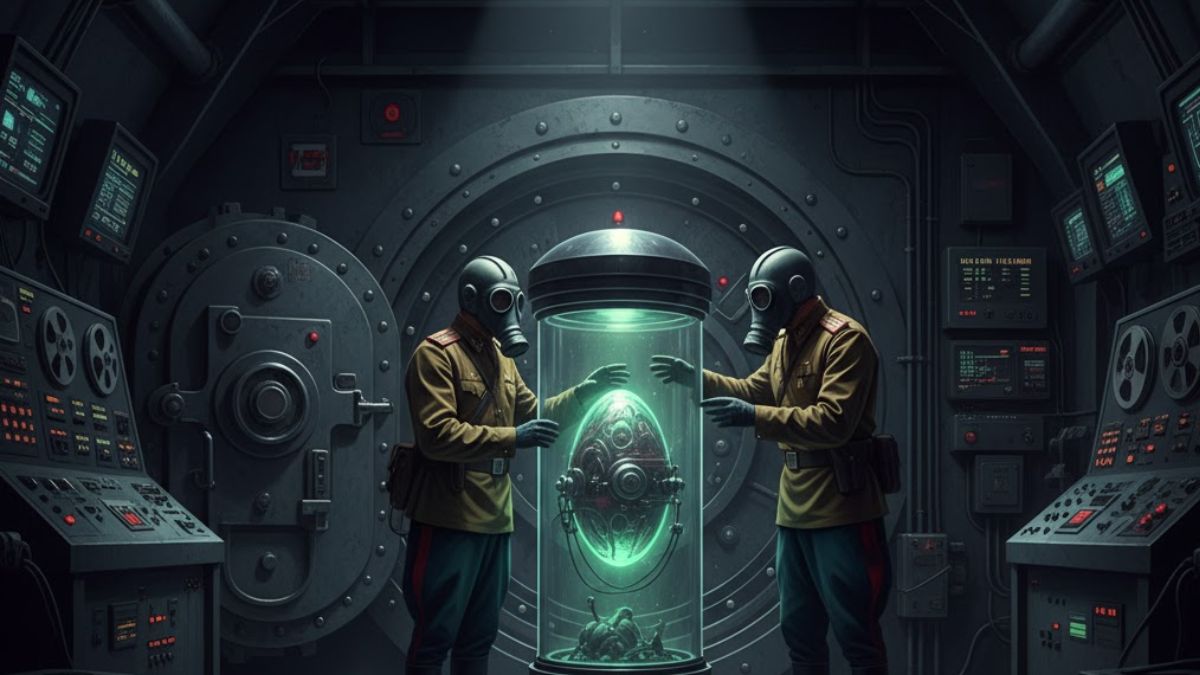
There’s a story we all know about the Cold War. It’s a tale of two superpowers, the United States and the Soviet Union, locked in a tense standoff. They built terrifying nuclear weapons, competed in sports, and even argued about which economic system was better. But this competition had a very public, and very exciting, front: the race to space. We watched rockets blast off, heard about heroes like Yuri Gagarin and Neil Armstrong, and marveled at satellites blinking in the night sky.
But what if the very nature of that fierce competition created the perfect place to hide a secret? The Cold War was built on secrecy and mistrust. Both sides had powerful spy agencies, hidden bunkers, and top-secret projects they didn’t want the other to find out about. In an atmosphere where spying was normal and paranoia was high, could something as monumental as finding alien life have been kept under wraps?
This article isn’t here to say that aliens were definitely found. Instead, we’re going to explore a fascinating idea. We’ll look at the strange UFO sightings during that time, the secretive projects governments ran to investigate them, and ask a simple question: did the Cold War provide the perfect cover to hide the biggest discovery of all time?
So, if the governments of the world did find something not of this Earth, would we ever have been told?
What Was the Cold War, Really?
To understand why the Cold War is such a popular setting for alien conspiracy theories, we first need to be clear about what it was. The Cold War wasn’t a war with constant fighting between the main opponents. Instead, it was a decades-long period of extreme political and military tension between the United States and its allies, and the Soviet Union and its allies.
Think of it like two rival schoolkids, each claiming to be the strongest and smartest. They don’t get into a fistfight in the playground, but they compete in everything—who can get the best test scores, who has the coolest bike, and who has the most friends. They glare at each other from across the classroom, spread rumors, and are always trying to get ahead. That was the Cold War on a global scale. This “competition” meant both sides were constantly trying to develop better technology than the other. They wanted faster planes, better rockets, and more advanced spy gear. Secrecy was their most valuable tool. If your rival didn’t know what you were building, they couldn’t build something better to counter it.
This environment of top-secret labs, hidden documents, and a public that was already fearful of a nuclear war set the stage perfectly. If a pilot saw something strange in the sky, the government’s first thought wouldn’t be “Is it alien?” It would be, “Is it a new Soviet spy plane? Have they developed technology we don’t understand?” This mindset meant that any unusual aerial phenomenon was immediately classified and investigated behind closed doors. The public was often left in the dark, their questions met with silence or simple explanations that didn’t always seem to fit. This gap between what people saw and what they were told is where speculation and mystery thrive.
Why Were There So Many UFO Sightings During the Cold War?
If you look at a timeline of UFO reports, you’ll see a huge spike starting in the late 1940s and continuing through the Cold War. It seemed like everyone was seeing flying saucers! But why then? The answer lies in what was happening in the skies above.
For the first time in history, humans were flying faster and higher than ever before. Jet aircraft were being tested, and both the U.S. and the Soviet Union were pushing the boundaries of aviation. They were developing strange-looking experimental aircraft in secret bases. The U-2 spy plane, for example, could fly at altitudes much higher than commercial planes, and its wings gave it a peculiar, silvery appearance that could look like a distant, strange object to someone on the ground.
When a civilian saw one of these secret tests, they would report a “UFO”—an Unidentified Flying Object. The military, not wanting to reveal its secret projects, would often dismiss these reports as weather balloons, temperature inversions, or even “swamp gas.” These explanations sometimes felt weak and unsatisfying to the public. Imagine you see a silent, disk-shaped object moving at impossible speeds, and the government tells you it was just a weather balloon. You might not believe them. This created a deep sense of distrust.
The other key ingredient was fear. The world was afraid of a surprise nuclear attack. People were looking up at the sky with anxiety, wondering if the next plane they saw would be a bomber. This heightened state of alertness made people more likely to notice and report anything unusual. So, the Cold War created a perfect storm: secret advanced aircraft in the sky, and a nervous population on the ground looking up. This combination led to an explosion of UFO reports that continues to fuel the debate to this day.
What Secret Projects Did the Governments Run?
Both the United States and the Soviet Union took these UFO reports very seriously, but they did so in secret. They weren’t necessarily looking for aliens; they were trying to figure out if the other side had a technological advantage.
In the U.S., the most famous project was Project Blue Book. This was an Air Force program that collected and analyzed thousands of UFO reports from 1952 to 1969. While its public goal was to determine if UFOs were a threat to national security, many believe its real purpose was to debunk sightings and calm public panic. The government would study a report, often come up with a conventional explanation, and then close the case. But what about the cases they couldn’t explain? Project Blue Book itself stated that a small percentage of sightings remained “unidentified.” So what were those?
Beyond Blue Book, there were even more secretive efforts. We now know about a Pentagon program that started much later, in 2007, called the Advanced Aerospace Threat Identification Program (AATIP). This shows that the government’s interest in unexplained aerial phenomena never truly went away. If they were still secretly studying this in the 2000s, it makes you wonder how deep the investigations went during the peak of the Cold War.
On the other side, the Soviet Union had its own equally secretive programs. The KGB, the Soviet security agency, and the Soviet military collected files on what they called “Anomalous Phenomena.” They were just as worried that these UFOs might be American spy planes. Both superpowers were trapped in a cycle of suspicion. Each time one saw something strange, they assumed it was the other’s new technology, which drove them to develop even more advanced and secretive technology of their own. This secretive arms race provided a vast, dark shadow where the truth about anything—even something not human—could potentially be hidden.
Could a Secret That Big Really Be Kept?
This is the biggest question for any conspiracy theory. Is it really possible for hundreds or thousands of people to keep a world-changing secret like the discovery of alien life? Wouldn’t someone have talked by now?
It’s a very strong argument. However, when we look at the Cold War, we see that governments were remarkably good at keeping enormous secrets for long periods. For decades, the American public had no idea about the U-2 spy plane’s existence or its true mission. The details of many nuclear tests and their effects on soldiers and civilians were hidden. The existence of entire intelligence agencies was a secret.
The secret wouldn’t have to be kept by everyone. Perhaps only a very small, powerful group at the very top would know the full truth. The scientists and military personnel working on the project might only see small pieces of the puzzle. They might be studying a strange material without being told where it truly came from. In a climate of strict secrecy and national security, leaking information was seen as treason, punishable by severe consequences. The culture of “need-to-know” was designed to prevent any single person from having the whole story.
Furthermore, disinformation was a common tool. If a credible person came forward with a story, government agencies could release other, false stories to create confusion. They could label people as crazy or unreliable. In a flood of conflicting information, it becomes very hard for the public to figure out what is real. So, while it seems difficult to believe a secret of that magnitude could be kept, the Cold War era was uniquely suited for it. The machinery of state secrecy was powerful and well-funded, all in the name of gaining an advantage over a rival.
What Do the Declassified Files Tell Us?
Over the years, many government files from the Cold War have been declassified, meaning they have been released to the public. UFO researchers have spent countless hours going through these documents, hoping to find the “smoking gun”—that one document that proves the existence of aliens.
So far, that definitive proof hasn’t been found in the declassified files. But the files do tell us something very important: the governments were deeply concerned and deeply confused. The documents are full of reports from highly credible witnesses—military pilots, radar operators, and police officers—describing objects with capabilities far beyond any known aircraft. They report objects making instant 90-degree turns, accelerating at impossible speeds, and hovering without any visible means of propulsion.
The files also show that officials were struggling to find explanations. They would often rule out conventional causes like planets, stars, or weather balloons, but then be left with a blank space under “Conclusion.” The real story in these documents is not a cover-up of aliens, but a cover-up of ignorance. The governments didn’t want to admit that there were things flying in their airspace that they could not identify or understand. For a superpower trying to project an image of total control, admitting this kind of vulnerability was unthinkable. So, the official policy became one of dismissal and secrecy, not to hide aliens, but to hide their own confusion and prevent public fear.
Is There a Connection to the Nuclear Missile Sites?
One of the most chilling and persistent stories from the Cold War involves UFOs and nuclear weapons. There have been numerous reports from former U.S. military personnel about Unidentified Flying Objects appearing over nuclear missile silos and, in some cases, even temporarily disabling the missiles.
Imagine the scene: it’s the middle of the night at a top-secret military base. Your job is to guard a nuclear missile, the most powerful weapon ever created. Suddenly, alarms go off. The control panels show that your missile is no longer operational. You look outside and see a strange, silent craft hovering over the silo. Then, after a few minutes, the object zips away and the missile systems come back online as if nothing happened.
This isn’t science fiction; it’s a story told by multiple retired Air Force officers. If these accounts are true, it adds a whole new layer to the mystery. Why would these objects be so interested in our nuclear weapons? Were they monitoring us? Were they sending a warning? For the military, an unknown object that can shut down your most powerful weapons is the ultimate national security threat. This would certainly be a reason to investigate the phenomenon with the highest level of secrecy and to keep any findings completely hidden from the public and from other nations. An event like this wouldn’t just be about aliens; it would be about the very survival of the nation.
Conclusion
The Cold War was a time of shadows, secrets, and silent threats. The race for space was a public drama, but the real story may have been happening just out of sight. We may never know for certain if alien discoveries were hidden in all that secrecy. The truth is, the reality of advanced secret military projects is often strange enough to explain many of the mysteries from that era.
But the lingering questions are powerful. The unexplained sightings by reliable witnesses, the interest in our nuclear weapons, and the decades of official secrecy create a puzzle that we are still trying to solve. The Cold War provided the perfect blanket of mistrust under which the truth about almost anything could have been concealed.
Perhaps the final question isn’t just about what might have been hidden then, but what we are still being told today. As new government reports on UFOs—now called UAPs—are released, the conversation is changing. The mystery that began in the Cold War is far from over.
What do you think is the most likely explanation for the UFOs seen during that tense time?
FAQs – People Also Ask
1. What does UFO stand for?
UFO stands for Unidentified Flying Object. It simply means any object or light in the sky that the observer cannot identify. It does not automatically mean “alien spacecraft.”
2. When did the Cold War start and end?
The Cold War is generally considered to have started shortly after World War II, around 1947, and lasted until the collapse of the Soviet Union in 1991.
3. What was the Space Race?
The Space Race was a competition between the United States and the Soviet Union to achieve superior spaceflight capability. It included milestones like launching the first satellite (Sputnik), the first human in space (Yuri Gagarin), and the first humans on the Moon (Apollo 11).
4. What was Project Blue Book?
Project Blue Book was a series of systematic studies of UFOs conducted by the United States Air Force from 1952 to 1969. Its goals were to determine if UFOs were a threat and to scientifically analyze the data.
5. Have any governments admitted to having alien spacecraft?
No government has officially and credibly admitted to possessing an alien spacecraft. While there are many rumors and claims, there is no publicly available verifiable evidence to support this.
6. Why is there so much government secrecy around UFOs?
During the Cold War, secrecy was primarily to protect new military aircraft and technology from rivals. Today, secrecy may still surround unidentified objects that are considered potential threats to national security until they can be fully understood.
7. What is the difference between a UFO and a UAP?
UFO means Unidentified Flying Object. UAP means Unidentified Aerial Phenomenon. UAP is a newer term used by governments to describe a wider range of unexplained events, including objects seen underwater or that seem to break the laws of physics.
8. Did the Soviet Union have its own UFO program?
Yes, the Soviet Union had several secret programs run by the KGB and the military to investigate UFOs, which they often believed were advanced American spy planes.
9. What is the most famous UFO incident from the Cold War?
One of the most famous is the 1947 Roswell incident, where the U.S. military initially reported recovering a “flying disk,” then quickly stated it was a weather balloon. This event remains a focal point for conspiracy theories.
10. Are pilots a reliable source for UFO sightings?
Military and commercial pilots are considered highly reliable witnesses. They are trained observers, familiar with aircraft and weather phenomena, and their reports are often taken very seriously by investigators.