

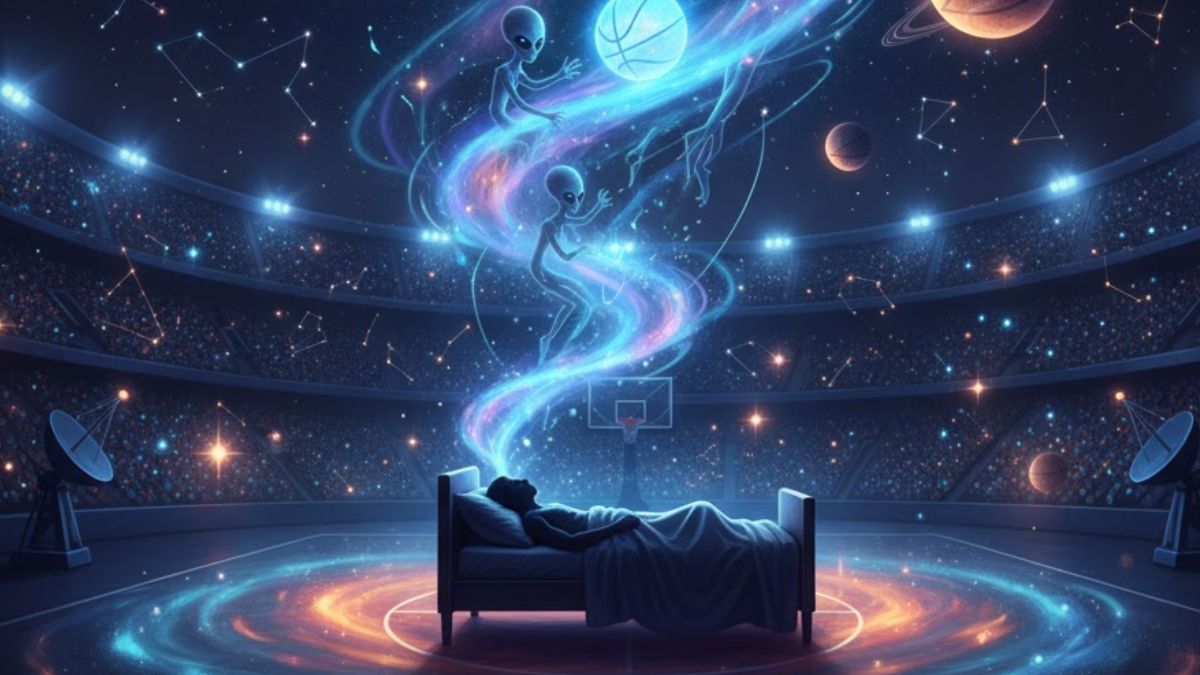
There’s a quiet moment that comes for everyone, just after the day ends and before sleep takes over. In that hazy twilight, your mind begins to drift, creating worlds that defy logic and physics. You might find yourself flying over cities, talking to animals, or revisiting a childhood home. But what if these strange night-time journeys are more than just your brain sorting through the day’s clutter? What if, in some way we don’t yet understand, they are a connection to something far beyond our world?
For centuries, dreams have been seen as messages from gods, glimpses of the future, or windows into our deepest selves. In our modern world, we often explain them as the brain’s way of filing memories and processing emotions. Yet, a fascinating and persistent idea lingers in the corners of science and imagination: could our dreams be a channel for contact with intelligent life from other planets? It’s a concept that lives where the solid ground of science meets the misty shores of the unknown.
This idea invites us on a journey to explore the very nature of consciousness and the universe. If beings from another star system are out there, perhaps they are too far for our rockets to reach. Maybe their method of communication isn’t a radio signal, but something more subtle, more intimate. What if they are trying to speak to us not with sound, but with thought, using the universal language of the mind? This leads us to a single, captivating question: is it possible that when we close our eyes at night, we are opening a door to the cosmos?
What Exactly Are Dreams Made Of?
Before we can consider talking to aliens in our sleep, we need to understand what dreams are. Every night, when you enter the stage of sleep known as REM (which stands for Rapid Eye Movement), your brain becomes incredibly active. It’s almost as busy as it is when you’re awake. During this time, it weaves together stories, images, and sensations using your memories, fears, and hopes. Think of your mind as a master chef. It takes all the ingredients of your day—a conversation you had, a problem you’re solving, a movie you saw—and mixes them together to create a completely new, and sometimes very strange, recipe.
Scientists believe this process helps us learn and manage our feelings. It’s a private theater where you are the writer, director, and audience all at once. But sometimes, the show feels so real and so foreign that it’s hard to believe it came entirely from inside your own head. Have you ever had a dream that felt like a message? Or one where you encountered a being that was not human? These are the experiences that make us wonder if the stage of our mind is sometimes shared with other, unseen actors.
How Could Beings from Another World Possibly Reach Our Minds?
The universe is almost unbelievably vast. The closest star to our Sun, Proxima Centauri, is so far away that it would take our fastest spacecraft tens of thousands of years to get there. If there is intelligent life out there, the physical distance is a huge problem for a coffee chat. This is where the idea of non-physical contact comes in. Some scientists and thinkers suggest that a highly advanced civilization would have mastered not just technology, but the nature of consciousness itself.
Imagine consciousness as a radio. Our brains might normally be tuned to one station—the one that deals with our everyday life on Earth. But what if an advanced extraterrestrial intelligence could broadcast on a different frequency, one that our minds can only access when our guard is down during sleep? In this theory, dreams wouldn’t be random neural firings, but a potential receiver for a cosmic signal. It’s a way to bypass the incredible distances of space and communicate mind-to-mind. While this sounds like science fiction, it pushes us to think about the untapped potential of our own brains and the mysteries of the universe that we have yet to solve.
Have People Really Claimed to Meet Aliens in Their Dreams?
Stories of dream-time encounters with non-human entities are not new. In fact, they appear in cultures all around the world. Many people have reported vivid, intense dreams where they communicate with strange, intelligent beings. These are not the fuzzy, forgettable dreams of most nights. They are often described as “hyper-real”—more vivid and real than waking life. The dreamers might receive complex information, see detailed symbols, or feel a profound sense of connection.
One of the most famous examples is the experience of Betty and Barney Hill in the 1960s. They claimed to have been taken aboard a spacecraft. Under hypnosis, they recalled details of their experience, and Betty described a “star map” shown to her by the beings. Some researchers have wondered if the initial contact, or the memory of it, was imprinted in a dream-like state. Whether these accounts are literal events, powerful dreams, or something in between, they highlight a recurring human experience: the feeling of contact with another intelligence in a realm that exists outside our normal waking reality.
What Does Science Say About This Idea?
From a strict scientific standpoint, there is no proof that dreams are a means of extraterrestrial contact. Mainstream science explains dreams through biology and psychology. They are seen as a natural process of the human brain, a internal show with no external broadcasters. Scientists who search for extraterrestrial intelligence, known as SETI researchers, typically use giant radio telescopes to scan the heavens for deliberate signals. They are looking for something concrete and measurable.
The idea of dream communication falls into a category that is much harder to test. How could you prove that an image in a dream came from another world? You can’t capture it in a bottle or record it on a frequency band. This doesn’t mean the idea is automatically false, but it means it lives outside the boundaries of what current science can confirm or deny. It remains a fascinating possibility, a mystery that encourages us to keep an open mind about the vast, unknown capabilities of consciousness and the universe.
Could It Be Our Own Imagination Trying to Make Sense of the Unknown?
Our brains are wired to find patterns and meaning. This is a wonderful trait that helped our ancestors identify a predator hiding in the grass or find fruit on a tree. But this same skill can sometimes see patterns where none exist. When we are faced with the profound mystery of the cosmos and the deep question of whether we are alone, our minds might try to create an answer.
The beings we meet in our dreams, no matter how alien they seem, are still built from the building blocks of our own minds. The grey-skinned, large-eyed alien figure that is so common in pop culture and dream reports could be a symbol our brain creates to represent the ultimate “Other.” It is a face we put on the concept of intelligence that is not human. So, when we have a powerful dream about an alien, it might be our own powerful imagination giving form to the infinite possibilities of the universe. It is our psyche’s way of reaching out into the silence and trying to get an answer back.
What Can We Learn from Exploring This Possibility?
Even if dreams are not a literal phone line to another planet, exploring this idea is incredibly valuable. It stretches our imagination and challenges our understanding of reality. It forces us to ask bigger questions: What is consciousness? Is it possible that minds can connect across space? Are there dimensions of existence we are only barely aware of?
Thinking about these questions can be a starting point for a deeper personal journey. Paying closer attention to your dreams can teach you a lot about yourself—your hidden fears, your secret wishes, and the way your mind works. And who knows? By becoming more aware of the inner universe of your mind, you might just become more attuned to the wonders of the outer universe. The search for connection, whether with ourselves or with the stars, is a fundamental part of being human.
Conclusion
The question of whether we can contact extraterrestrial beings through our dreams remains one of the most intriguing mysteries. Science offers a biological explanation for our dreams, while the world of possibility suggests there could be more to the story. Perhaps the truth lies somewhere in the middle. Our dreams are a personal, internal process, but they might also be a canvas upon which deeper, more universal connections could be painted. They are a reminder that the human mind is a vast and largely unexplored frontier, as mysterious in its own way as the distant galaxies we see through our telescopes. So tonight, when you drift off to sleep, remember that you are embarking on a journey into an incredible inner world. What, or who, might you find there?
FAQs – People Also Ask
1. What is the most common description of an extraterrestrial being in dreams?
Many people describe seeing beings that are human-like but with distinct differences, such as large, dark eyes, grey skin, and slender bodies. These figures often feel highly intelligent and communicate without words, using thoughts or images.
2. Can dreams predict the future or are they just random?
While most scientists believe dreams are a mix of memory processing and emotional regulation, some people report having “precognitive” dreams that seem to predict future events. There is no scientific consensus on this, and it remains a topic of fascination and debate.
3. Why do we sometimes forget our dreams so quickly?
Dreams are primarily formed in the short-term memory centers of the brain. Unless you wake up during or immediately after the dream and actively think about it, the memory often fades away as you transition into deeper sleep or wakefulness.
4. Have any scientists seriously studied dreams as a form of alien contact?
This idea is generally considered a part of “fringe science” and is not a mainstream area of study. Most SETI (Search for Extraterrestrial Intelligence) scientists focus on detecting physical signals like radio waves, not psychological phenomena.
5. What is the difference between a dream and a vision?
A dream typically occurs during sleep and is often disjointed and symbolic. A vision is usually a vivid, purposeful mental image that can occur in a waking state, often attributed to spiritual or profound insight.
6. Could aliens be using telepathy to communicate with us?
Telepathy, or mind-to-mind communication, is not supported by current scientific evidence. However, if an alien civilization were advanced enough, it is a theoretical possibility that they might use a form of communication we cannot yet comprehend or detect.
7. Why do some people have more vivid dreams than others?
Factors like sleep quality, stress levels, personality type (creative people often report vivid dreams), and even certain medications can influence how vividly a person dreams and how well they remember their dreams.
8. Are there any cultures that believe dreams are a connection to other worlds?
Yes, many indigenous and ancient cultures around the world hold the belief that dreams are a time when the soul travels to other realms or communicates with spirits, ancestors, and otherworldly beings.
9. What should I do if I have a scary dream about aliens?
Remember that dreams, even frightening ones, are a normal product of your mind. Talking about the dream, writing it down, and reassuring yourself that it was not real can help reduce the fear. If scary dreams are frequent, it might help to look at sources of stress in your waking life.
10. Is there any link between UFO sightings and dreams?
Some people who report UFO sightings also describe experiencing strange dreams around the same time. Researchers are unsure if this is a coincidence, if the excitement of the event influences their dreams, or if there is a deeper connection we don’t yet understand.