

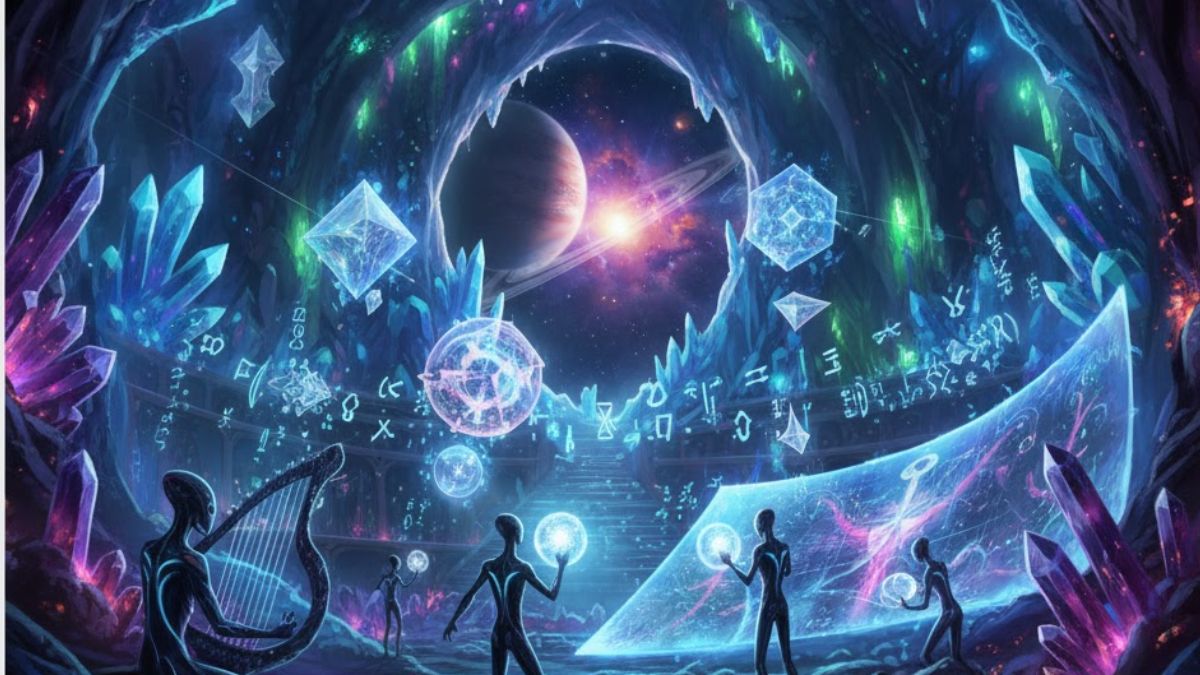
We often look up at the stars and wonder if anyone is out there. We think about what they might look like, how they might talk, or what kind of cities they could build. But have you ever stopped to think about what their music would sound like? What kind of paintings would hang in their homes? The idea of alien art and music is a fascinating puzzle. It makes us think about what art really is and how it might be different in a world completely unlike our own.
Art and music on Earth are deeply connected to our bodies and our planet. We have two ears that hear certain sounds, two eyes that see specific colors. We make music with voices, hands, and instruments that rely on air vibrating in a certain way. Our art is shaped by what we see: sunsets, oceans, forests, and faces. But an alien living on a distant world would have a completely different experience. Their senses, their world, and even their bodies would be nothing like ours.
So, if we ever received a message from space that wasn’t words or numbers, but a piece of music or a digital painting, would we even understand it? What would it tell us about the creatures who created it? Let’s explore this incredible idea together.
What is the main purpose of art and music?
Before we can imagine alien art, we should think about why art exists at all. On Earth, humans create music and art for many reasons. We use it to tell stories, to express our feelings like joy or sadness, to bring people together in celebration, and to make sense of the world around us. A sad song can make you feel less alone. A painting of a beautiful landscape can make you feel peaceful. A rhythmic drumbeat can make a whole community dance together.
It is very likely that any intelligent alien species would also have a need to express themselves. They might also have feelings, stories to tell, and a desire to create things that are beautiful or meaningful to them. So, the purpose of their art might be similar to ours. They might create things to communicate complex ideas that are hard to say with simple words. The big difference wouldn’t be why they create, but how they create it. Their art would be a direct reflection of their unique biology and their alien environment.
Imagine an alien that lives in a world with three suns. Their idea of a beautiful sky would be completely different from ours. An alien that communicates by changing the color of its skin might create light shows instead of paintings. The core desire to create and share might be universal, but the results would be astonishingly foreign.
How would an alien’s body shape their art?
Our human art is limited by our human senses. We can only see a small part of the light spectrum, which we call “colors.” We can only hear a certain range of sounds. An alien’s senses could be wildly different, and this would completely change their art forms.
Let’s think about hearing. What if an alien had ears that could hear very low rumbles, like those made by earthquakes? Their music might be built on deep vibrations that we could only feel in our bones, not hear with our ears. Or what if they could hear the very high-pitched sounds of radio waves? Their symphonies could be broadcast through the air, completely silent to us. Their music might not even have melodies as we know them. It could be a complex pattern of clicks, pulses, and hums that tell a story about the weather on their planet or the migration of their giant flying animals.
Now, think about sight. What if an alien had eyes that could see infrared or ultraviolet light? A painting that looks blank or black to us could be a vibrant, bursting-with-color masterpiece to them. It might show heat signatures or magnetic fields. What if they had more than two eyes, seeing the world from multiple angles at once? Their sculptures and buildings might look confusing and twisted to us, but to them, they would be perfectly harmonious and beautiful from every viewpoint. Their art would be made for senses we don’t even possess.
What if their world has a different environment?
The place where an alien lives would be the biggest inspiration for their art. An ocean world, a desert planet, or a gas giant would each create a unique kind of artist.
Imagine intelligent beings living in the thick, soupy atmosphere of a gas giant like Jupiter. There might be no solid ground, and they could be creatures that float forever in the clouds. For them, music might not be made with instruments, but with the wind. Their songs could be long, swirling patterns of gas and storm sounds, lasting for centuries. Their “art” might be the beautiful, natural arrangement of ammonia crystals or the creation of intricate, temporary structures from clouds.
Now, think about a planet that is completely dark, like a world deep in space far from any star. If the aliens there used sound to “see” like bats, their most valued art form might be soundscape poetry. They would create beautiful, complex echoes that paint a picture of fantastic, imaginary places in the minds of their listeners. A “museum” for them would be a series of rooms where you could walk through and experience these crafted sonic environments. The idea of a visual painting would be meaningless, but a “sound painting” would be their highest art.
Could we ever understand or appreciate alien art?
This is the biggest challenge. If we ever received a transmission of alien music, our first reaction might be to call it noise. If we saw an alien painting, it might just look like a random blotch of color. Our brains are wired to understand patterns that are familiar to us. A beautiful alien melody might sound like a car alarm or static to our ears.
To appreciate their art, we would first need to understand them. We would need to learn about their senses, their planet, their history, and what they find important. That sad, slow song might be about the longing for a moonrise that happens only once every thousand years. That chaotic, noisy painting might be a portrait of their parent, painted in a color we cannot see. The meaning would be locked away until we learned the context.
Perhaps the first step wouldn’t be to send scientific data, but to send our own art. We might send the sounds of whales singing, the music of Beethoven, or images of our forests and cities. This would be a way of saying, “This is what we find beautiful. This is what it feels like to be us.” In return, their art would be the same message. It would be a window into their alien soul, showing us what it feels like to live on a world trillions of miles away. Understanding it would be the greatest cultural exchange in history.
Conclusion
The idea of alien music and art pushes our imagination to its limits. It forces us to think beyond our own human experience and consider a universe filled with infinite varieties of beauty. Their creations might be strange, frightening, or even invisible to us at first. But they would represent the same beautiful human urge to create, to express, and to connect. The universe is likely filled with symphonies we cannot hear and galleries we cannot see, all waiting to be discovered. When we finally listen, what new kinds of beauty will we find?
What do you think would be the most surprising thing about art from another world?
FAQs – People Also Ask
1. Why would alien music probably not sound like human music?
Alien music would be based on the alien’s biology and environment. They might hear different sound frequencies, communicate in ways we can’t imagine, and be inspired by the natural sounds of their own world, making their music fundamentally different from anything created on Earth.
2. Could alien art be dangerous to humans?
It’s an interesting thought. If alien art uses specific light patterns or sound frequencies that affect our brain in a negative way, it could potentially be disorienting or harmful. It’s a concept often explored in science fiction stories.
3. What would alien architecture look like?
Alien buildings would be designed for their bodies and their planet’s conditions. On a high-gravity world, structures might be wide and low. For creatures that fly, there might be no stairs at all. Their architecture would be a practical and artistic response to their environment.
4. Have we ever tried to send music into space?
Yes, we have. The Voyager spacecraft carry Golden Records with sounds and music from Earth, including greetings in many languages, nature sounds, and songs from different cultures. It’s a message in a bottle showing our artistic side to anyone who might find it.
5. Is it possible that aliens have no art or music?
It is possible. If a species is purely logical and doesn’t experience emotions like we do, they might not feel the need to create art. However, many scientists believe that creativity is a sign of high intelligence, so it seems likely that an advanced species would have some form of art.
6. How would a blind alien species create art?
They would likely focus on art for their other senses. This could involve incredible sculptures meant to be touched, complex perfumes that tell a story (scent art), or the intricate sound-based “paintings” mentioned in the article.
7. What if aliens communicate with smells?
If an alien race used pheromones or scents to talk, their art could be like a symphony of smells. They might create complex, changing perfumes that express stories or emotions, something we would have a very hard time understanding or appreciating.
8. Could we use computers to translate alien art?
We would probably need very advanced computers to even begin. A computer could analyze patterns in their music or art and compare them to information we have about their planet, helping us find meaning in what initially seems like chaos.
9. Would alien music have rhythm?
Rhythm is often connected to heartbeat and cycles in nature, like day and night. If an alien has a heartbeat or lives on a planet with regular cycles, their music might have rhythm, but it could be far more complex or slower than anything we are used to.
10. What is the first thing we should try to understand about alien art?
The first step would be to understand the artist. We would need to learn about the alien’s senses, their physical world, and their social structures. The art wouldn’t make sense until we understood the creature who created it.