

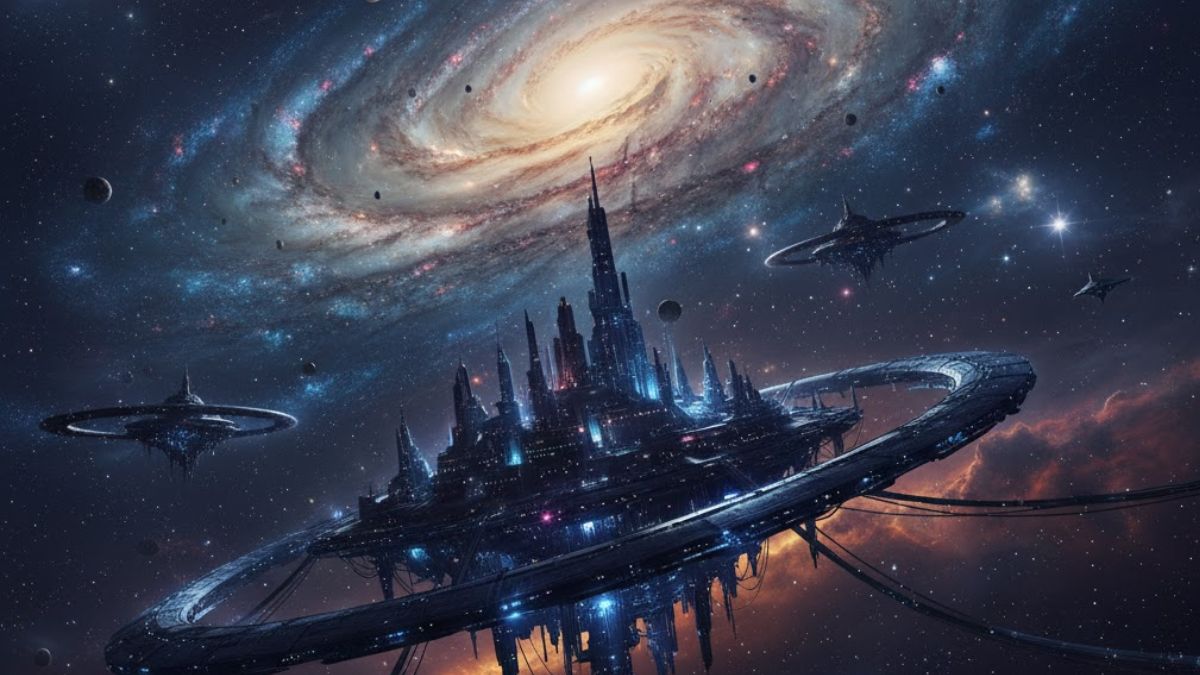
We often look up at the night sky and see a vast, dark blanket dotted with tiny, twinkling lights. Each of those lights is a star, and many of them have planets, just like our Sun has Earth. Our home, Earth, is part of a giant family of stars, gas, and dust called the Milky Way galaxy. This galaxy of ours is incredibly old—about 13.6 billion years old. Life on Earth, by comparison, has only been around for a fraction of that time, with humans appearing very recently in the cosmic story.
This leads us to a thought that can feel both exciting and a little dizzying. If our galaxy is so ancient, what came before it? The universe itself is even older than the Milky Way, at roughly 13.8 billion years old. That means the first galaxies started forming when the universe was still very young. So, if life could develop on our planet, could it have started on a planet in one of those first galaxies? And if it did, could that life have grown into a civilization so ancient that it existed before our own galaxy even finished taking shape?
This idea pushes the limits of our imagination. We’re asking if there could be civilizations whose history stretches back so far that our entire galaxy is a newcomer to them. To explore this, we need to understand the scale of time in the cosmos and consider the possibilities of life in the early universe. So, let’s dive in. Is it possible that we are the newcomers in a universe filled with ancient, perhaps even unimaginable, civilizations?
What does “older than our galaxy” really mean?
When we say something is “older than our galaxy,” we are talking about a timeline that is almost impossible for our minds to grasp. Our daily lives are measured in hours, months, and years. Human history is measured in thousands of years. But the universe operates on a scale of billions of years.
Let’s try to imagine the entire history of the universe squeezed into a single calendar year. The Big Bang happens at the first second of January 1st. Our Milky Way galaxy forms around mid-January. Our Solar System and Earth don’t appear until early September. The first simple life on Earth emerges in late September, but all of complex life, from dinosaurs to humans, happens in the final week of December. Modern humans show up in the last few minutes of December 31st. In this compressed timeline, a civilization older than our galaxy would have originated in those first few weeks of January. Their entire civilization, with all its history, science, and art, could have risen and perhaps fallen long before our Earth even existed as a cloud of dust and gas.
This isn’t just about a civilization being a few thousand years older than us. We are talking about a difference of billions of years. A civilization with a billion-year head start would be so advanced that their technology and knowledge would seem like magic to us. They wouldn’t just have better smartphones; they might have the ability to engineer stars, travel between galaxies, or even manipulate the fabric of space and time itself. The concept isn’t just about age; it’s about a level of existence we can barely conceive of.
How old is our galaxy, and when did the first ones form?
To understand if something could be older than our galaxy, we first need to know how old our galaxy is. Astronomers estimate that the Milky Way began to form about 13.6 billion years ago. This was not long after the Big Bang, which started our universe 13.8 billion years ago. Think of the universe just after the Big Bang as a hot, dense soup of particles. As it expanded and cooled, tiny fluctuations in density began to pull matter together through gravity.
The first stars ignited in small, clumpy clusters, and these clusters then merged together, drawn by their mutual gravity, to build the first small, primitive galaxies. The Milky Way is one of these ancient galaxies. Over billions of years, it grew by consuming smaller galaxies and accumulating more gas and dust, becoming the magnificent spiral we call home today. So, our galaxy is a cosmic elder, but it was not the very first. The earliest galaxies began forming perhaps just 200 to 400 million years after the Big Bang. This means there are islands of stars out there that are a little bit older than our own.
This timeline is crucial. It tells us that there was a window of opportunity for planets to form around stars in those very first galaxies. If planets could form that early, then the ingredients for life could have been present almost from the beginning. The universe didn’t wait for the Milky Way to be perfect; it started building its structures right away. This opens the door to the possibility that life, and therefore civilizations, could have gotten a much earlier start elsewhere.
Could life even exist in the early universe?
This is one of the biggest questions. The early universe was a very different and much more violent place. The first stars, often called Population III stars, were behemoths. They were hundreds of times more massive than our Sun and burned ferociously hot and bright, ending their lives in gigantic explosions called supernovae after only a few million years. These conditions don’t sound very friendly for life.
However, those same violent deaths were essential for creating the building blocks of life. Inside these early stars, nuclear fusion created heavier elements like carbon, oxygen, and iron. When the stars exploded, they scattered these elements across space. This “stardust” then became part of the next generation of stars and planets. So, while the very first stars might not have had planets capable of hosting life, the second generation of stars certainly could have. These stars, richer in heavy elements, could have formed rocky planets like Earth.
Scientists believe that the necessary elements for life were available in the universe surprisingly early. Some calculations suggest that Earth-like planets could have formed as early as 12 billion years ago. That is a full 7 billion years before Earth itself formed! If that is true, then the cosmic clock for life started ticking a very, very long time ago. Life on one of those early planets would have had billions of years of a head start on us. It’s a staggering thought that when our Sun was born, the universe might have already been filled with the ruins or active communications of civilizations that were ancient beyond measure.
What would such an ancient civilization be like?
Trying to imagine a civilization that is a billion years more advanced than ours is like trying to explain the internet to an ant. The gap in knowledge and capability would be so vast that we probably couldn’t even recognize their technology or their works. Human civilization, in a technological sense, is only about 10,000 years old. In just the last 200 years, we have gone from horse-drawn carriages to smartphones and space telescopes.
Now, multiply that progress by a factor of a thousand or a million. What could a species achieve in 10 million years? Or 100 million? Or a billion? They would have overcome problems we consider fundamental, like disease, aging, and energy scarcity. They might have learned to harness the power of entire stars, a concept we call a Dyson Sphere. They might be able to travel between stars as easily as we fly between continents. They might have even transcended their biological bodies, existing as pure consciousness or as forms of artificial intelligence that live for eons.
Their structures might not even be on planets. They could build enormous space habitats or megastructures that orbit stars. Their art, science, and philosophy would be based on knowledge gathered over millions of years of observing the universe. To them, our entire recorded history might be nothing more than a brief footnote. The most intriguing question is, if they are out there, why haven’t we found any evidence of them? This is known as the Fermi Paradox, and it leads us to some sobering thoughts.
If they are out there, why can’t we see them?
This is the great silence. The universe is enormous and old, and seems to have all the right ingredients for life, so where is everybody? There are several possible answers, and some of them are quite haunting.
One possibility is that life is incredibly rare. Maybe the conditions needed for life to begin are so specific that it has only happened a handful of times in the entire universe. Another idea is that while simple life might be common, the jump to intelligent, technology-building life is extremely difficult. Perhaps most civilizations destroy themselves before they can master interstellar travel, maybe through war or environmental collapse.
For civilizations older than our galaxy, the reasons could be even more profound. They might have evolved beyond a form that we can detect. Their communication might use technologies we don’t understand, like quantum entanglement or gravitational waves, instead of the radio signals we look for. They might be observing us silently, like we observe animals in a forest, without interfering. Or, perhaps the most likely scenario, the distances between galaxies are so unimaginably vast that even a super-advanced civilization would find it incredibly challenging to cross them or send signals that remain strong over billions of light-years.
It’s also possible that we are simply looking at the wrong time. A civilization that arose 10 billion years ago might have only lasted for a “short” 50 million years before going extinct. In the grand timeline of the universe, we might just be blinking our eyes at the wrong moment to see the flash of another’s existence.
Conclusion
The question of whether civilizations older than our galaxy exist is one of the most profound we can ask. It forces us to confront our own place in the cosmos, not just in space, but in time. We are living on a young planet, orbiting a middle-aged star, in an ancient galaxy, in an even older universe. The conditions for life were present billions of years before Earth was born, opening up the very real possibility that we are not the first, and we are certainly not the oldest.
While we have no proof, the sheer scale of the universe—with its two trillion galaxies—suggests that it is a possibility we cannot ignore. The search for answers continues, with scientists using powerful telescopes to look for signs of life, or even signs of giant alien structures, in the light from distant stars and galaxies. Every new exoplanet we discover adds another piece to this cosmic puzzle.
So, the next time you look up at the stars, remember that you are not just looking across space, but also back in time. The light from those stars started its journey to your eyes millions of years ago. And perhaps, in another galaxy, far, far away, the light from a world that existed before our galaxy was fully formed is just now arriving, carrying with it the untold stories of a civilization that watched the cosmos evolve. What do you think we would learn from them if we ever made contact?
FAQs – People Also Ask
1. How many galaxies are there in the universe?
Scientists estimate that there are about two trillion galaxies in the observable universe. Each of these galaxies can contain billions or even trillions of stars, and many of those stars have their own planets.
2. What is the oldest known galaxy?
As of now, one of the oldest known galaxies is called JADES-GS-z13-0. We see it as it was when the universe was only about 300 million years old, making it over 13.5 billion years old.
3. Can a planet be older than its star?
No, a planet cannot be older than the star it orbits. Planets form from the leftover disk of gas and dust that surrounds a young star, so the star always forms first.
4. What are the requirements for a planet to support life?
The main requirements are thought to be liquid water, a source of energy (like from a star), and a stable environment with the right chemical building blocks, like carbon and other essential elements.
5. How do scientists look for alien life?
Scientists use giant radio telescopes to listen for signals from space, look for changes in starlight that indicate an orbiting planet, and study the atmospheres of distant planets for gases like oxygen or methane that might be produced by living things.
6. What is the Fermi Paradox?
The Fermi Paradox is the contradiction between the high probability of alien life existing in the universe and the complete lack of any evidence for it. It’s often summed up by the question, “Where is everybody?”
7. Could we ever communicate with a civilization in another galaxy?
With our current technology, it is highly unlikely. The distances are so vast that a simple radio message could take millions of years to reach another galaxy, and a reply would take millions more to return.
8. What is a Dyson Sphere?
A Dyson Sphere is a hypothetical megastructure that an advanced civilization might build to completely surround a star and capture a large percentage of its power output for their own energy needs.
9. How old is the Earth compared to the universe?
The Earth is about 4.5 billion years old. The universe is about 13.8 billion years old, meaning the Earth formed when the universe was already roughly two-thirds of its current age.
10. Have we found any evidence of ancient civilizations in our own galaxy?
No, we have not found any credible evidence of ancient civilizations, either in our galaxy or beyond. All searches so far have come up empty, but the search is still in its early stages, and we have only explored a tiny fraction of our own galaxy.