

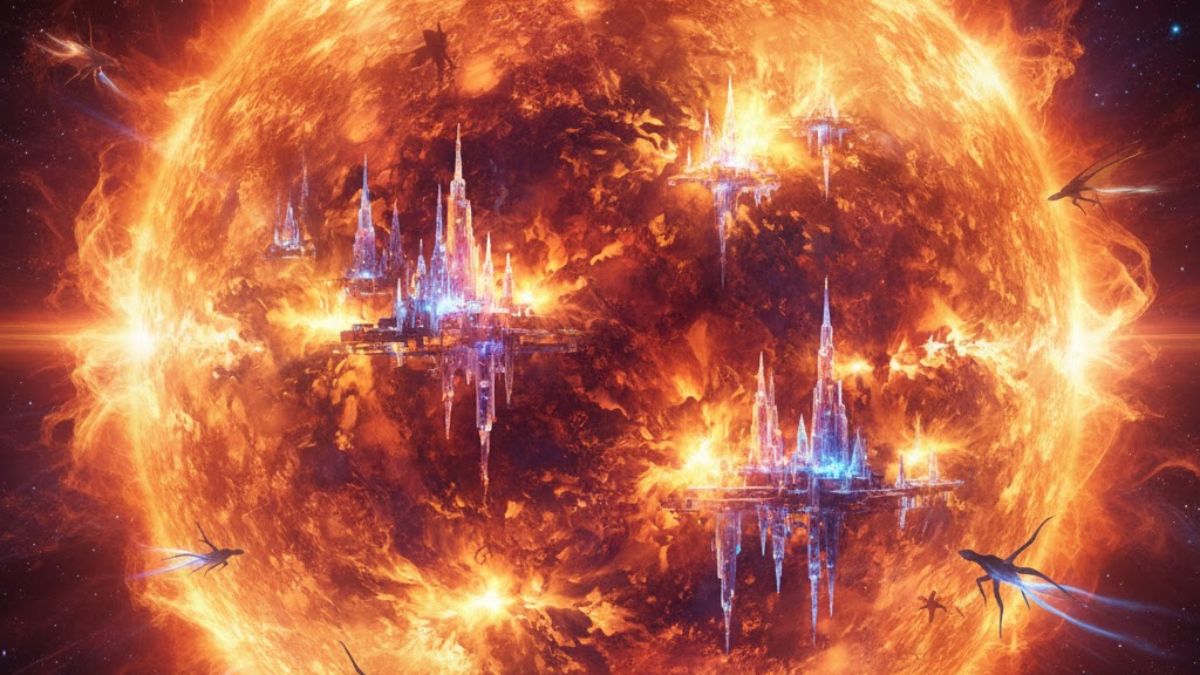
We often picture aliens on distant planets, maybe in a desert world with two suns or a moon covered in ice. We imagine them living on a surface, under a sky, much like we do. But what if we are thinking too small? What if life, in forms we can barely imagine, doesn’t need a planet at all? What if entire civilizations exist in the most unlikely place we can think of—inside a star?
It sounds like science fiction. Stars are gigantic balls of super-hot plasma, constantly exploding with nuclear fusion. Our own Sun has a surface temperature of around 10,000 degrees Fahrenheit, and its core is millions of degrees. How could anything survive that? The idea seems impossible. But scientists are exploring the possibility that life might not always need a rocky planet. It might find a way in environments we consider pure chaos.
So, let’s dive into this incredible idea. Could a star be more than just a ball of fire? Could it be a home? What kind of life could possibly call the heart of a sun its safe haven?
What is a star, really?
When we look up at the night sky, we see stars as tiny, twinkling points of light. They seem peaceful and still. But the truth is, a star is a raging cosmic engine. Think of it as a massive, continuous nuclear explosion, held together by its own gravity. For billions of years, a star burns its fuel, creating immense heat and light that travel across the universe.
At its very center, or core, the pressure and temperature are unimaginably high. This is where atoms of hydrogen are squeezed together so hard that they fuse into helium, releasing a tremendous amount of energy. This energy pushes outward, trying to escape. Meanwhile, the star’s incredible gravity pulls everything inward. This creates a delicate balance. The star is constantly fighting between these two forces—explosion and gravity—and that struggle is what keeps it stable for most of its life. It’s not a solid surface you could stand on; it’s a churning, seething ocean of superheated gas. To us, it’s the definition of a place where nothing could ever live.
So, how could anything live inside a star?
This is where we have to stretch our imaginations and think about what “life” really means. We are carbon-based life forms, which means our bodies are built from carbon atoms. We need water, a certain temperature range, and a solid surface. But what if life elsewhere isn’t like us? What if it’s based on something else entirely?
Some scientists have theorized about life forms that aren’t like the fleshy, water-dependent creatures we know. One fascinating idea involves “plasma-based life.” A star is made of plasma, which is often called the fourth state of matter. It’s like a gas, but its atoms have been torn apart into a soup of electrons and atomic nuclei. This plasma is controlled by powerful magnetic and electrical forces.
Now, imagine if a super-advanced civilization, one that has evolved over millions of years, learned to build structures not out of metal and rock, but out of these magnetic forces. Instead of building houses, they might create stable “bubbles” or zones inside the star’s plasma. These zones could be pockets where the temperature and pressure are somehow lower, acting as safe havens. These beings wouldn’t have physical bodies as we do. They might be conscious patterns of energy, living within the flowing currents of their star, feeding directly on the star’s immense nuclear energy. They wouldn’t see the universe as we do; their entire world would be the swirling, energetic interior of their sun.
What would a “star civilization” look like?
Trying to picture a day in the life of a star-being is a real challenge. Since they would live in a sea of plasma, their perception of reality would be completely different. For one, there is no “up” or “down.” Their world is a vast, three-dimensional ocean of light and heat. They might “communicate” by sending ripples through the magnetic fields, similar to how we use sound waves. Their “cities” could be complex networks of magnetic knots, stable for centuries within the star’s constant turmoil.
How would they travel? Perhaps they would ride the star’s natural currents, flowing from the core to the surface and back again. Their version of astronomy might involve studying the vibrations of the star itself to understand the universe outside. They might even be able to detect our presence by studying the tiny, regular dips in their star’s light caused by planets like Earth passing in front of it. To them, our solid, rocky world might seem as strange and inhospitable as their star seems to us. They might look at our cold, slow planet and think, “How could anything possibly live there?”
What evidence would we look for?
If we wanted to search for such civilizations, we couldn’t send a probe. It would be vaporized instantly. Instead, astronomers would have to look for strange signs in the light from distant stars. A star with an intelligent civilization inside might not behave like a normal star. Its energy output might be unusually stable, as if something is managing its nuclear reactions. Or, it might flicker in a complex, patterned way that doesn’t match any known natural process.
Scientists already look for unusual star behavior, like the famous “Tabby’s Star,” which had mysterious, unpredictable dips in brightness that some people jokingly suggested could be caused by a giant alien megastructure. While it was almost certainly a natural phenomenon, it shows how we use a star’s light as a clue to what might be happening there. A star housing life might emit a unique signature, a pattern in its light that screams “intelligence” to anyone who knows how to read it.
Is this idea just a fun fantasy, or could it be real?
Right now, the idea of civilizations inside stars sits firmly in the realm of theoretical physics and science fiction. There are enormous problems with the idea. The biggest one is entropy, which is a scientific way of describing disorder and chaos. A star is a high-entropy environment, meaning it’s incredibly chaotic. Life, as we understand it, needs a certain level of order and stability to store information and complex structures, like DNA. It’s hard to see how such order could emerge in the chaotic core of a star.
However, the universe is vast and old. It has over 100 billion galaxies, each with billions of stars. The laws of physics are the same everywhere, but the conditions are infinite. To say with absolute certainty that life can only exist on Earth-like planets is perhaps a little narrow-minded. The universe might be far more creative than we are. The true answer is that we don’t know. The possibility, however tiny, reminds us that the cosmos is full of wonders beyond our current understanding.
The search for alien life is really a search for possibilities. We start by looking for life similar to our own, on planets that resemble Earth. But as we learn more, we are encouraged to think bigger and stranger. The idea of civilizations thriving inside the heart of a star pushes the boundaries of our imagination. It challenges our definition of life, of intelligence, and of a home. It suggests that the universe could be teeming with life in forms so alien that we might not even recognize them as life at all. The next time you look up at a star, remember—it might be more than just a light in the sky. It might be a world all by itself.
So, if a star could be a home, what other impossible places in the universe might be hiding life?
FAQs – People Also Ask
1. What is a star made of?
A star is primarily made of hydrogen and helium gas. Under immense pressure and heat at its core, these gases turn into a state of matter called plasma, which is like a super-hot, electrically charged soup.
2. How hot is the inside of a star?
The temperature inside a star is incredibly high. The core of our Sun, for example, reaches about 27 million degrees Fahrenheit (15 million degrees Celsius). The surface is much cooler, but still around 10,000 degrees Fahrenheit (5,500 degrees Celsius).
3. What is nuclear fusion?
Nuclear fusion is the process that powers a star. It occurs when atoms, like hydrogen, are squeezed together under extreme pressure and heat, forcing them to merge and form new atoms, like helium. This process releases a massive amount of energy.
4. What are plasma-based life forms?
Plasma-based life is a theoretical idea where living beings could be made of plasma—the super-hot, charged state of matter found in stars. Instead of having biological bodies, they might exist as organized patterns of magnetic energy within the stellar material.
5. Could there be solid matter inside a star?
No, the intense heat and pressure inside a star prevent any solid matter from forming. Anything we consider solid, like metal or rock, would be instantly vaporized into plasma.
6. What is Tabby’s Star?
Tabby’s Star, officially known as KIC 8462852, is a star that was discovered to have unusual and unpredictable dips in its brightness. While scientists believe natural causes like dust are the reason, its strange behavior led to speculation about alien megastructures.
7. How do scientists look for alien life?
Scientists primarily use telescopes to look for biosignatures (signs of life) on distant planets, such as specific gases like oxygen or methane in their atmospheres. They also listen for artificial radio signals and look for unusual patterns in starlight.
8. What is a Dyson Sphere?
A Dyson Sphere is a hypothetical megastructure that an advanced alien civilization might build to completely surround a star and capture a large percentage of its power output. We could potentially detect one by the unusual infrared heat it would give off.
9. How long do stars live?
The lifespan of a star depends on its size. Massive stars live short, violent lives of only a few million years. Smaller stars, like our Sun, can burn steadily for 10 billion years or more.
10. What is the most likely place to find alien life?
Currently, the most likely places are considered to be planets or moons within the “habitable zone” of their star, where temperatures could allow liquid water to exist. In our own solar system, Mars and moons like Europa (orbiting Jupiter) and Enceladus (orbiting Saturn) are prime candidates.