

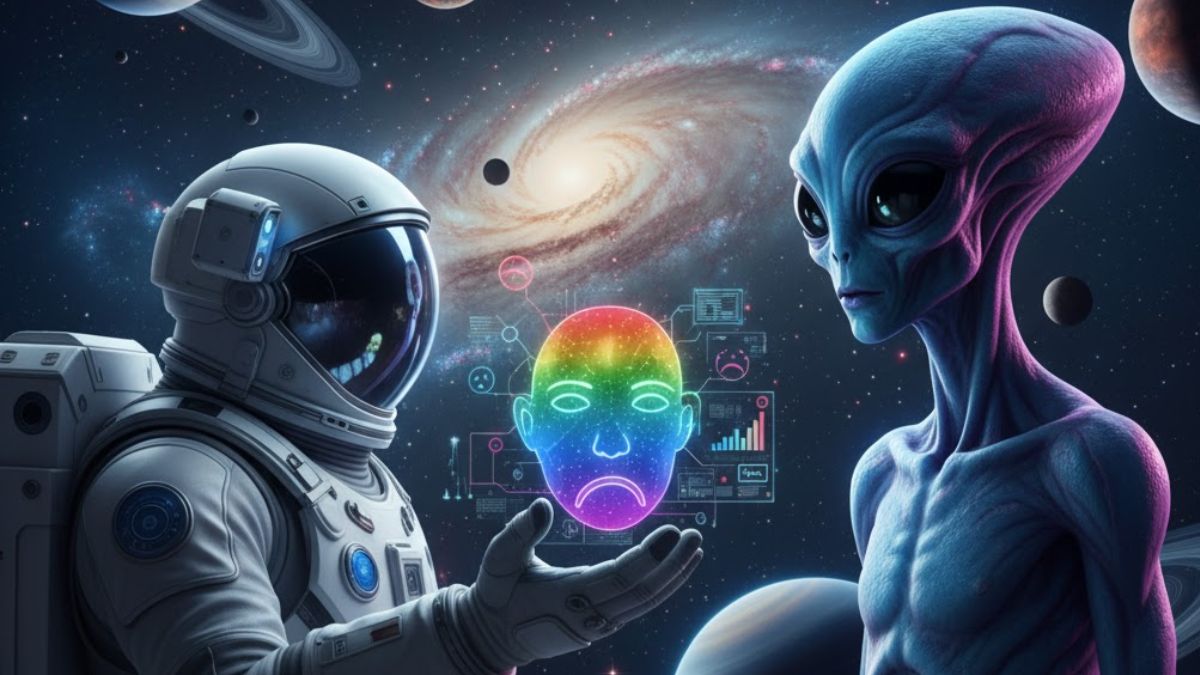
The night sky is a blanket of tiny lights, each one a sun very far away. For thousands of years, we have looked up and asked a simple question: are we alone? Today, with powerful telescopes and robots on other planets, we are closer than ever to finding an answer. But if we ever meet beings from another world, a new question will appear. We could show them our cities and our technology, but could we ever show them what it feels like to be human?
Think about the last time you felt a deep joy, a sudden fear, or a quiet sadness. These emotions are the colors of our inner world. They shape our art, our music, and our relationships. They are so natural to us that we hardly ever stop to think about what they really are. But for a creature that evolved on a completely different planet, under a different sun, our tears and our laughter might be the most confusing thing they have ever seen.
This is the heart of a fascinating puzzle. If we make contact, how would we explain a feeling? Would an alien mind know what love is, or what grief means? Or would our deepest emotions be like a secret code they can never crack? To explore this, we have to think about what emotions really are, and if they are something that only humans can have.
So, what would it actually take for an alien to truly understand a human heart?
What Are Emotions, Really?
To figure out if an alien could understand us, we first need to understand ourselves. What are these things we call emotions? At their simplest, emotions are signals from our brain. They are like an internal alarm system that helped our ancestors survive. The feeling of fear told them to run from a predator. The feeling of happiness encouraged them to build friendships and communities, which made them safer.
But emotions are more than just survival tools. They are deeply connected to our bodies. When you feel anxious, your heart might beat faster. When you feel embarrassed, your cheeks might turn warm. These physical changes are a big part of the experience. An alien scientist could probably measure these things. They could see your racing heart and your rising body temperature. They could even scan your brain and see which parts are active when you feel sad or happy.
However, knowing the recipe for a cake is not the same as tasting it. We can explain the science of a smile, describing which muscles move and which chemicals flood our brain. But that explanation doesn’t capture the warm, happy feeling that comes with a genuine smile. This inner experience, the personal feeling of what it’s like to be you, is called “qualia.” It is the hardest thing to explain or share with another person, let alone a being from another world. An alien might learn every fact about human sadness, but would they ever feel its weight?
Is Love a Universal Language?
We often hear that love is a universal language. It is a beautiful idea. But is love, as we know it, truly universal? On Earth, love is tied to how we raise our children. Human babies need years of care, so evolution gave us powerful bonds of love to keep parents and children connected. This love is built on touch, on shared looks, and on a deep, selfless care for another.
Now, imagine an alien species that is nothing like us. What if they hatch from eggs by the thousands and receive no parental care at all? The concept of a mother’s love would be completely foreign to them. It wouldn’t be a part of their world. They might see our devotion to our children as a strange and inefficient biological quirk.
Or, what if their society is based purely on logic, like a giant, thinking computer? They might form alliances for survival, but the idea of writing poetry for someone, or sacrificing yourself for a friend, might seem utterly irrational. They could understand the word “love” as a description of a cooperative behavior. They could see that humans who “love” each other often help one another survive. But the dizzying joy, the aching longing, the profound sense of connection—the actual feeling of love—might be a color they cannot see. They might have a completely different set of emotions that we could never imagine, or they might have no inner feelings at all.
How Would We Even Talk About Feelings?
Let’s say we meet friendly aliens. We’ve managed to learn each other’s languages enough to trade information about science and history. How would we start the conversation about our feelings? Our words for emotions are often based on metaphors, which are comparisons to things we all know.
We say we have a “broken heart.” An alien might take this literally and try to fix our circulatory system. We say we are “feeling blue.” They might wonder if our skin changes color. We say a piece of music is “sad.” How would we explain that a series of sounds can evoke a feeling of loss, when the alien might just hear vibrating air?
This communication problem goes beyond words. So much of our emotional communication is non-verbal. A slight shift in the tone of our voice, a small frown, or the way we stand can say more than a thousand words. An alien might not have a face. They might communicate by changing colors, like an octopus, or through complex radio signals. They might not have the physical equipment to make the expressions we recognize, and they certainly wouldn’t have evolved to understand ours.
We would need to become emotional translators, not just word translators. We would have to find a way to link our inner experiences to something they can relate to, if such a common ground even exists.
Could They Have Their Own Emotions?
While we are wondering if aliens can understand our feelings, we should also ask: do they have their own? It is very likely that any intelligent species would have some kind of internal signaling system to help them survive. But would it be anything like ours?
Their emotions would be shaped by their world. Imagine a creature that lives in a vast, dark ocean beneath the ice of a moon. Its world is one of pressure, sonar echoes, and patience. Its “emotions” might be tied to sensing tiny vibrations in the water or changes in pressure. Their version of “fear” might be a complex calculation about water currents, and their version of “curiosity” might be a slow, patient mapping of a canyon over centuries.
Their feelings could be far more complex than ours, or much simpler. They might experience a range of colors of emotion that we don’t have words for. They might feel a collective consciousness, a “hive mind” emotion, where the happiness of the group is all that matters. Trying to explain our individual, personal joy to such a being would be like trying to explain a single instrument’s note to someone who only hears the entire symphony.
If they do have emotions, finding a shared emotional language would be our greatest bridge. We could point to their feelings and say, “This thing you feel, we have something a little like it, and we call it ‘hope’.” But if they don’t have any inner life at all, then we might be forever alone with our feelings, the artists of a gallery that no one else can enter.
What If They Understand Us Better Than We Do?
There is another, more surprising possibility. What if an alien intelligence is so advanced that it understands human emotions better than we understand them ourselves? Our own feelings can be a mystery to us. Sometimes we feel angry without knowing why, or we feel a sudden sadness from a forgotten memory.
A super-intelligent alien, with a deep understanding of biology and physics, might see our emotions as a beautiful and predictable pattern. They could look at our brain scans, our history, and our biochemistry and know exactly what we are feeling, why we are feeling it, and what we will feel next. They might understand the roots of our love and our hate with perfect clarity.
This brings up a strange thought. Is it more important to feel an emotion, or to understand it? If this alien could explain your own heart to you, would that be a great comfort, or would it feel like an invasion? Their understanding might be cold and factual, without any of the messy, beautiful confusion that makes our emotional lives so human. Or, their advanced understanding might be a form of great empathy, a way to finally be fully seen and known.
The Biggest Question of All
Our search for aliens is really a search for ourselves. By wondering if they can understand our emotions, we are forced to look at what those emotions are. We are exploring the very thing that makes us human. The laughter that fills a room, the comfort of a hug, the quiet tears at a funeral—these are the unique signatures of our species.
Perhaps the first message we receive from the stars won’t be a complex mathematical formula. Perhaps it will be a simple, universal expression of a feeling. A sequence of sounds that conveys a peaceful greeting, or a pattern of lights that means, “We are here, and we feel wonder too.”
Until that day, we can only guess. We look up at the stars and send out our own messages of emotion through our art and our stories. We are, in a way, trying to explain the human heart to the universe, hoping that someone, or something, out there is listening.
If you could share one human emotion with an alien species, which one would it be, and why?
FAQs – People Also Ask
1. What are human emotions made of?
Human emotions are complex reactions that involve our brain, our body’s chemicals (like hormones), and our thoughts. They are not physical things you can touch, but they cause real physical changes like a faster heartbeat or a smile.
2. Could aliens be emotionless?
Yes, it is possible. An alien species might have evolved to rely purely on logic and calculation for survival, with no need for feelings as we know them. They could be intelligent but without any inner emotional life.
3. How do scientists look for aliens?
Scientists use giant radio telescopes to listen for signals from space, and space telescopes to study the atmospheres of distant planets for signs of life, like oxygen or methane gas. They also send robots to other planets in our solar system to look for microbes.
4. Would aliens have brains like ours?
It is very unlikely. Alien brains would have evolved differently to suit their own bodies and environments. They might not be made of neurons like ours; they could have a completely different biological or even non-biological structure for thinking.
5. What is the most basic human emotion?
Many scientists believe that fear is one of the most basic and ancient human emotions. It is a powerful survival tool that triggers a “fight or flight” response to keep us safe from immediate danger.
6. Can animals understand human emotions?
Many animals, especially pets like dogs and cats, are very good at reading human body language and tone of voice. They can often tell when we are happy or sad and may respond with comfort, which shows a level of understanding.
7. What would aliens look like?
Aliens could look like almost anything. Their appearance would depend entirely on their home planet’s environment. They might have multiple limbs, different types of senses (like sonar), or body shapes we can’t even imagine.
8. How would we talk to aliens if we found them?
At first, we would probably use mathematics and universal scientific concepts, like the structure of atoms, to establish a basic language. From there, we would have to slowly build a shared vocabulary, which could take a very long time.
9. Is sadness a weakness?
No, sadness is a natural and important human emotion. It helps us process loss and difficult events, and it often leads us to seek comfort and support from others, strengthening our social bonds.
10. Why do we care if aliens understand us?
We care because understanding is the foundation of any relationship. If we are not alone in the universe, we would want to connect with other intelligent life. Being understood emotionally would mean we could share our art, our stories, and our humanity, making the universe feel a little less lonely.