

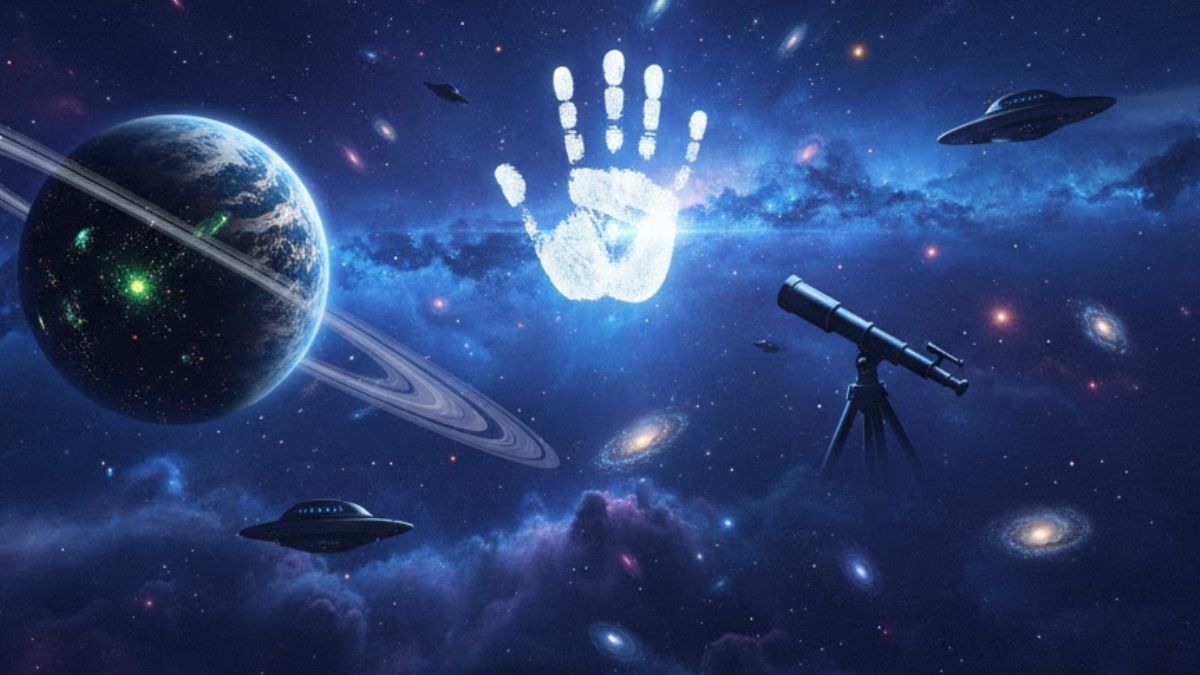
There’s a quiet moment that happens for many of us on a clear, dark night. We look up, see the countless stars scattered like dust, and a single, powerful thought often pops into our heads: “Are we alone?” It’s a question that feels both ancient and brand new. For thousands of years, humans have told stories about gods in the skies or strange creatures from other worlds. Today, we have powerful telescopes and robots on Mars, but that core question remains. It’s one of the biggest mysteries we can possibly imagine.
This isn’t just a question for scientists in labs. It’s a question for everyone. What happens in your mind when you seriously consider that we might not be the only intelligent life in this vast universe? The idea of aliens isn’t just about little green men in flying saucers. It’s about a possibility, a “what if” that can shake the very foundation of how we see ourselves and our place in the cosmos. Believing in the possibility of aliens is more than a belief; it’s a new way of looking at everything.
This article is not going to prove that aliens exist. Instead, we will explore a fascinating idea: simply being open to their existence can change your perspective on our planet, our technology, and even our conflicts. What if the search for extraterrestrial life is really a search for a better understanding of ourselves?
So, if the stars make you feel curious, what might happen if we found out we have cosmic neighbors?
What does it mean to “believe” in aliens?
When we talk about “believing in aliens,” it doesn’t always mean you are convinced that little green beings are visiting Earth right now. For most people, it’s about accepting a probability. The universe is unbelievably huge. Our own galaxy, the Milky Way, has billions of stars. Many of those stars have planets orbiting them, just like our Sun does. Scientists call these “exoplanets,” and they have discovered thousands of them already.
When you look at those numbers, the idea that life only started on one tiny planet, Earth, seems almost unlikely. Believing in aliens, then, is often a belief in the numbers. It’s thinking that in a cosmos this enormous and full of possibilities, it would be stranger if we were alone. This kind of belief is less about faith and more about logic. It’s about looking at the evidence of a vast, busy universe and concluding that life probably found a way somewhere else, too. This opens a door in our minds to a much bigger reality, one where humanity is not the sole focus of creation.
How does this belief make us see Earth differently?
Imagine you’ve lived your entire life in one single, beautiful house. You’ve never left it, and you know every room, every corner, and every creaky floorboard. To you, this house is the entire world. Then, one day, you climb up to the attic and find a window you never noticed. You look out and see a whole neighborhood you never knew existed. Other houses, other families, other lives being lived. Your perspective on your own home changes instantly. It’s still your home, but now you understand it’s part of something much larger.
This is what happens when we seriously consider the existence of aliens. Our planet, Earth, becomes that beautiful house. It is our only home, filled with everything we have ever known—all our history, our oceans, our forests, and all the people we love. The possibility of other life out there is that window. It shows us that our world is precious, but not unique. It is a single, fragile spaceship flying through a dark and mostly empty void. This view, often called the “Overview Effect,” is something many astronauts describe feeling when they see Earth from space—a small, blue marble in the blackness.
Suddenly, the arguments and borders that seem so important down here on the surface feel very small. If we are not the only ones, then we are all in this together as humans. The idea of aliens can make us feel a new sense of unity and a stronger desire to protect our only home.
Could the search for aliens help us invent new technology?
The drive to answer the question “Are we alone?” has pushed human creativity and science forward in incredible ways. The entire field of radio astronomy, which we use to study the universe, was largely advanced by the search for extraterrestrial intelligence, often called SETI. Scientists pointed giant radio telescopes at the stars, hoping to pick up a signal, a message from another civilization.
While we haven’t found that message yet, the effort itself led to amazing new technologies. The need to process huge amounts of data from space has helped improve our computer software and hardware. The algorithms developed to search for faint, artificial signals are now used in medicine to find tiny patterns in our own bodies, like spotting early signs of cancer in medical scans. The challenge of searching the cosmos has forced us to build better, more sensitive equipment, which then helps us learn more about the natural universe, from distant galaxies to newborn stars.
So, even if we never find a signal, the very act of looking makes us smarter and more capable. It solves other problems along the way. It’s like training for a marathon you might never run—you still end up healthier and stronger for having tried.
What if aliens are nothing like us?
Our movies and books are full of aliens that often look a bit like us, with heads, bodies, and eyes. But what if reality is much stranger? Life on other planets would have developed under completely different conditions. A planet with higher gravity might have life that is slow and strong, living close to the ground. A world covered in a dark ocean might have creatures that use sound or electrical pulses to “see,” with no concept of light or eyes at all.
Thinking about this stretches our imagination. It forces us to define “life” and “intelligence” in much broader ways. What if their “technology” isn’t based on metal and wires, but on biology? What if they communicate in ways we can’t even detect, using senses we don’t possess? This possibility teaches us a deep lesson about humility. It shows us that our way of living and thinking is just one way. The universe might be filled with forms of intelligence so different from our own that we might not even recognize them at first.
This makes the universe a much more mysterious and exciting place. It tells us that we are just at the beginning of understanding what is possible. Accepting that aliens could be truly alien opens our minds to a cosmos of infinite wonder.
Does believing in aliens make us more curious about science?
When you start to think that there might be other civilizations out there, you naturally start to ask more questions about how the universe works. How do stars form? What does a planet need to support life? How does life begin from non-living chemicals? These are the very questions that drive the fields of astronomy, planetary science, and biology.
This belief can turn a casual glance at the night sky into a deep, personal curiosity. It makes science feel urgent and personal. Learning about the methane lakes on Saturn’s moon Titan or the icy oceans of Jupiter’s moon Europa isn’t just a boring fact from a textbook anymore. It becomes a clue in the greatest detective story of all time. Are we close to finding life? Could it be in our own solar system? This curiosity is powerful. It can inspire a child to study harder in school, or it can make an adult follow the latest news from NASA with excitement. The search for aliens fuels our general thirst for knowledge, pushing all of science forward.
How does this idea affect our view of human problems?
It is easy to get caught up in our daily lives and think that our human problems are the most important things in the world. And on a personal level, they are. But when you zoom out to a cosmic scale, things look different. The idea that there might be other worlds, with other beings who have their own histories, art, and struggles, can make our own conflicts seem smaller.
This isn’t to say our problems aren’t real. They are. But the cosmic perspective offers a form of mental relief. It’s like looking at a map of the whole world when you’re stuck in a traffic jam in your own town. The traffic jam is still frustrating, but you understand it’s happening in just one small part of a much bigger picture. The possibility of alien life gives us that bigger picture. It encourages us to think as a human species, to work together to solve global issues like climate change or disease, because we are all crew members on the same spaceship Earth.
Conclusion
Believing in aliens is not about waiting for a spaceship to land. It is about embracing a perspective that is both humbling and inspiring. It makes our planet seem more precious, our science more driven, and our minds more open. It connects us to the curiosity that has always defined humanity at its best—the desire to explore, to understand, and to reach out into the unknown.
This belief changes the way we think by giving us a cosmic context for our lives. It reminds us that we are part of a story that is much, much bigger than ourselves. And whether we ever make contact or not, that shift in thinking alone is a powerful and positive thing. It encourages us to be better, smarter, and more united inhabitants of our pale blue dot.
So the next time you look up at the stars, consider this: What would it mean for you, personally, if we discovered we were not alone?
FAQs – People Also Ask
1. How many planets could support life?
Scientists estimate there are billions of planets in our galaxy alone that orbit their star in the “habitable zone,” where temperatures might be just right for liquid water to exist, which is a key ingredient for life as we know it.
2. What is the closest star system that could have life?
Proxima Centauri is the closest star to our Sun, and it has a planet called Proxima Centauri b located in its habitable zone. It is about 4.24 light-years away from us.
3. Why haven’t we found any aliens yet?
This is known as the Fermi Paradox. There are many theories, including that space is too vast for easy travel or communication, that intelligent life is very rare, or that civilizations might not last long enough to make contact before dying out.
4. What would aliens look like?
Aliens could look like anything. Their appearance would depend entirely on their home planet’s environment. They might not even be carbon-based life forms like us, so they could be truly unimaginable to our human minds.
5. What are scientists using to look for aliens?
Scientists use giant radio telescopes to listen for signals, space telescopes like the James Webb to study the atmospheres of distant planets, and send rovers to places like Mars to look for signs of ancient or current simple life.
6. Could aliens be dangerous?
It’s possible, which is why scientists like Stephen Hawking cautioned about actively broadcasting our location. However, any civilization advanced enough for interstellar travel would likely also have advanced beyond the need for pointless violence.
7. Have aliens ever visited Earth?
There is no scientific evidence to support the idea that aliens have visited Earth. Most UFO sightings have conventional explanations like weather balloons, military aircraft, or natural atmospheric phenomena.
8. What is the Drake Equation?
The Drake Equation is a mathematical formula used to estimate the number of active, communicative extraterrestrial civilizations in our galaxy. It considers factors like the rate of star formation and the fraction of planets that could support life.
9. Can we communicate with aliens?
We are already trying in small ways, like sending messages on spacecraft. The main challenge is the immense distances and time it would take for a message to travel, often thousands of years, and the difficulty of creating a language they could understand.
10. What would discovering alien life mean for religion?
This would vary greatly between different religions and individuals. Many religious leaders have stated that the discovery of alien life could be incorporated into their beliefs, seeing it as part of God’s grand creation rather than a challenge to their faith.