

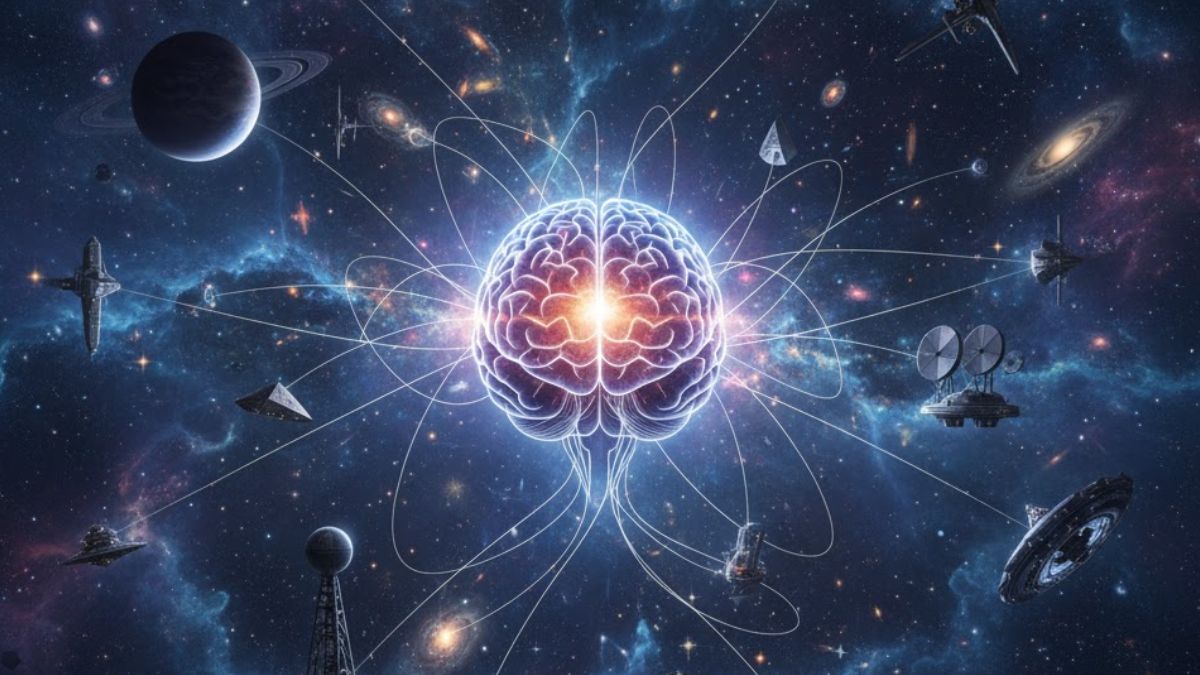
The night sky is a silent, sparkling ocean. For thousands of years, humans have looked up at those tiny points of light and felt a deep, pulling curiosity. Are we the only ones here? Is Earth the only place in this vast, dark expanse where life has taken root? We send out radio signals and powerful telescopes to search for answers, hoping to find a signal, a sign, a footprint in the cosmic sand.
But what if the tools we need aren’t just outside of us, but inside? What if the human mind itself holds a potential, an untapped ability to connect with the universe in a way we don’t yet understand? This idea takes us beyond satellites and antennas into a much more mysterious realm. It asks a question that feels like it’s from a science fiction story, yet is incredibly fascinating to consider.
Could we, in some way, train our own awareness, our consciousness, to sense other civilizations? This isn’t about building a better radio. It’s about exploring the deepest parts of our own perception. If the universe is teeming with life, might there be a way to feel it, to know it, in a way that is more like intuition than a scientific calculation? Let’s explore this captivating possibility together.
What does it mean to ‘sense’ something without our normal five senses?
We rely on our sight, hearing, touch, taste, and smell to understand the world. They are our personal data collectors, telling us everything we know about our environment. But think about other ways we “know” things. You can sometimes feel that someone is watching you, even from behind. A mother might suddenly think of her child just moments before they cry in another room. We call this intuition, a gut feeling, or a hunch.
These experiences suggest that our minds might be capable of picking up on information that doesn’t come through the traditional five senses. It’s a subtle kind of knowing. Now, stretch that idea across the cosmos. If other intelligent beings exist, perhaps they have developed this subtle sense to an incredible degree. Maybe they communicate not with sound waves or written words, but through a direct connection of consciousness. The idea is that the universe might be filled with a kind of mental “static” or a network of thought that we haven’t learned to tune into yet. Training the mind, in this context, would be like learning to find a new station on a radio dial you never knew you had.
How do we currently search for alien life?
Right now, our search for extraterrestrial intelligence, often called SETI, is a hunt for physical evidence. Scientists use enormous radio telescopes to scan the heavens, listening for a pattern, a signal, or a message hidden in the cosmic noise. They look for unusual flickers of light from distant stars that might be caused by gigantic alien structures. They send rovers to Mars to drill into the soil, searching for tiny fossils of ancient microbes.
This work is incredibly important and has taught us so much about our universe. It is built on a solid, scientific foundation. We are looking for proof that we can see, hear, and measure with our instruments. This method is like trying to find a friend in a giant, dark city by shouting and hoping they shout back. But what if your friend is whispering? Or what if they are communicating by flashing a light in a code you don’t understand? Our current tools might miss that entirely. This is where the idea of training the mind comes in—as a potential way to listen for the whispers of the universe.
Is there a connection between the mind and the universe?
This might sound like a strange question, but science has already found some surprising connections. In physics, there is a famous idea called quantum entanglement. It shows that two tiny particles can be linked in such a way that whatever happens to one instantly affects the other, no matter how far apart they are—even across millions of miles. Albert Einstein called it “spooky action at a distance.”
If two particles can be connected across a vast emptiness, what does that say about the fabric of the universe? It suggests that everything might be more deeply interwoven than we can see. Now, consider the human brain. It is one of the most complex structures we know of, a network of billions of neurons firing with electrical and chemical signals. It generates our consciousness, our thoughts, our sense of self. If the universe is fundamentally interconnected, could our conscious minds also be linked to that web in some way? Perhaps a highly trained mind could learn to feel the “tug” of another consciousness elsewhere in that web, just like one entangled particle feels the state of its partner.
What would it mean to ‘train’ your mind for this?
Training the mind to sense other civilizations wouldn’t be like studying for a math test. It would be more like learning a new language or a delicate art form. Think of it as a form of deep mental conditioning. The first and most important step would be learning to achieve a state of profound quiet and focus. Our minds are usually very noisy, filled with a constant stream of thoughts, worries, and plans. This internal noise could be drowning out more subtle signals.
Practices like deep meditation are all about calming this internal storm. By sitting quietly and focusing on your breath or a single point, you learn to let the chatter of your mind settle down. It’s like letting the mud in a muddy pond settle until the water becomes clear. Only when the water is clear can you see what is at the bottom. In the same way, a calm and clear mind might be able to perceive things that a busy, noisy mind cannot. This is the foundational step—creating inner silence to become a better receiver.
Could ancient practices hold a clue?
Long before we had telescopes, ancient cultures around the world spent a lot of time looking inward. They developed sophisticated systems of meditation, prayer, and mindfulness. Many of these traditions speak of accessing higher states of awareness or connecting with a universal consciousness. Yogis in India, for example, describe reaching a state of Samadhi, where the sense of a separate self dissolves and one feels united with everything.
Were these explorers of the inner world stumbling upon the same principle? Were they, in their own way, training their minds to tune into a broader reality? They may not have been thinking about aliens on other planets, but they were seeking a connection to something greater than themselves. Their methods for achieving expanded states of consciousness could be the very blueprint we need. They teach us discipline, focus, and the ability to move beyond the limits of our individual ego, which might be the first step in sensing another intelligence.
What role does imagination and creativity play?
When you read a powerful novel or get lost in a beautiful piece of music, your mind travels to another place. Artists, writers, and musicians often say their best ideas feel like they come from somewhere else, as if they are simply channeling the idea into existence. This spark of creativity is a mysterious and powerful function of the human mind.
What if this is not just a flight of fancy? What if imagination is actually a tool for connection? When we imagine what an alien civilization might be like, we are stretching our minds beyond the known. We are trying to think in a way that is not human. This act of creative stretching could be a form of mental training in itself. By opening our minds to infinite possibilities, we might be making ourselves more receptive to concepts and sensations that are truly foreign. An open, creative mind is a flexible mind, and a flexible mind might be better able to recognize a signal that is utterly unexpected.
What are the biggest challenges and doubts?
It is very important to approach this idea with a healthy sense of doubt. The biggest challenge is that this entire concept cannot be measured with our current scientific tools. How do you prove that a feeling or an intuition is a real connection to an alien mind and not just your own imagination? Without proof, it remains in the realm of philosophy and personal experience.
Our own brains are also very good at playing tricks on us. We see patterns in random clouds, and we can convince ourselves of things that aren’t true. This is called apophenia. Any signal received by the mind would have to be carefully checked and re-checked to ensure it wasn’t just the brain creating its own story. Furthermore, the distances in space are unimaginably vast. The idea that a thought or consciousness could travel across light-years goes against everything we know about physics. These are not small obstacles, and any serious exploration of this idea must honestly confront them.
How would we know if we actually sensed something?
This is the million-dollar question. If you suddenly had a strange thought or a vivid dream about a world with two suns, how would you know it was real? One proposed way is through verification. What if many people, independently and in different parts of the world, all trained their minds and began reporting similar sensations or images? If hundreds of meditators started describing the same symbolic patterns or the same type of non-human intelligence, that would be very difficult to explain as a coincidence.
Another way might be through correlation with physical evidence. Imagine someone, through deep concentration, gets a strong mental image of a specific star system with a planet that has a purple ocean. If astronomers then turned their telescopes to that exact star and, using new technology, confirmed a world with signs of a purple-hued liquid surface, that would be groundbreaking. The mental impression would have provided a testable prediction, bridging the gap between the inner and outer worlds.
What would discovering another civilization this way change about us?
Finding out we are not alone in the universe would be the most profound discovery in human history. But discovering it through a connection of consciousness would change everything we think we know about reality itself. It would mean that the universe is not just a physical place, but also a mental or conscious one. It would prove that life is interconnected in a way that is deeper than biology or physics.
This kind of connection would also bypass all the fears we have about alien contact. There would be no scary ships arriving in our skies. There would be no risk of war over resources. Instead, the first contact would be a meeting of minds. It would be a silent, thoughtful, and peaceful introduction. It would suggest that the highest form of intelligence in the cosmos might not be about building bigger technology, but about achieving a higher state of understanding and connection. It would give us a new direction for our own evolution, not as a species that conquers space, but as one that learns to become a harmonious part of a cosmic community.
The question of whether we can train our minds to sense other civilizations takes us on a journey from the silent practice of meditation to the farthest reaches of space. It challenges the very tools we use to search for truth, suggesting that the ultimate instrument for discovery might be the consciousness that resides within each of us. While this path is filled with mystery and unanswered questions, it opens a door to a universe that is not cold and empty, but potentially alive with connection.
The stars have always called to us. For centuries, we have answered that call by building better lenses and faster rockets. Perhaps it is now time to also answer that call by looking inward, to see if we can hear the universe not just with our ears, but with our minds.
What do you think—is the first message from another world waiting to be found in a radio signal, or could it be waiting to be heard in the quiet of our own thoughts?
FAQs – People Also Ask
1. What is the main goal of training your mind to sense aliens?
The main goal would be to explore a different way of understanding the universe and our place in it. It’s about seeing if human consciousness can connect with other forms of intelligence in a non-physical way, beyond our traditional scientific methods.
2. Has anyone ever claimed to have telepathic contact with aliens?
Yes, some people have claimed to have had telepathic experiences or channeled messages from extraterrestrial beings. However, these claims are highly controversial and are not supported by any verifiable scientific evidence.
3. How is meditation related to finding alien life?
Meditation is a practice for calming the mind and increasing focus. The idea is that a quiet, clear mind might be more receptive to subtle, non-physical information or sensations that our busy minds normally filter out.
4. What is the difference between intuition and a real signal from space?
Intuition is a personal feeling or hunch that is difficult to prove. A real signal would need to be verifiable, such as if multiple people independently received the same specific information that could later be confirmed by scientific observation.
5. Can children sense things adults cannot?
Some believe that children, being more open-minded and less burdened by logical assumptions, might be more receptive to subtle sensations. However, this is also very difficult to prove scientifically.
6. What would an alien thought even feel like?
This is a great mystery. It might not feel like a human thought in words. It could come as a sudden understanding, a complex image, a mathematical pattern, or a pure emotion that is completely foreign to us.
7. Is this idea considered real science?
Currently, the idea of using the mind to sense aliens is not considered mainstream science. It falls into the category of pseudoscience or parapsychology because it lacks testable hypotheses and repeatable evidence according to the scientific method.
8. Could animals be sensing aliens we cannot?
It’s an interesting thought. Animals often perceive the world through senses sharper than our own. There is no evidence for this, but it’s a creative concept to consider if they are aware of things beyond our perception.
9. What kind of mental training would be needed?
The training would likely involve advanced meditation techniques, deep concentration exercises, and practices aimed at expanding self-awareness and quieting the ego, similar to those found in some mystical and philosophical traditions.
10. Would this mean that aliens are also meditating to find us?
It’s a fascinating possibility. If this form of connection is real, then a highly advanced civilization might have mastered this ability long ago. They could be patiently waiting for other species, like us, to become quiet and aware enough to join the conversation.