

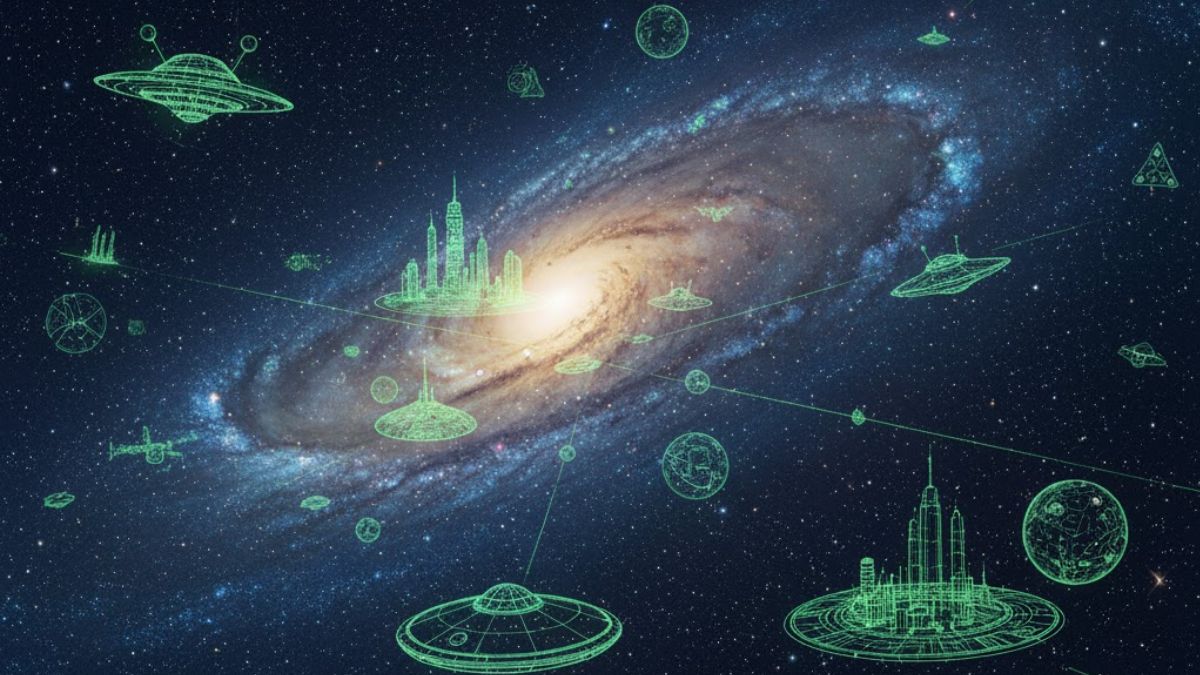
Our galaxy, the Milky Way, is a vast and beautiful collection of stars, gas, and dust. On a clear, dark night, you can see a faint, milky band of light stretching across the sky. This band is the view from our edge-on position within a gigantic cosmic disk. Every single star you can see with your naked eye belongs to this same galactic neighborhood. It’s our home in the universe. But when you look up at that sea of stars, a powerful and ancient question often arises: Are we alone?
This isn’t just a question for science fiction. For the first time in human history, we have the technology to begin searching for a real answer. We are building powerful telescopes that can analyze the atmospheres of distant planets. We are listening for signals that are not just natural cosmic noise. We are actively hunting for signs that we are not the only thinking beings to have looked up at the sky and wondered. The search for other civilizations is one of the most exciting adventures humanity has ever undertaken.
So, just how many other civilizations could be out there, sharing our galaxy with us? The number isn’t zero—we are proof of that. But is it a handful, or are there thousands, even millions, of worlds with their own stories, their own histories, and their own skies filled with stars? To find out, we need to dive into one of the most fascinating ideas in science.
What is the Drake Equation and How Does it Help?
Back in 1961, a scientist named Frank Drake was preparing for a meeting about the search for extraterrestrial intelligence, or SETI. He wanted a way to organize the conversation, to break down the huge question “Are we alone?” into smaller, more manageable pieces. So, he wrote a simple equation on a chalkboard. This equation, now known as the Drake Equation, isn’t a magic formula that gives one right answer. Instead, it’s a framework for thinking about all the factors needed for a civilization to arise and one we could potentially detect.
The equation is like a cosmic checklist. It multiplies a series of probabilities together. Imagine you’re trying to figure out how many people in a big city might become a professional baker. You’d start with the total population. Then, you’d estimate what fraction of those people enjoy cooking. From that group, what fraction decided to get formal training? And from that trained group, how many actually opened a successful bakery? Each step narrows down the number.
The Drake Equation does the same thing for civilizations. It starts with the number of stars in our galaxy. Then it asks: How many of those stars have planets? How many of those planets are in the right spot for life? On how many of those does life actually begin? On how many does that life become intelligent? And finally, for how long do those civilizations send detectable signals into space? The final number you get is an estimate of how many communicating civilizations might exist in the Milky Way right now. The tricky part is that for many of these factors, we are still making our best guesses.
How Many Stars Could Host Planets with Life?
Let’s start with the first ingredient: stars. The Milky Way is home to a staggering number of stars. Current estimates suggest there are between 100 and 400 billion stars. To make the math easy, let’s use 200 billion. That’s 200,000,000,000. It’s a number so large it’s hard to even picture.
For a long time, we didn’t know if other stars had planets like our Sun does. It was a big open question. But thanks to missions like NASA’s Kepler Space Telescope, we now have an answer. Kepler spent years staring at a small patch of sky, watching for the tiny dimming of a star that happens when a planet passes in front of it. What it found revolutionized our understanding of the cosmos. Planets are not the exception; they are the rule.
It turns out that most stars have at least one planet orbiting them. In fact, on average, there is likely more than one planet per star. This means there could be over a trillion planets in our galaxy alone. Suddenly, the playing field for potential life has expanded enormously. We are no longer guessing; we know the galaxy is filled with worlds. But not all these worlds are good candidates for life. A giant ball of gas like Jupiter, or a scorching hot rock like Mercury, probably aren’t very hospitable. We need to look for a special kind of planet.
What is the “Goldilocks Zone” and Why is it So Important?
You might have heard of the “Goldilocks Zone.” Its official name is the “habitable zone,” and it’s one of the most important ideas in the search for life. Think about the story of Goldilocks and the Three Bears. She didn’t want porridge that was too hot or too cold; she wanted one that was just right. Planets are the same way.
The Goldilocks Zone is the region around a star where it’s not too hot and not too cold for liquid water to exist on a planet’s surface. Why is water so important? On Earth, everywhere we find liquid water, we find life. It’s a universal solvent, a key ingredient for the chemical reactions that make life possible. A planet too close to its star would be like Venus, with surface temperatures hot enough to melt lead. Any water would boil away. A planet too far would be like Mars, where water mostly exists as ice.
Finding a planet in this “just right” zone is our first big filter. Our own Earth is perfectly situated in the Sun’s habitable zone. With our current technology, we have already discovered thousands of these exoplanets—planets orbiting other stars—that are in their star’s Goldilocks Zone. Some are rocky, like Earth. Others might be “water worlds” covered in deep oceans. Each one is a potential cradle for life, a place where the story of biology could have begun, just like it did here on Earth.
How Often Does Life Actually Get Started?
This is perhaps the biggest question with the least certain answer. We know that life can start because it did so here on Earth. The fossil record tells us that life appeared on our planet surprisingly quickly after it formed and cooled down. This suggests that given the right conditions, the emergence of life might be a fairly common process in the universe.
But is it? We simply don’t know. Some scientists think that the step from non-living chemicals to a self-replicating organism is a highly probable event. They point to experiments that show how the basic building blocks of life, like amino acids, can form naturally in conditions that mimic the early Earth. If the recipe is common, maybe the result is, too.
Other scientists argue that life’s beginning was a fantastically rare fluke, a one-in-a-trillion accident that might not have happened anywhere else. We only have one example—life on Earth—so it’s impossible to say for sure. This factor in the Drake Equation is a giant question mark. The only way to answer it is to find a second example of life, even if it’s just simple bacteria, on another world. If we find life on Mars, or in the subsurface ocean of Jupiter’s moon Europa, it would tell us that life is not a miracle, but a cosmic imperative. It would mean the galaxy is likely teeming with living worlds.
Would That Life Always Become Intelligent and Technological?
Let’s imagine that simple, single-celled life is common throughout the galaxy. The next step is even more uncertain: how often does that life evolve into intelligent, technology-building beings? On Earth, life stayed as simple microbes for billions of years. The jump to complex, multi-cellular organisms, and then to intelligence, took a very long time.
Intelligence, as we define it, is not a guaranteed outcome of evolution. Evolution favors what works, not necessarily what is smart. Dinosaurs were the dominant form of life on Earth for over 150 million years without, as far as we know, ever developing technology. It was only after a catastrophic asteroid impact wiped them out that mammals got a chance to thrive and eventually lead to us.
So, how many worlds out there have seen life progress from a single cell to a creature that can build a radio telescope or a spaceship? It might be very common, or it might be incredibly rare. Perhaps on most worlds, life stays in the oceans as clever octopus-like creatures, or never progresses beyond the stage of simple animals. Or perhaps intelligence does arise often, but it takes different forms we can’t even imagine. This is another huge filter that could drastically reduce the number of potential civilizations.
How Long Do Civilizations Last Before They Disappear?
The final factor in the Drake Equation is perhaps the most sobering. It asks: What is the average lifetime of a technological civilization? In other words, how long does a civilization like ours survive once it develops the technology to communicate across the stars?
A civilization could end for many reasons. It could destroy itself through war, climate change, or a technological accident. It could be wiped out by a natural disaster like a gamma-ray burst or a super-volcanic eruption. Or, it might simply evolve beyond the need for broadcast technology, moving to a form of communication we can’t detect.
Think about our own civilization. We’ve only had the ability to send radio waves into space for about a hundred years. In that short time, we have also developed weapons that could destroy our global society. Are we a civilization that will last for 10,000 years, or will we be a brief, hundred-year flicker in the cosmic record? If most civilizations destroy themselves quickly after discovering radio technology, then the galaxy might be full of the silent ruins of societies that didn’t last long enough to find each other. But if even a small number of civilizations learn to survive and thrive for millions of years, then the galaxy could be a busy and ancient place.
So, What is the Final Number?
When you plug in all the numbers—from the very optimistic to the very pessimistic—the answers from the Drake Equation vary wildly. Some calculations suggest there could be just one civilization in the galaxy: us. This is a lonely but possible answer. Other, more optimistic estimates suggest there could be tens of thousands, or even millions, of civilizations scattered among the stars.
The famous astronomer Carl Sagan, using his own estimates, once calculated that there might be up to a million civilizations in the Milky Way. More recent and conservative scientists, considering how difficult each step might be, suggest the number might be closer to a few dozen. The truth is, we don’t know. The equation shows us what we need to look for. Every new exoplanet we find in a habitable zone gives us more data. Every mission that searches for life in our solar system helps us understand the probability of life starting.
The real value of the Drake Equation isn’t in a final number. It’s in the journey of discovery it inspires. It forces us to think about our place in the cosmos, the fragility of our civilization, and the incredible potential that lies within our vast and wonderful galaxy. The search itself is what matters.
Conclusion
Gazing up at the Milky Way will never be the same once you’ve considered the possibilities. Each tiny point of light is a sun, and many of those suns have families of planets. On some of those planets, oceans may wave against alien shores, and in those oceans, life may have begun its long, slow dance. On a fraction of those, beings with their own cultures, art, and science might be looking back at our star, asking the very same question we are: Is anyone out there?
The universe has given us a galaxy with hundreds of billions of stars and trillions of planets. The raw materials for life are everywhere. The potential is immense. The silence we hear so far may not be a sign of emptiness, but simply a sign of the vast distances and brief timescales we are dealing with. We are just beginning to listen.
What do you think? When we finally make contact, will it be with a civilization that is young and struggling like ours, or with an ancient intelligence that has watched the galaxy evolve for eons?
FAQs – People Also Ask
1. How many planets are in the Milky Way galaxy?
Scientists estimate that there are likely more planets than stars in our galaxy. With between 100 and 400 billion stars, this means there could be over a trillion planets in the Milky Way alone.
2. What is an exoplanet?
An exoplanet is simply a planet that orbits a star outside of our own solar system. Thousands of exoplanets have been confirmed, and they come in many different types, like gas giants, ice giants, and rocky planets similar to Earth.
3. Has NASA found a planet like Earth?
NASA has found several exoplanets that are Earth-sized and located within their star’s habitable zone, often called “Earth cousins.” However, we have not yet found an exact “Earth twin” with a similar atmosphere and conditions, but our telescopes are getting closer to being able to detect these signs.
4. Can we see planets in other galaxies?
Seeing individual planets in other galaxies is currently impossible with our technology because of the enormous distances involved. All the exoplanets we have discovered so far are located within our own Milky Way galaxy.
5. What would aliens actually look like?
This is a great question for imagination! While science fiction often shows human-like aliens, real extraterrestrial life would have evolved to suit its own environment. It could look like anything—from simple blobs or complex insect-like creatures to forms we can’t even conceive of.
6. What is SETI?
SETI stands for the “Search for Extraterrestrial Intelligence.” It is a collective term for scientific efforts to detect evidence of technological civilizations, usually by searching for artificial radio or laser signals coming from space.
7. Why is water so important for finding life?
Water is crucial because it dissolves nutrients and allows for the chemical reactions that life is based on. On Earth, every known form of life requires water to survive, so it’s the most logical place to start our search elsewhere.
8. What is the closest exoplanet to Earth?
The closest known exoplanet is Proxima Centauri b, which orbits the star Proxima Centauri, the closest star to our Sun. It’s about 4.2 light-years away and is located in its star’s habitable zone.
9. Could we ever travel to another star?
With our current technology, a journey to even the nearest star would take tens of thousands of years. However, scientists are researching new propulsion technologies, like nuclear fusion or light sails, that could one day make such an incredible journey possible, though it remains a tremendous challenge.
10. What would happen if we found a signal from aliens?
There is a formal international protocol in place. The first step would be to verify the signal is truly artificial and from beyond Earth. Scientists would then alert the global astronomical community, and the discovery would be publicly announced. Governments and organizations would work together to decide on a response, if any.