

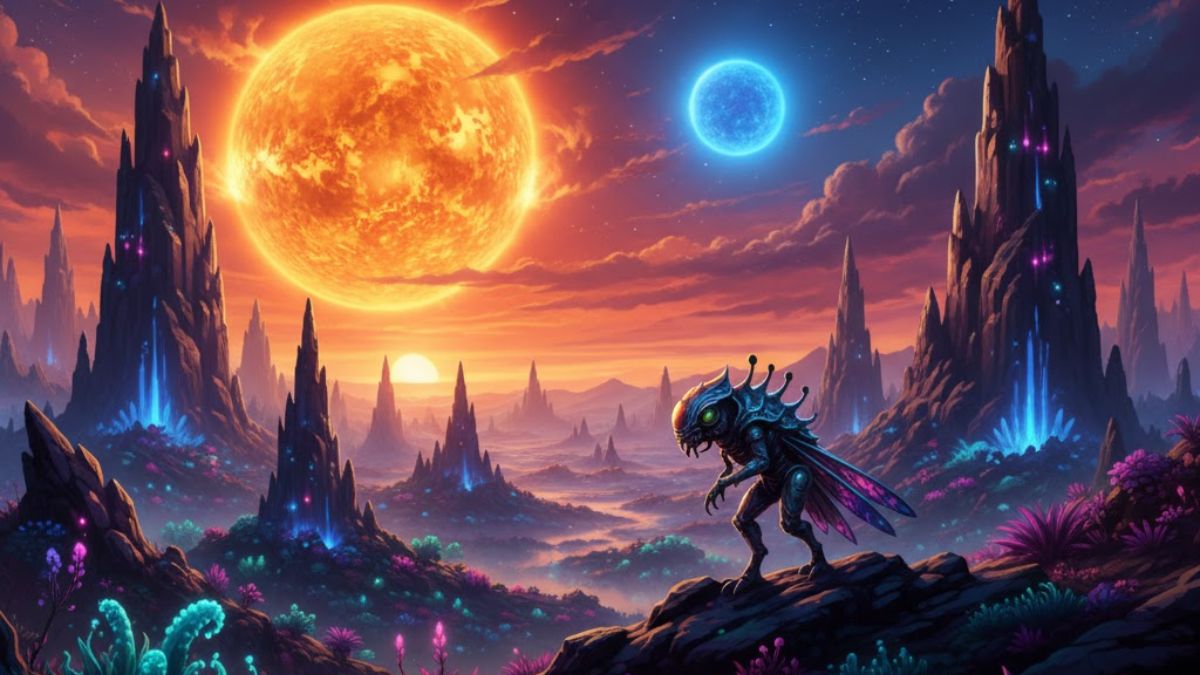
For most of human history, we’ve lived under the gentle, reliable rhythm of a single sun. It rises in the east, sets in the west, and gives us our days, our seasons, and the very light that makes life possible. Our entire concept of time is built around this one star. But what if our sky told a different story? What if, when we looked up, we saw not one, but two brilliant suns hanging in the heavens?
This isn’t just science fiction. Astronomers have discovered thousands of planets orbiting double-star systems. They have names like “Tatooine” from Star Wars, but these real worlds are called “circumbinary planets.” They are places where the sky is governed by a complex dance of two stars, casting ever-changing light and shadows on the landscape below. The rules of day and night, summer and winter, would be completely rewritten.
Thinking about life on such a world opens up a universe of fascinating possibilities. How would plants adapt? What would the weather be like? And what would it be like to stand on the surface and watch two suns move across the sky? Let’s take a journey in our minds to a planet with two suns and explore what daily life might truly be like.
What would the sky look like with two suns?
The first thing you would notice on this alien world is the sky itself. It would never look the same way twice. The view would depend entirely on the types of stars in your system and how they move around each other. You might have two stars that are very close together, appearing as a single, long peanut of light in the sky. Or, you might have one large, bright sun and one smaller, dimmer one, looking like an eternal sunrise and sunset happening at the same time.
Imagine stepping outside on a clear morning. Instead of one source of light, you see two distinct suns, one perhaps yellow like our own, and the other a cooler, orange glow. They would rise and set at different times, creating incredibly long periods of daylight. Your shadows would be a constant companion, but a confusing one. With light coming from two directions, you wouldn’t have one dark, sharp shadow. Instead, you might have two faint shadows stretching in different directions, or a blurry, soft shadow all around you. The colors of the sky would be a painter’s dream. Sunsets and sunrises could last for hours, with blends of purple, orange, and deep red as the two suns dip below the horizon at different times. The concept of “noon” might not exist, as the light would always be shifting and changing.
How would two suns change the weather and seasons?
If you think Earth’s weather can be unpredictable, a planet with two suns would have a climate beyond our wildest imagination. The temperature would be a constant rollercoaster. When both suns are high in the sky, the planet would bake under intense heat. This double-dose of sunlight would create incredibly powerful weather systems. The winds would be fierce, driven by massive temperature differences across the planet. Storms would be frequent and potentially devastating, with hurricanes of a size and strength we can barely comprehend.
The seasons would be even more complex. They wouldn’t be a simple cycle of spring, summer, autumn, and winter. They would depend on the orbit of the planet around the two stars and the orbit of the stars around each other. You might have a relatively normal season when the planet is far from both stars, followed by a “double-summer” when the planet is close to both, creating a super-heated period. There could also be a time when one star is blocked by the other, casting the planet into a long, cold twilight for weeks or months. Life on this world would have to be incredibly resilient to survive these dramatic and chaotic shifts in climate.
Could plants and animals exist on a two-sun world?
Life is tenacious and finds a way to adapt to the most extreme conditions. On a planet with two suns, plants would look very different. With so much available light, they might not need broad, flat leaves to catch sunlight like Earth’s plants. Instead, they might develop narrow, reflective leaves or even protective coatings to shield themselves from the harmful radiation of two stars. The color of plants might not be green. They could be black to absorb every bit of light, or shades of grey and purple to protect themselves.
Animals would have evolved unique features to cope with the strange environment. To protect their eyes from the double glare, creatures might have extra sets of eyelids or eyes that are permanently shaded by large brow ridges. Nocturnal animals would have a very short window to be active, as true darkness might be a rare event. The entire food chain would be built around surviving the extreme heat and the potentially long periods of lower light. Life would likely be tough, hardy, and very different from the fluffy or furry animals we know on Earth.
What would a day be like for a person living there?
For any intelligent beings living on this world, their entire culture and daily routine would be shaped by the two suns. Your sense of time would be completely different. A “day” might not be 24 hours. It could be much longer, followed by a very short night. Or, the planet might be tidally locked, with one side in permanent daylight and the other in permanent darkness, forcing civilization to exist only in the “ring of twilight” in between.
Building architecture would be designed for maximum shade and temperature control. Cities might be built underground or with deep, covered streets to escape the scorching heat of the twin suns. The calendar would be incredibly complex, based on the orbits of two stars instead of one. Holidays and seasons would be calculated by astronomers, not by simple observation. The stories, art, and religions of these people would undoubtedly revolve around their two life-giving, and sometimes life-threatening, suns. Their entire understanding of the universe would be based on a binary system, a concept that would feel as natural to them as our single sun feels to us.
Could our Earth have a twin sun?
Our solar system is a single-star system, and it is very stable. The Sun is a solitary star, which has been a key factor in allowing life to develop and thrive on Earth in a relatively calm environment. The chances of another star wandering into our system and settling into a stable orbit are astronomically small. Such an event would be catastrophic, as the gravitational pull of a second sun would likely throw the planets out of their orbits, sending Earth spiraling into the frozen outer solar system or directly into the sun.
So, while it’s a fun idea to imagine a second sun lighting up our sky, the reality is that it would probably destroy the delicate balance that makes our home possible. We are lucky to have one, steady, reliable sun. It gives us a stable climate, predictable seasons, and a consistent cycle of day and night that has nurtured life for billions of years. The existence of planets with two suns shows us just how diverse and weird the universe can be, and it makes our own, simpler solar system seem all the more special.
Living on a planet with two suns would be a life of dramatic beauty and constant challenge. It would be a world of double sunrises, chaotic weather, and life forms built for survival above all else. While we may never set foot on such a world, imagining it helps us appreciate the incredible variety of planets that must exist in the cosmos. It expands our idea of what is possible and reminds us that our own experience of the universe is just one version of reality. If you could design your own perfect planet, what would it look like? Would you choose the exciting chaos of two suns, or the peaceful reliability of one?
FAQs – People Also Ask
1. Can a planet really have two suns?
Yes, absolutely. Astronomers have discovered many planets in binary star systems. These are real planets that orbit two stars instead of one, and they are often called “Tatooine planets” after the famous world in Star Wars.
2. What would happen if Earth had two suns?
If Earth suddenly had two suns, it would be disastrous. Our climate would become extremely hot and unstable, ice caps would melt causing massive flooding, and the gravitational pull could knock Earth out of its stable orbit, making life as we know it impossible.
3. How many suns can a planet have?
A planet can, in theory, have more than two suns. Scientists have found planets in systems with three stars. In such a system, the planet would orbit one or two of the stars, while the other stars orbit farther away, creating a very complex pattern of light in the sky.
4. Do two suns mean twice the sunlight?
Not always. It depends on the size and brightness of the stars. A planet could have one bright sun and one dim sun, so the total light might not be double. However, when both suns are in the sky, the planet would certainly receive much more light and heat than Earth does.
5. Is there a planet with two suns in our galaxy?
Yes, there are many planets with two suns right here in our own Milky Way galaxy. The first one discovered was Kepler-16b, and since then, missions like the Kepler Space Telescope have found several more.
6. How long is a day on a planet with two suns?
The length of a day would be very strange and unpredictable. It could be much longer than an Earth day, and the cycle of light and dark would be constantly changing based on the movement of the two stars, meaning some days might not have a night at all.
7. Could we see two sunrises and two sunsets?
Yes, that is a very likely scenario. You could witness one sun rise, followed hours later by the second sun rising. The same would happen at dusk, with one sun setting and then the other, creating very long periods of twilight.
8. Would there be any night on a two-sun planet?
It depends on the system. In some setups, the planet might experience a short night when both suns are below the horizon. In other systems, the stars might be so close that one is always in the sky, meaning true darkness would never occur.
9. What color would the sky be with two suns?
The color of the sky would depend on the stars’ colors. If you had a yellow sun and a red sun, the sky might be a permanent orange or salmon color. The sunsets would be spectacular blends of multiple colors lasting for hours.
10. Could humans ever live on a planet with two suns?
It would be extremely challenging. Humans would need to build protected habitats to shield themselves from the intense radiation and wild temperature swings. Finding water and growing food would also be major hurdles, making long-term survival very difficult without advanced technology.