

For a long time, when we imagined aliens, we pictured beings living on a world much like our own. They might be on a planet with warm sunshine, green land, and lots of liquid water. We looked for planets in the “Goldilocks Zone” around their stars, where temperatures are just right for water to flow. But what if we are looking in the wrong places? What if the most common kind of alien life is not on the surface at all, but hidden away in the most unexpected of places: deep under thick, frozen ice.
Our own solar system is showing us that we need to think differently. Far from the Sun, where sunlight is just a faint star in a black sky, there are worlds that look like frozen marbles. But scientists are discovering that these icy moons are not just dead balls of rock and ice. They are hiding a secret. Beneath their frozen, cracked surfaces, there are vast, dark, global oceans—more water than exists on the entire Earth. This discovery has completely changed the way we think about where life could exist.
If life can start and thrive in the sunlit oceans of Earth, could it also do the same in the eternal darkness under a miles-thick ceiling of ice? The possibility that aliens could evolve beneath ice oceans is one of the most exciting ideas in science today. It means life might be much more common in the universe than we ever dreamed. So, what would it take for life to not just survive, but truly flourish, in such a strange and sunless world?
What are these ‘ice ocean worlds’ we keep finding?
When you look at a map of our solar system, the planets beyond Mars seem like distant, frozen wastelands. But some of the most interesting places are not the planets themselves, but the moons that orbit the gas giants like Jupiter and Saturn. Think of Jupiter as a mini solar system of its own, with dozens of moons dancing around it. Two of these moons, Europa and Ganymede, along with Saturn’s moon Enceladus, are the rock stars of this new search for life.
These moons are not warmed by the Sun. Instead, they are heated from the inside out by a powerful force called gravity. As these moons orbit their giant planets, the planet’s immense gravity constantly stretches and squeezes the moon’s rocky core. This process, known as tidal heating, creates a tremendous amount of friction and heat. It is this internal heat that keeps their vast subsurface oceans from completely freezing solid, even though the surface temperature is hundreds of degrees below zero.
We have seen amazing evidence of these hidden oceans. The Hubble Space Telescope has observed what look like giant plumes of water vapor spraying out from cracks in the surface of Europa. The Cassini spacecraft flew right through similar plumes erupting from Enceladus, and it analyzed the water, finding that it was salty and contained organic molecules—the building blocks of life. So, we are not just guessing these oceans are there; we have proof. They are real, watery environments, trapped between a rocky floor and a thick, icy sky.
How could life possibly survive without any sunlight?
On Earth, almost every food chain is built on a foundation of sunlight. Plants use photosynthesis to turn sunlight into energy, and then animals eat the plants. So, the idea of a thriving ecosystem in a place where the sun has never shone seems impossible. But our own planet has already shown us another way. Deep at the bottom of our oceans, at cracks in the seafloor called hydrothermal vents, life exists in total darkness.
These vents spew out superheated, mineral-rich water from inside the Earth’s crust. They are like geysers on the ocean floor. Microbes that live there don’t need the sun. Instead, they perform a trick called chemosynthesis. They use the chemicals from the vent—like hydrogen sulfide—as their source of energy, just like plants use sunlight. These microbes form the base of a whole food web that includes giant tube worms, strange clams, and unique shrimp.
An ice ocean world could work in the exact same way. At the bottom of its dark ocean, where the water meets the rocky core, there could be hydrothermal vents just like on Earth. The tidal heating that keeps the ocean liquid could also power these vents, providing a steady supply of heat and life-giving chemicals. In this scenario, the energy for life doesn’t come from above, from a star, but from below, from the moon’s own hot heart. Life there would be completely independent of the sun, thriving in a world of perpetual night.
What would aliens in a dark, underwater world look like?
Trying to imagine what these potential aliens might look like is a fascinating exercise. Their appearance would be shaped entirely by their environment. Since their world is pitch black, sight might be much less important, or they might not have eyes at all. Other senses would become far more critical for navigating and finding food in the endless dark.
We can get some ideas by looking at the creatures that live in the deepest, darkest parts of Earth’s oceans. Many deep-sea fish have developed a heightened sense of touch or can detect the slightest movement in the water. They might use a form of sonar, like dolphins or bats, to “see” their surroundings by making sounds and listening for the echoes. Some creatures on Earth even produce their own light through bioluminescence—creating glowing patterns on their bodies to attract mates, lure prey, or confuse predators.
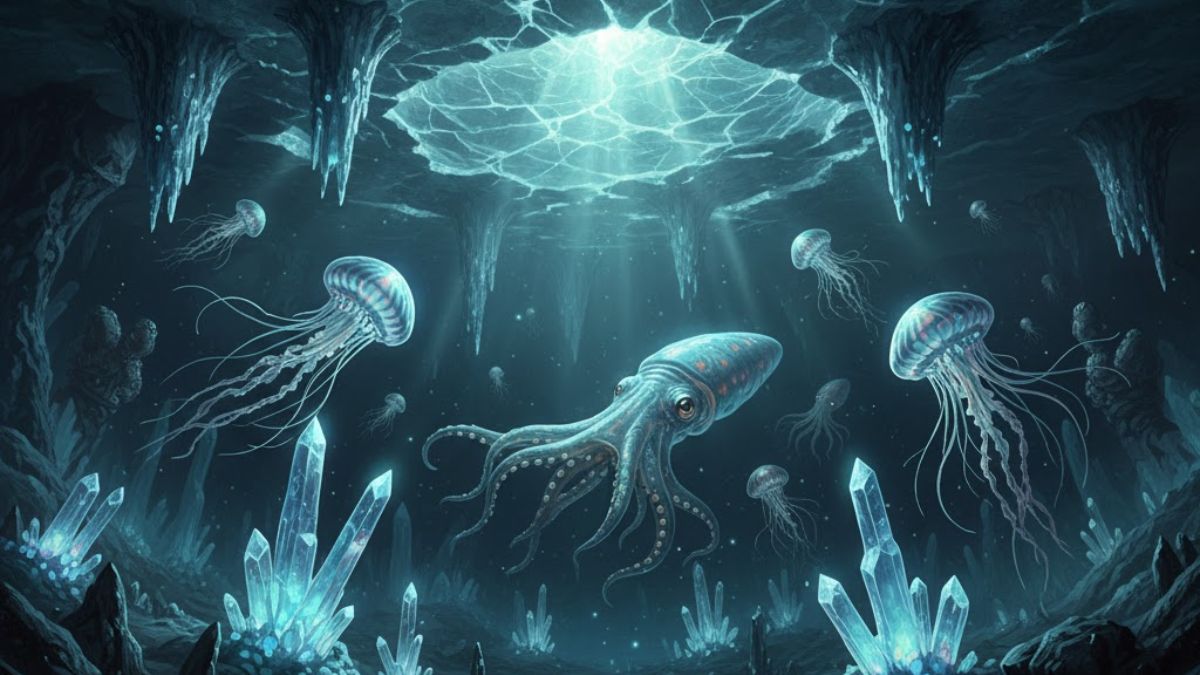
An alien in an ice ocean could be a soft-bodied creature, perhaps similar to a giant squid, since there are no hard surfaces to bump into. They might be slow-moving to conserve energy in a world where food could be scarce. Their color would likely be pale or even transparent, as there would be no need for camouflage from sunlight. They wouldn’t need to be strong swimmers fighting against waves, but they might need to be tough enough to handle immense water pressure near the ocean floor. They would be perfectly adapted to a life of quiet, cold, and darkness.
What are the biggest challenges to life under the ice?
Living under a miles-thick shield of ice is not easy. One of the biggest challenges is energy. On Earth, we have an abundance of energy from the Sun. In an ice-covered ocean, energy sources would be limited to what leaks out from the rocky core. This means the total amount of life, or its biomass, might be much smaller. The ecosystem could be more like a sparse desert than a lush rainforest, with creatures spread very far apart.
Another major challenge is the availability of nutrients. For life to get started and keep going, it needs a good mix of chemicals. While hydrothermal vents can provide many key ingredients, other important elements might be locked away in the ice above or the rock below. If the chemical soup isn’t quite right, life might never begin. Or, if the vents become inactive, the entire ecosystem could collapse, as it would lose its main source of energy and nutrients.
The environment itself is also incredibly harsh. The pressure from the weight of all that water and ice above would be crushing. The temperature, while liquid, would be just above freezing. There is also no access to the surface, which means no atmosphere and no way for any waste products to escape. It is a completely closed system. Any life that exists there would have to be incredibly resilient, possibly growing and reproducing at a very slow pace, perfectly tuned to survive in one of the most extreme environments we can imagine.
How are we searching for life on these distant moons?
We are not just thinking about these alien oceans; we are actively planning missions to explore them. NASA is working on a spacecraft called the Europa Clipper, set to launch in the next few years. Its job is not to land on Europa but to fly close by it many times. It will use powerful instruments to map the ice shell, measure the depth and salinity of the ocean, and study those plumes of water vapor. It will help us understand if Europa’s ocean is habitable.
The next, even more exciting step is to land on the surface and touch the ice. Scientists are designing concepts for a future Europa Lander. This robot would drill or melt its way through the ice, perhaps only a few inches, to analyze the ice for any signs of past or present life. It could look for the frozen remains of microbes or complex organic molecules that would tell us life is, or was, there.
Perhaps the most ambitious idea is to send a probe that could actually get into the ocean. Imagine a robotic submarine, or “cryobot,” that could melt its way all the way through the icy crust and then release a small underwater vehicle. This aquatic robot would then be free to swim in the alien sea, sampling the water, looking for microbial life, and even sending back pictures of whatever it might find. While this mission is a long way off, the technology is being developed today, bringing us closer than ever to answering the ultimate question.
Could intelligent life exist in such a place?
When we talk about life under the ice, we are most likely talking about microbes, or maybe something like fish or squid. But could intelligence evolve? It is not impossible, but it seems very unlikely. On Earth, intelligence evolved in social, tool-using creatures that lived in a complex and changing environment. The deep ocean under the ice is a very stable and uniform place. There are no seasons, no days and nights, and no forests to build shelter in.
Without hands or similar appendages, it is hard to imagine a creature being able to manipulate its environment to create tools or technology. How would a squid-like alien smelt metal or create electricity in a salty, watery world? Furthermore, without fire, the entire path of technological development that humans followed would be closed to them. Their intelligence might be more emotional or social, used for complex communication and cooperation to find food, rather than for building a civilization.
Their world also traps them. Even if a species did become intelligent and curious, they are imprisoned under a ceiling of ice that could be ten or twenty miles thick. They would have no knowledge of a universe beyond their ocean, no stars to look at, and no concept of a world outside their own. Their entire reality would be the dark, cold water. Their intelligence would be focused entirely on surviving and understanding their immense, but limited, underwater universe.
What would finding life under the ice mean for us?
If we one day send a probe to Europa or Enceladus and it finds even a single, tiny microbe that is clearly alien, it would be a discovery that shakes the world. It would prove once and for all that life is not a unique miracle confined to Earth. The universe would suddenly become a living universe, filled with potential. If life could start independently in two different places in our one small solar system, then it is probably common everywhere.
This discovery would tell us that the recipe for life is written into the fundamental laws of chemistry and physics. Given the right ingredients—water, energy, and the right elements—and enough time, life seems to emerge. This would give us great confidence that life exists on countless worlds around other stars, and that we are not alone in the vast cosmic ocean.
Finding any life, even the simplest kind, would also completely change our future. It would drive a new age of exploration, with a clear mission to find and study other life forms. It would raise profound questions about our place in the universe. Are we the rule or the exception? Is intelligent life common, or are we a rare fluke? The answers would be hidden in the dark, cold waters of a small, icy moon, waiting for us to find them.
The search for life under the ice is more than just a scientific quest; it is a journey to understand what it means to be alive. These hidden oceans, so close and yet so far, challenge our imagination and push us to explore the final frontiers of our own solar system. They remind us that life is tenacious and creative, and that the universe is always full of surprises.
FAQs – People Also Ask
1. Which moons in our solar system have underground oceans?
The most famous moons with suspected or confirmed subsurface oceans are Jupiter’s moons Europa, Ganymede, and Callisto, and Saturn’s moons Enceladus and Titan. Scientists also suspect that other distant objects, like Pluto, might have similar oceans.
2. How do we know these moons have water if we can’t see it?
We have strong indirect evidence from spacecraft. For example, we’ve seen giant plumes of water vapor shooting into space from Enceladus and Europa. We also measure how these moons slightly wobble in their orbits, which tells us they have a sloshing liquid layer inside, and we study their magnetic fields, which can be influenced by a salty, global ocean.
3. Could there be giant sea monsters in these oceans?
While it’s fun to imagine, it’s very unlikely. The environment is extreme, with limited energy and nutrients, so life would probably be small and slow-moving, like microbes or perhaps something similar to shrimp or jellyfish. Large, complex predators probably wouldn’t have enough food to survive.
4. Why is water so important for life?
Water is often called the “universal solvent” because it can dissolve so many different substances. This allows it to carry nutrients into cells and carry waste out. It also helps in the chemical reactions that life depends on. Basically, it’s the perfect liquid for mixing the ingredients of life together.
5. How thick is the ice on a moon like Europa?
Scientists are still trying to figure out the exact thickness, but estimates suggest Europa’s ice shell is between 10 and 20 miles thick. For comparison, the deepest ice on Earth, in Antarctica, is less than 3 miles thick.
6. What is the temperature in these underground oceans?
The temperature at the very top of the ocean, right under the ice, would be close to freezing. However, at the very bottom, where the ocean meets the rocky core and possible hydrothermal vents, the water could be much warmer, even hot, due to the moon’s internal heat.
7. Could humans ever visit these ice ocean worlds?
A human visit is a very long way off due to the incredible challenges. The journey takes years, the surface is bathed in harmful radiation, and drilling through miles of ice in a foreign environment is beyond our current technology. For now, we will explore these places with smart, hardy robots.
8. What is the difference between an ice giant like Uranus and an ice moon like Europa?
An ice giant like Uranus is a massive planet made mostly of ices like water, ammonia, and methane, with a small rocky core. An ice moon like Europa is a much smaller rocky body that is covered by a thick layer of water ice, with a liquid ocean hidden beneath that ice.
9. If we find life there, could it be dangerous to Earth?
Any mission that goes to these moons is built with planetary protection in mind. This means spacecraft are sterilized to make sure we don’t contaminate these worlds with Earth germs. If we find life, scientists would study it with extreme caution, but the chance of it being a danger to Earth is considered extremely low, as it would be adapted to a completely different environment.
10. When will we know for sure if there is life there?
We won’t know for sure until we send a dedicated life-detection mission, which is at least 10 to 20 years away. The upcoming Europa Clipper mission will tell us a lot about how habitable the ocean is, but it will take a lander or an underwater probe to finally give us a definitive answer.