

In the quiet of a clear night, when you look up at the stars, it’s hard not to feel a sense of wonder. Each tiny point of light is a sun, and many of those suns have planets of their own circling them. Scientists now believe there are more planets in our galaxy than there are grains of sand on every beach on Earth. With so many worlds, the question isn’t just “Are we alone?” but “If others are out there, what would they be like?” How could we even begin to understand a civilization so different from our own?
Back in 1964, a Russian astronomer named Nikolai Kardashev asked himself this very question. He knew that any society, no matter how strange its biology or culture, would need one thing to survive and grow: energy. The ability to harness power—to light cities, fuel ships, and run computers—would be the true measure of its advancement. From this simple but powerful idea, he created a thought experiment, a way to classify civilizations not by their looks or language, but by their energy consumption. This idea became known as the Kardashev Scale.
It’s not a list of real civilizations we have found. Instead, it’s a map of possibilities, a guide to what might be out there in the vast cosmic ocean. It stretches our imagination and helps us think about the ultimate destiny of humanity itself. It makes you wonder, if we ever did pick up a signal from the stars, what kind of power would be behind it?
What is the Kardashev Scale in simple terms?
Think about the history of humanity. A thousand years ago, we used the muscles of people and animals, along with simple water wheels and windmills. Then, we learned to burn wood and coal. Later, we tapped into oil and gas. Today, we are starting to capture the power of the sun and the atom. Our entire story can be told through our growing mastery of energy.
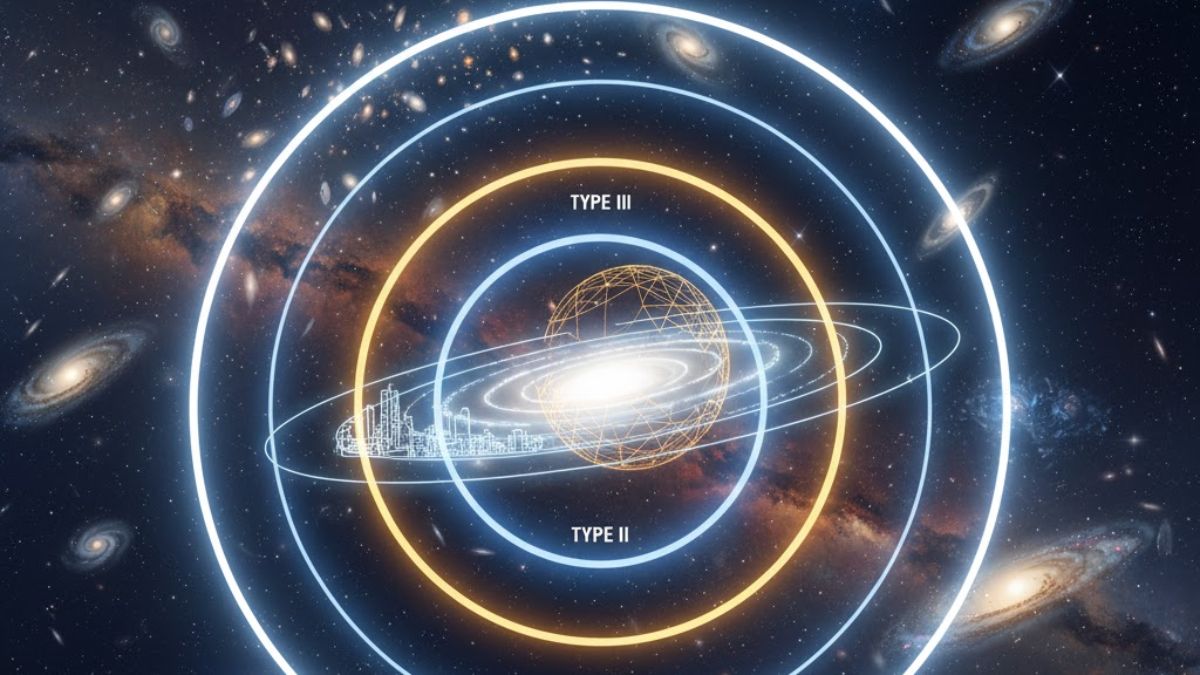
The Kardashev Scale takes this idea and applies it to the whole universe. It’s a way of grouping imaginary alien civilizations into three main types based on how much energy they can use. The scale is simple: a Type I civilization can use all the energy that reaches its home planet from its sun. A Type II civilization can harness the entire energy output of its sun. A Type III civilization can control the energy of its entire galaxy. It’s a way of measuring a civilization’s “power level” on a cosmic stage. It helps us imagine not just what aliens might look like, but what they might be capable of building and doing.
Who created this scale and why?
The mind behind this cosmic ruler was Nikolai Kardashev. He was a brilliant astronomer working at the Soviet Union’s leading space research institute at a time when humanity was first reaching into space. In 1964, the search for extraterrestrial intelligence, or SETI, was just beginning. Scientists were starting to point radio telescopes at the stars, hoping to hear a signal.
Kardashev thought about what kind of signal we should be listening for. He realized that a truly advanced society would be broadcasting with immense power, perhaps using energy on a scale we could barely imagine. To help focus the search, he proposed his scale as a tool for thinking about what to look for. He wasn’t trying to prove these civilizations existed; he was creating a framework to guide our imagination and our scientific efforts. He wanted us to consider the most extreme possibilities, to open our minds to engineering projects that could span stars.
What exactly is a Type I Civilization?
A Type I civilization is a planetary civilization. It has achieved complete mastery over its home world. This doesn’t just mean they have global internet and international travel. It means they can control the weather, they have tapped into the planet’s heat from its core, and they can harvest every single bit of sunlight that falls on their world. They can probably also control volcanoes and earthquakes.
For a real-world comparison, think about all the solar energy that hits the Earth. Right now, we only capture a tiny, tiny fraction of it. A Type I civilization would have solar panels covering deserts, floating on oceans, and even in orbit, beaming energy down. They would have such a deep understanding of their planet that they could prevent natural disasters or use them for power. On this scale, humanity is not even a full Type I yet. We are currently a Type 0 civilization, still getting most of our energy from dead plants and animals (fossil fuels) buried in the ground. But we are slowly, steadily, inching our way toward becoming a true planetary civilization.
How powerful is a Type II Civilization?
If a Type I civilization is the master of a planet, a Type II civilization is the master of a star. This is a leap in power that is almost impossible to picture. A Type II civilization doesn’t just live on planets around their sun; they use their sun as a direct power source. The most famous idea for how they might do this is something called a Dyson Sphere.
Imagine a vast structure, a swarm of millions of giant solar panels, completely surrounding the sun. This swarm would capture every single photon of light the star emits. None of that precious energy would be wasted into empty space. With that much power, a Type II civilization could do things that seem like magic to us. They could move planets to different orbits to create perfect climates. They could travel easily throughout their star system. They might even start engineering the star itself, perhaps to make it burn longer or to change its color. If we ever looked at a distant star and saw its light flicker in a strange way because it was partially covered by giant structures, that could be our first evidence of a Type II civilization.
What does a Type III Civilization look like?
A Type III civilization is on a whole other level. This is a galactic empire. They have spread across their entire galaxy, much like how humans have spread across the Earth. Their energy needs are so colossal that a single star is not enough. They harness the power of billions of stars.
Think of the Milky Way, our own galaxy. It’s a swirling disk containing over 100 billion stars. A Type III civilization would have outposts, colonies, or energy collectors around a significant number of those stars. They might travel through wormholes or use other physics we can’t yet understand. They could build rings around black holes to siphon their incredible energy. Their constructions would be visible from across the universe. From our perspective, their activities might look like natural cosmic events. If such a civilization exists, its signature might be written across the sky in ways we are only just learning how to look for. Their power is so vast that to them, a Type II civilization might look like a small village, and a Type I like a single household.
Could there be even more advanced types?
The original scale only went up to Type III, but scientists and science fiction writers love to push ideas to the limit. They have speculated about what might come next. A Type IV civilization would be truly terrifying in its power. This civilization would not be limited to a single galaxy. It would tap into the energy of the entire visible universe. They might manipulate dark energy or create their own baby universes.
Some even talk about a Type V civilization, where the beings would have power over multiple universes, operating on a scale that belongs to the realms of philosophy and religion more than science. These concepts are not based on any known physics. They are thought experiments that help us explore the ultimate limits of what might be possible. They show us that the Kardashev Scale is not a fixed ladder but a doorway to infinite imagination, asking what the ultimate destiny of intelligence in the cosmos could be.
Where is humanity on the Kardashev Scale?
So, where do we fit into this grand cosmic picture? As mentioned, we are currently a Type 0 civilization. We get our energy from plants, fossil fuels, and we are just starting to use wind, solar, and nuclear power in a significant way. The famous astronomer Carl Sagan took Kardashev’s idea and refined it, creating a formula to calculate our exact position. According to his calculations, humanity sits at about 0.73 on the Kardashev Scale.
We are still a very, very long way from becoming a Type I civilization. To get there, we would need to increase our energy production by a factor of 100,000. We would also need to learn to control our planet’s systems in a way that avoids self-destruction. Our progress is not just about technology; it is about wisdom. Can we solve our problems with climate change, war, and resource sharing? Reaching Type I is the greatest challenge our species has ever faced, but it is a goal that could unite all of humanity in a common project: the careful and responsible management of our precious planet.
Why is this scale important for our future?
The Kardashev Scale is more than just a fun way to think about aliens. It is a mirror that shows us our own potential and our own fragility. It gives us a long-term goal, a vision for a future that is almost unimaginably bright. It pushes us to think about sustainable energy on a global scale, because that is the first and most important step on the cosmic ladder.
It also helps us in our search for other life. When our telescopes scan the heavens, we now have a better idea of what to look for. We are not just looking for little green men. We are looking for giant engineering projects—megastructures—that would block the light of a star, or for galaxies that glow with a strange, unnatural heat signature. The scale turns the search for aliens from a fantasy into a serious scientific pursuit with a clear direction. It tells us that the universe might be filled with silent, dark worlds like ours, or it might be blaring with the energy of civilizations whose power we can barely comprehend.
A Final Thought
The Kardashev Scale paints a picture of a universe filled with potential, a cosmos where the journey of life and intelligence could lead to powers that reshape stars and galaxies. It reminds us that our current squabbles and problems are the struggles of a very young species taking its first steps. We are huddled around a small campfire on a tiny planet, only just beginning to understand the immense darkness around us, and the incredible possibilities it holds.
The scale doesn’t just ask if there are gods out there among the stars. It asks if, given enough time and wisdom, we could one day become them. What kind of future do you think we should strive for as we take our first, tentative steps up this cosmic ladder?
FAQs – People Also Ask
1. Is the Kardashev Scale a real scientific theory?
No, it is not a proven theory. It is a thought experiment, or a framework, designed to help scientists categorize and think about the potential energy needs of advanced civilizations. It is a tool for imagination and for guiding the search for extraterrestrial intelligence.
2. Could a Dyson Sphere actually be built?
While it is theoretically possible, building a solid shell around a star is considered impractical due to the immense strength of materials required. A more likely concept is a “Dyson Swarm,” which is a vast collection of individual orbiting solar collectors that together capture most of the star’s energy.
3. What is a Type 0 civilization?
A Type 0 civilization is one that, like humanity today, gets its energy from raw materials found on its planet, such as fossil fuels. It has not yet achieved full control over its planetary resources and is still vulnerable to extinction from natural disasters or its own actions.
4. How long would it take for humans to reach Type I?
Estimates vary wildly, but many scientists suggest it could take between 100 to 200 years, assuming we continue to advance our technology at a steady rate and avoid a major global catastrophe that halts our progress.
5. Why haven’t we found any Type II or III civilizations yet?
This is a famous question known as the Fermi Paradox. There are many possible answers: they might be too advanced for us to detect, they might be hiding, they might have chosen not to use energy in ways we can see, or they might not exist at all. Our search methods are also still very limited.
6. What would a Type II civilization use all that energy for?
They might use it for massive computing projects, to create artificial worlds, to travel between stars, to extend their lifespans indefinitely, or for purposes we can’t even conceive of with our current human minds.
7. Can a civilization skip a type on the scale?
It is considered very unlikely. Each type represents such an enormous leap in energy control, infrastructure, and knowledge that it probably requires mastering the previous level first. You need to learn to manage a planet before you can manage a star.
8. What is the biggest challenge to becoming a Type I civilization?
The biggest challenge is likely political and social, not just technological. Humanity would need to unite as a single global civilization, sharing resources and technology fairly, and learn to manage the entire Earth’s ecosystem without causing a collapse.
9. Are black holes used in the Kardashev Scale?
While not in the original scale, later thinkers have suggested that advanced civilizations could use black holes as powerful energy sources. A Type III civilization might tap into the rotational energy of the supermassive black hole at the center of its galaxy.
10. Has any potential evidence of a Type II civilization been found?
There have been a few strange stars, like Tabby’s Star (KIC 8462852), that dim in unusual ways. Some scientists speculated this could be caused by alien megastructures, but further study has pointed to more natural explanations, like clouds of dust. No confirmed evidence has ever been found.