

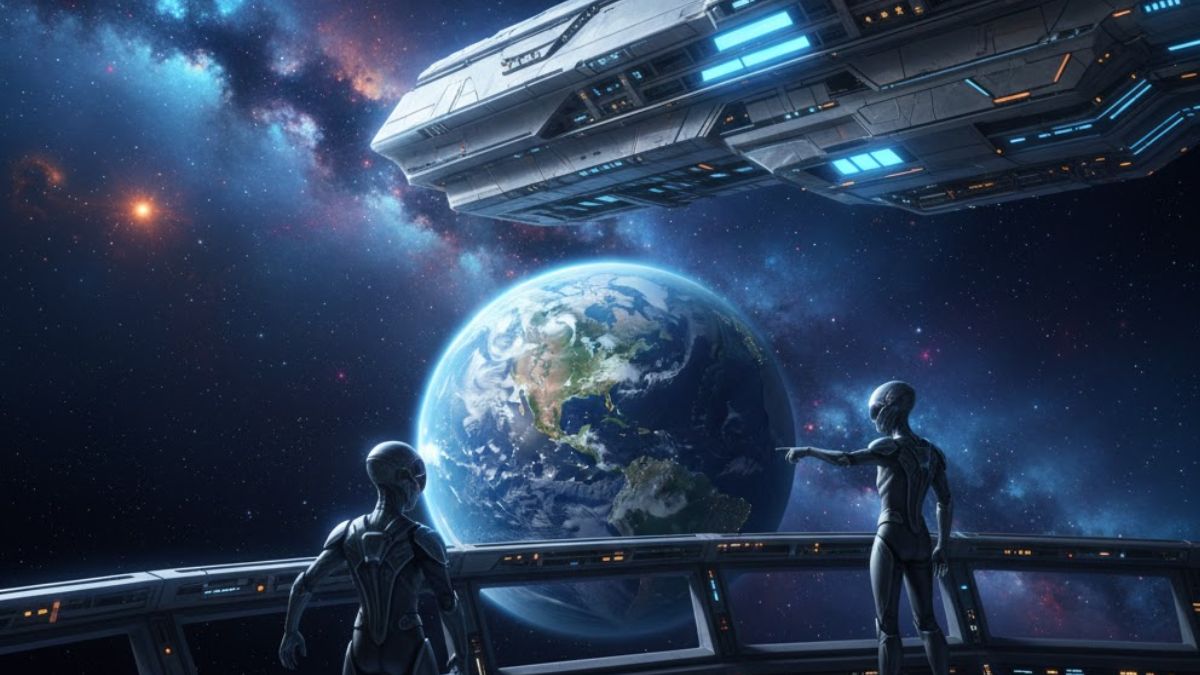
We often look up at the night sky and feel a sense of wonder. Those tiny points of light are actually giant suns, many with their own families of planets. We send out probes, build powerful telescopes, and listen for signals from the cosmos, hoping to find a sign that we are not alone. We consider ourselves an advanced species, capable of incredible technology and deep understanding of our world. But what if, from the perspective of a truly advanced alien civilization, our entire planet is seen as primitive? What if Earth is the cosmic equivalent of a quiet, undeveloped village in a vast, interconnected universe?
This idea turns everything we think we know on its head. We might picture aliens arriving in massive ships to conquer us, but a civilization that has mastered interstellar travel would likely see us as we see an anthill. We might not even be interesting enough to conquer. Our greatest achievements—the internet, space stations, nuclear power—might look like simple tools to them, the kind of basic steps every young species goes through. The universe is nearly 14 billion years old, and Earth is only about 4.5 billion years old. There has been plenty of time for other life to not only begin but to evolve far beyond our current level.
So, what would make our planet seem primitive to a cosmic observer? Let’s explore this fascinating and humbling possibility. What clues do we have that we might not be the smartest beings in the neighborhood?
How Old is the Universe Compared to Earth?
To understand why we might be primitive, we first need to look at the cosmic calendar. Imagine the entire history of the universe, from the Big Bang to today, squeezed into a single year. This scale really puts our place in the universe into perspective.
The Big Bang happens at the first second of January 1st. Our own galaxy, the Milky Way, might not form until around March. For months and months, the universe is busy making stars and building the elements needed for life. Our Sun and Earth don’t even show up until mid-September. All of human history, from the first pyramids to you reading this article, takes place in the last few seconds of December 31st. We are a very new arrival on the cosmic scene.
Now, consider this. If the universe is so old, there must be planets that formed billions of years before Earth. Imagine a planet that had a five-billion-year head start on us. Life there would have had an almost unimaginable amount of time to develop, learn, and advance. Their technology wouldn’t just be a little better than ours; it would be as different as a smartphone is from a stone wheel. They might have solved problems we cannot even conceive of, like diseases and aging. They might have learned to harness the energy of entire stars. To such a civilization, our struggles with climate change and our reliance on fossil fuels would seem incredibly basic. We are like a newborn baby taking its first steps, while they are adults with lifetimes of experience.
What Would a Truly Advanced Civilization Look Like?
We often imagine alien technology as just a shinier version of our own—faster ships, bigger lasers. But a civilization millions of years more advanced would likely have technology that seems like magic to us. A useful way to think about this is the Kardashev Scale, a way of measuring a civilization’s advancement based on the energy it can use.
A Type I civilization can use all the energy that reaches its home planet from its star. This includes solar, wind, and geothermal power. We are not even a full Type I civilization yet; we still get most of our power from burning dead plants and animals (coal, oil, and gas).
A Type II civilization is far beyond us. They can harness the entire power output of their star. They might build a giant structure around their sun, called a Dyson Sphere, to capture every bit of its energy. For such a species, the energy from a single star would be like a personal battery.
A Type III civilization is almost god-like. They can control the energy of their entire galaxy, using the power of billions of stars. Their abilities would be indistinguishable from the forces of nature itself. They could rearrange stars or even prevent galaxies from colliding.
To a Type II or III civilization, our planet would be a quaint reminder of their own distant past. They might look at our efforts to build a small space station or send a rover to Mars and smile, the way we might look at a child building a sandcastle. Our most powerful nuclear bomb would be less than a firecracker to them. Their communication might not even use radio waves, which we desperately scan for. They might use something we can’t detect, like neutrinos or quantum entanglement, making them completely invisible to our current methods.
Why Don’t We See Any Signs of Them?
This is a famous question known as the Fermi Paradox. If the universe is so big and so old, and likely full of life, then where is everybody? The silence from the cosmos is one of the biggest mysteries. One possible answer is that we are simply too primitive to notice them.
Think about an ant hill in a vast forest. The ants are busy with their own lives, building their tunnels, gathering food, and fighting off rival ants. They are completely unaware of the hikers walking past them, the satellites orbiting overhead, or the nearby city with its skyscrapers and internet. The ants are living in their own world, oblivious to the much larger and more complex world around them.
This could be our exact situation. Advanced civilizations could be all around us, but operating on a level we cannot perceive. Their ships might be in our solar system, but cloaked in ways our instruments cannot detect. They might be communicating on a channel we haven’t discovered yet. They might be observing us as part of a galactic nature preserve, choosing not to interfere with our development until we reach a certain level of maturity. We are the ants, too busy with our own anthill to see the galactic civilization happening just beyond our perception.
What Makes a Planet “Primitive”?
When we call a society primitive, we usually mean it lacks advanced technology, has a simple social structure, and may not have a full written language. On a planetary scale, we can apply similar ideas. A primitive planet might be one that is still struggling with its own internal problems and has not yet learned to live in harmony with its environment.
From an alien point of view, Earth might check all the boxes for a primitive world. We still fight wars over resources and ideas. We are causing a mass extinction of other species on our planet. We are polluting our air and oceans. A truly advanced civilization would likely have moved beyond such self-destructive behaviors long ago. They would have learned to manage their planet as a single, balanced system.
Furthermore, we are “radio loud” but only for a short time. We have been broadcasting signals into space for about a century. For an alien civilization hundreds of light-years away, our first radio shows are just now reaching them. But our television and radio signals are getting weaker as we switch to digital cables and satellites, which don’t leak into space as much. Soon, from space, Earth might go quiet. We had a brief, noisy outburst and then fell silent—another sign of a very young, fluctuating civilization.
Could We Be a Cosmic Zoo?
One intriguing idea is that Earth is a protected planet, a sort of galactic zoo or wildlife sanctuary. Advanced civilizations might have a prime directive similar to the one in Star Trek—a rule against contacting less developed species to allow them to evolve naturally.
They might be watching us from a distance, studying our development, our cultures, and our history. They might be waiting for us to pass a major test, like overcoming our global differences, ending war, or learning to sustainably manage our planet’s resources. Until we solve these basic problems, we might be considered too volatile and dangerous to join the galactic community. We are like a classroom of promising but unruly students who need to learn to get along before we can be let out for recess.
Is Our Technology Too Simple?
Let’s take a closer look at our own technology through an alien’s eyes. We are very proud of our internet, but it relies on fragile cables under the ocean and servers that can be damaged by natural disasters. We are excited by artificial intelligence, but our best AIs are still narrow and can be easily confused. We have sent probes beyond our solar system, but they are traveling so slowly that it would take them tens of thousands of years to reach the nearest star.
Now, imagine a civilization that has mastered faster-than-light travel. They could cross the galaxy in the time it takes us to fly across the ocean. They might have computers that are conscious, or they might have merged biology and technology so completely that the line between person and machine is gone. They might use black holes as power sources or create new universes in labs. Our most powerful particle collider, the Large Hadron Collider, would seem like a child’s toy to them. Our technology is based on physics we are still trying to understand, while theirs would be based on a complete knowledge of the universe’s laws.
What Would It Take for Us to “Grow Up”?
If Earth is a primitive planet, what is the path to becoming an advanced one? The first step would likely be to solve our problems here at home. This means uniting as a species to protect our planet. We would need to move beyond nationalism and see ourselves as Earthlings. We would need to stop using destructive energy sources and switch entirely to clean ones, like solar and nuclear fusion when we master it.
The next step would be to become a truly spacefaring species. This means building permanent bases on the Moon and Mars, and learning to mine asteroids for resources. We would need to develop faster and more reliable propulsion systems to explore our solar system and beyond. Most importantly, we would need to learn and adapt. The universe is undoubtedly full of surprises, and a mature civilization is one that is flexible, curious, and peaceful.
Becoming advanced isn’t just about having better gadgets; it’s about gaining wisdom. It’s about understanding our place in the cosmos and acting with responsibility. It’s about ensuring the survival of life and knowledge against cosmic threats like asteroid impacts or supernovae. When we can do that, we might finally get a welcome message from our galactic neighbors.
Conclusion
The idea that Earth could be a primitive planet is not a reason to feel discouraged. Instead, it should fill us with wonder and motivation. It means our greatest achievements and discoveries are still ahead of us. The universe is a much bigger, stranger, and more exciting place than we can imagine. We are at the very beginning of a long journey. Every time we learn more about physics, every time we send a probe to a new world, every time we cooperate to solve a global problem, we are taking a small step toward growing up as a civilization. One day, we might look back at this era as our simple, primitive childhood. The question is, what will we become next?
FAQs – People Also Ask
1. How long has the universe existed?
The universe is approximately 13.8 billion years old. This is an almost unimaginably long time, giving plenty of opportunity for other civilizations to arise long before our solar system even formed.
2. What is the Kardashev Scale?
The Kardashev Scale is a way to measure a civilization’s advancement based on energy use. It ranges from Type I (using a planet’s energy) to Type III (using a galaxy’s energy). Humans are currently not even a full Type I civilization.
3. Why haven’t we found aliens yet?
There are many theories, but one strong possibility is that we are too primitive to detect them. Their technology or methods of communication might be so advanced that they are completely invisible to our current instruments.
4. What is the Fermi Paradox?
The Fermi Paradox is the contradiction between the high probability that alien life exists and the complete lack of evidence for it. The question “Where is everybody?” captures the essence of this paradox.
5. Could aliens be visiting Earth without us knowing?
It’s possible. A civilization capable of interstellar travel would likely have stealth technology far beyond our understanding, making their spacecraft undetectable to our radar and telescopes if they wished to remain hidden.
6. What is a Dyson Sphere?
A Dyson Sphere is a hypothetical megastructure that a very advanced civilization could build around a star to capture its entire energy output. Finding evidence of one would be a clear sign of a Type II civilization.
7. How old is the Earth?
Earth is about 4.5 billion years old. While that seems ancient to us, it is only about one-third the age of the universe itself.
8. What is a Type 1 civilization?
A Type I civilization on the Kardashev Scale can use and store all of the energy that reaches its planet from its host star. This includes all solar, wind, geothermal, and other planetary energy sources.
9. How can we become a more advanced civilization?
The path likely involves solving global challenges like climate change and conflict, transitioning to sustainable energy, and expanding our presence into space to become a multi-planetary species.
10. Is it scary to think that we might be primitive?
It can be a humbling thought, but it’s also exciting. It means humanity has a tremendous potential for growth and that the future could hold discoveries and advancements we can barely dream of today.