

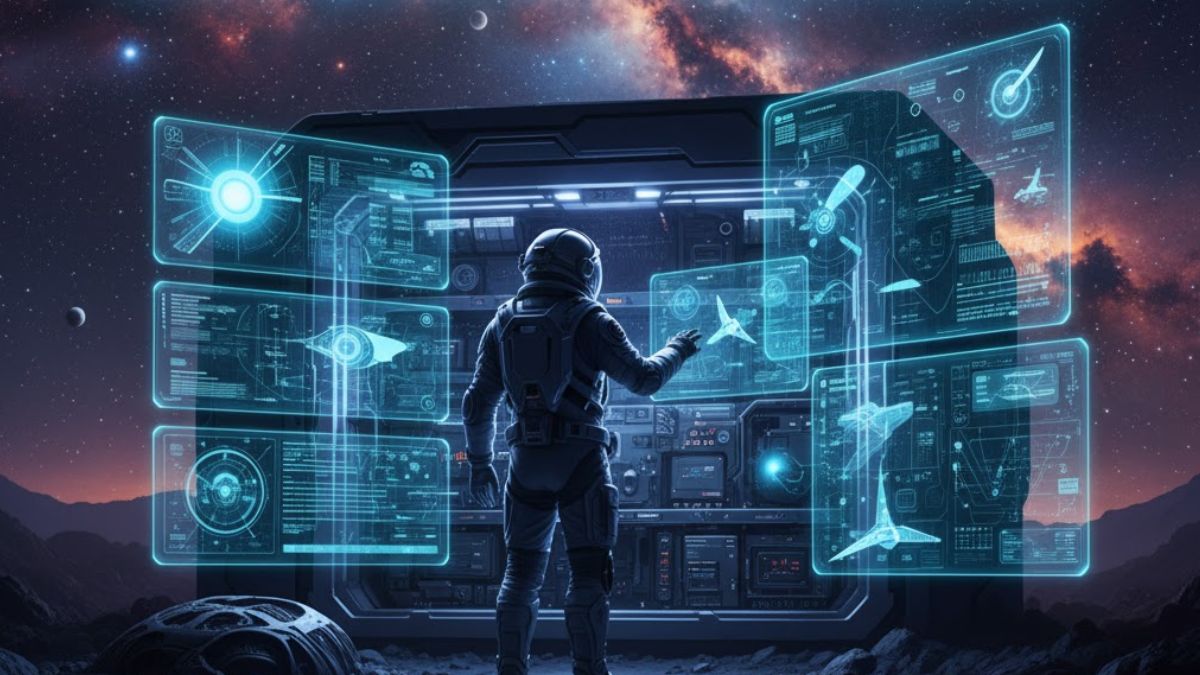
There’s a story we all know about space. It’s a story of brave astronauts, roaring rockets, and stunning pictures of distant galaxies. We see the polished results on TV and the internet, a perfect parade of human achievement. But behind that public story, there’s another one. It’s a tale of rooms filled with stacks of old data tapes, of files marked with words like “confidential” or “for internal review,” and of mysteries that were quietly shelved, waiting for the right moment or the right technology to be understood.
Think of NASA not just as a space agency, but as the world’s biggest detective agency. Its detectives are scientists and engineers, and their cases are the puzzles of the universe. Over the decades, these detectives have gathered millions of clues—photos, sensor readings, and strange signals from space. But not every clue gets solved right away. Some are too confusing. Some don’t fit the current understanding of science. And some are just so incredible that they need to be checked and re-checked before anyone dares to talk about them publicly. These unsolved cases form the secret history of NASA’s hidden files.
This is not about conspiracies or little green men, though those are fun stories. This is about the real, documented, and often overlooked data that sits in archives. It’s about the pictures that were almost deleted, the experiments that had unexpected results, and the sounds from space that no one can fully explain. We’re going to look at some of these fascinating cases. What did NASA’s telescopes really see in the dark depths of space? What strange things did the Apollo astronauts hear on the far side of the Moon?
So, what secrets are still tucked away in the vaults of the world’s most famous space program?
What kind of “hidden files” does NASA actually have?
When we say “hidden files,” it sounds like something from a spy movie, with locked cabinets and secret codes. The reality is both more ordinary and, in a way, more interesting. Most of these files aren’t deliberately hidden; they are simply inaccessible or forgotten. They are the raw, unprocessed data that never makes the front page.
Imagine a photographer taking a thousand pictures at a wedding. They might only show you the ten best, perfectly edited shots. NASA does something similar. The beautiful, color-enhanced images of nebulae we see are the “final product.” But before that, there are thousands of raw, black-and-white, grainy images filled with static and strange streaks. Most of those streaks are just cosmic rays or camera artifacts. But what if, in one of those raw images, there’s something that doesn’t belong? That image gets set aside for further study. It becomes part of the “hidden files.”
Another type of hidden file is the internal memo. These are documents written by scientists for other scientists. They are filled with technical language and cautious phrases like, “anomalous reading,” or “unexplained phenomenon.” These memos are not about announcing a discovery; they are about asking a question. They are the first step in a long investigation, and most of the time, that investigation leads to a boring, ordinary explanation. But the memos that don’t get solved, the ones that leave everyone scratching their heads, become legendary within the agency. They are the cases that remain open, waiting for a new generation of detectives or a new tool to crack them.
What was the “Moon Music” that Apollo astronauts heard?
One of the most eerie entries in NASA’s hidden files is the story of the “Moon Music.” During the Apollo 10 mission in 1969, the spacecraft was traveling on the far side of the Moon. For about an hour, the astronauts were completely cut off from all radio contact with Earth. It was just them, the silent vacuum of space, and the distant Moon.
Suddenly, a very strange sound came through their headsets. It wasn’t a random beep or static; it was a whistling, musical sound, like nothing they had ever heard before. The transcripts of their private conversation show they were completely surprised by it. One astronaut said, “That music sounds like, you know, outer-space type music.” They even debated whether or not they should tell mission control about it, worried that people would think they were crazy.
So, what was it? The files were classified for decades, and when they were finally released, the mystery captured the public’s imagination. NASA’s official explanation is that it was radio interference between the Lunar Module and the Command Module’s VHF radios. It was essentially the two spacecraft “talking” to each other and creating a weird feedback loop. But the astronauts on the mission, experienced pilots who knew every sound their ship could make, weren’t entirely convinced. The sound was so unusual and so specific to that lonely place behind the Moon that it remains one of the most haunting and debated anomalies in the space program. It was a secret not because it was dangerous, but because it was so bizarre that it challenged the very normal, technical world the astronauts lived in.
Have we found any “technosignatures” from other stars?
A “technosignature” is a modern word for a sign of technology from another world. It’s not a radio message saying “hello,” but rather evidence that someone, somewhere, has built something. It could be the light of a city on a distant planet, the waste heat from a massive machine, or a strange chemical in a planet’s atmosphere that shouldn’t be there naturally. NASA’s telescopes are constantly gathering data that could, in theory, contain a technosignature.
The most famous search for such a signal is the Wow! Signal. In 1977, a radio telescope picked up a powerful, narrow-band radio signal that seemed to come from the direction of the constellation Sagittarius. It was so strong and so perfect that the astronomer who saw the printout circled it and wrote “Wow!” in the margin. It fit all the criteria for a signal from an intelligent civilization. But then, it vanished. Despite decades of trying, it was never heard again. The data from that observation is a classic hidden file—a thrilling clue that led to a dead end.
Today, NASA’s Kepler Space Telescope and other observatories have found thousands of planets outside our solar system. The data from these missions is public, but scientists are still sifting through it, looking for anything odd. For instance, a star named KIC 8462852, or “Tabby’s Star,” showed a very strange pattern of dimming. It didn’t dim in a regular way like a planet passing in front of it; it dimmed erratically and dramatically. Some scientists suggested a wild theory: a giant, alien-built structure, like a swarm of solar panels, could be orbiting the star and blocking its light. After years of study, the most likely explanation is a cloud of dust. But for a while, that data point was a hidden file with a truly incredible possibility attached to it. The search continues, and with every new telescope we build, we get better at finding these cosmic needles in a haystack.
What are the mysterious “lost” Soviet missions that NASA monitored?
The Space Race wasn’t just about getting to the Moon first; it was also about knowing what your rival was doing. Both the United States and the Soviet Union had teams dedicated to listening to each other’s space missions. NASA was often the first to know when a Soviet mission had failed, sometimes even before the Soviet public did. The records of these observations are a fascinating part of NASA’s hidden history.
In the early days of space exploration, the Soviet Union was very secretive about its failures. They would launch a spacecraft with a heroic name, and if it failed, they would simply give it a generic name like “Cosmos” and never speak of its true purpose again. NASA’s tracking stations and intelligence agencies would listen to the radio signals and track the objects in space. They knew when a Soviet spacecraft was trying to go to the Moon and missed, or when a Mars lander stopped transmitting seconds before it touched down.
One of the most poignant stories is that of the Soviet cosmonauts who may have been lost in space before Yuri Gagarin’s famous first flight. There are persistent rumors, supported by some intercepted radio transmissions, that other men were launched but died in the attempt. While these claims are heavily debated and lack solid proof, they show that the history of spaceflight, as written in the public books, might have missing chapters. NASA’s files from that era contain the ghost signals of these lost missions, a silent testament to the dangers and the high stakes of early space travel.
What strange things has the Hubble Telescope seen that we don’t talk about?
The Hubble Space Telescope is like a time machine, showing us galaxies as they were billions of years ago. Its beautiful images are famous all over the world. But for every iconic picture, there are thousands of raw images where Hubble has seen things that are hard to explain.
One of the biggest mysteries Hubble helped uncover is Dark Energy. This is not an object, but a force. Scientists were using Hubble to measure how fast the universe was expanding. They expected the expansion to be slowing down because of gravity. Instead, they found it was speeding up. It was as if you threw a ball in the air, and instead of coming down, it shot faster and faster into the sky. This was a totally unexpected result that came from analyzing Hubble’s deep data. The force causing this acceleration was named “Dark Energy,” and to this day, no one knows exactly what it is. It’s a mystery hidden in plain sight, making up most of the energy in the universe.
On a smaller scale, Hubble has taken pictures of strange, glowing objects that don’t match any known type of galaxy or star. One such object was spotted in 2020—a giant, ghostly ring of light that astronomers nicknamed the “Hoag’s Object 2.” It was a perfect ring of stars with nothing in the center, a formation so rare they had only seen one like it before. These oddities are not announced with big press conferences. They are published in scientific journals, where other astronomers can study them and try to figure them out. They are the unsolved cases in Hubble’s detective notebook, reminding us that the universe is far stranger than we can imagine.
Is there a “forbidden” planet in our own solar system?
For centuries, people have wondered if there is another large planet lurking in the dark, outer reaches of our solar system. This is not about Pluto, which we know is a small dwarf planet. This is about the possibility of a much larger, undiscovered world, sometimes called “Planet Nine” or “Planet X.”
The evidence for this hidden planet is not a photograph. It’s gravitational. Astronomers have noticed that small, icy objects in the distant Kuiper Belt (a region beyond Neptune) are orbiting in a strange, clustered way. It’s as if something big, perhaps ten times the mass of Earth, is herding them with its gravity. The math suggests this planet would have a long, looping orbit, taking thousands of years to go around the Sun. Finding it is like finding a single specific grain of sand on a beach the size of a continent.
Why is it “forbidden”? The idea challenges our current model of the solar system’s formation. A planet that big, that far out, shouldn’t really be there according to some theories. Its discovery would force us to rewrite the textbooks. So, the search is on. Powerful telescopes like Subaru in Hawaii are scanning the skies, looking for this faint, slow-moving dot. The data from these surveys is another kind of hidden file. It’s a digital treasure map, and astronomers are patiently analyzing it, hoping to find the one pixel that isn’t a star or a galaxy, but a new world in our own cosmic backyard.
Conclusion
The hidden files of NASA are not a collection of covered-up alien encounters. They are something more real and more human. They are the record of our struggle to understand a universe that is vast, strange, and endlessly surprising. They contain our mistakes, our dead ends, and our most puzzling questions. From the mysterious music behind the Moon to the ghostly tug of an unseen planet, these files show that the adventure of exploration is not just about the answers we find, but about the new mysteries we uncover along the way.
The universe is under no obligation to make sense to us, and that is what makes the search so exciting. As we build new telescopes and send new probes, we are essentially adding more folders to this incredible, growing archive of cosmic secrets.
What do you think will be the next great mystery to emerge from the depths of space?
FAQs – People Also Ask
1. Why is Mars called the red planet?
Mars is called the red planet because its surface is covered in a fine dust of iron oxide, which is the same thing that gives rust its reddish color. This rusty dust is blown around by the wind, covering the entire planet and giving it a distinctive red appearance in our night sky.
2. How many galaxies are there in the universe?
Scientists estimate that there are between 100 billion and 200 billion galaxies in the observable universe. This number is constantly being refined as our telescopes become more powerful and can see deeper into space.
3. Can humans breathe in space?
No, humans cannot breathe in space because it is a vacuum, which means there is no air. Our lungs need air pressure to function, and in space, there is nothing to breathe. This is why astronauts must always wear spacesuits that provide them with oxygen when they are outside their spacecraft.
4. What is a black hole?
A black hole is a place in space where gravity is so incredibly strong that nothing, not even light, can escape from it. They are formed when a very massive star collapses in on itself at the end of its life.
5. How cold is it in space?
The temperature in space is very complex. In the empty areas between stars, the temperature can be as low as -455 degrees Fahrenheit (-270 degrees Celsius). However, if you are in direct sunlight, you would be exposed to intense heat because there is no atmosphere to protect you.
6. How long does it take to get to the Moon?
It takes about 3 days for a spacecraft to travel from Earth to the Moon. This was the travel time for the Apollo missions in the 1960s and 1970s, and it remains roughly the same for modern probes.
7. What is the name of our galaxy?
Our galaxy is called the Milky Way. It is a giant, spiral-shaped collection of stars, gas, and dust, and our solar system is located in one of its outer arms.
8. Does NASA still send people to space?
Yes, NASA currently sends astronauts to the International Space Station (ISS) using SpaceX’s Crew Dragon spacecraft. They are also working on the Artemis program to send astronauts back to the Moon.
9. What is the hottest planet in our solar system?
Venus is the hottest planet in our solar system, with surface temperatures hot enough to melt lead—around 867 degrees Fahrenheit (464 degrees Celsius). This is because its thick atmosphere traps the Sun’s heat in a powerful greenhouse effect.
10. How do astronauts sleep in space?
Astronauts sleep in small sleeping bags that are attached to the walls of their spacecraft or space station. In microgravity, there is no up or down, so they can sleep in any orientation, and they often wear sleep masks to block out the light from the Sun, which rises every 90 minutes in low Earth orbit.