

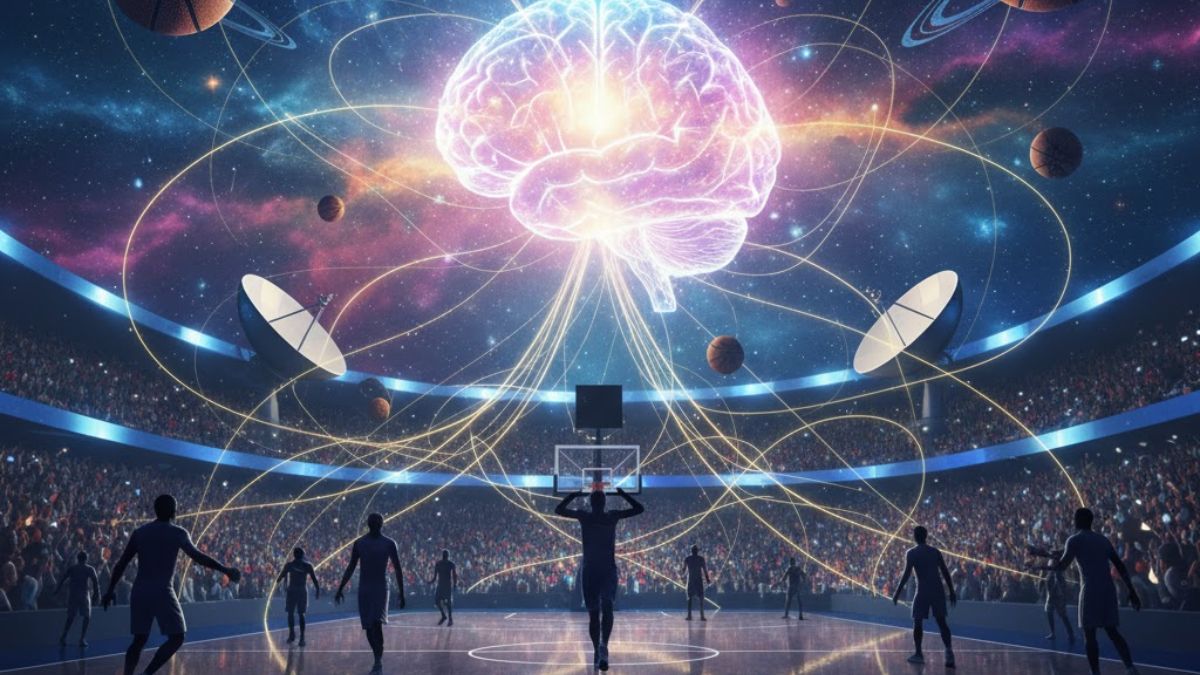
There’s a feeling that sometimes comes in a quiet moment. You might be looking up at the stars, feeling a deep sense of peace, or even watching a crowd of strangers and noticing how we all laugh the same way when we’re happy. In these moments, a thought might whisper in your ear: are we all connected? Is there something more that ties every person, every animal, and every glittering star together? This isn’t a new thought. For thousands of years, philosophers, scientists, and spiritual leaders have explored the idea of a Universal Mind—a single, vast consciousness that everything is a part of.
Think of it like this. Your body is made of billions of tiny cells. Each cell is alive on its own, doing its own job. A skin cell doesn’t know what a brain cell is thinking, but together, they form you—a complete person with thoughts, feelings, and dreams. What if we, and everything in the universe, are like those cells? What if each of us is a small, thinking part of a much larger, universal being? This idea suggests that the separation we feel between “you” and “me” might be an illusion, and that at the deepest level, we are all one.
This concept can sound like science fiction, but it also shows up in modern physics and biology in surprising ways. It challenges everything we think we know about who we are and our place in the cosmos. So, if we are all tiny pieces of a grand, universal consciousness, what does that mean for our daily lives, our choices, and our purpose?
What exactly is the idea of a Universal Mind?
The Universal Mind is the idea that all of existence springs from a single, unified consciousness. It’s not a physical brain somewhere in space. Instead, it’s often described as the fundamental fabric of reality itself—a field of intelligence and awareness that everything is embedded within. In this view, the universe isn’t a giant, mindless machine made of random matter. It is, itself, alive and conscious. Our individual minds are not separate from it; they are localized expressions of it, like waves are expressions of the ocean.
Different traditions have different names for this. Some call it God, the Source, or the Brahman. In philosophy, it’s sometimes called the Absolute or the One. Scientists exploring the edges of quantum physics sometimes use terms like a “conscious universe” or a “mental universe.” The core idea remains the same: there is one underlying consciousness, and we are all part of it. Your personal awareness, the thoughts in your head right now, are not locked away inside your skull. They are a unique perspective, a single point of view, within an infinite, cosmic mind. This means the tree outside your window, the dog sleeping at your feet, and the distant galaxy are all manifestations of this same, single intelligence, just experiencing itself in countless different forms.
This can be a difficult idea to grasp because we are so used to thinking of ourselves as separate individuals. But imagine a vast, silent lake. Now, imagine countless ripples appearing on its surface. Each ripple has its own unique shape and movement. They might even bump into each other. From the surface, they look separate and distinct. But if you look deeper, you see that every single ripple is made of the same water. They are not separate from the lake; they are the lake, just temporarily appearing as ripples. The Universal Mind theory suggests we are those ripples, and the lake is the fundamental consciousness of all that is.
Where does this idea come from in history and philosophy?
The idea of a single, universal consciousness is one of the oldest concepts in human history. You can find it at the heart of many of the world’s ancient wisdom traditions. In Hinduism, for example, the concept of Brahman is the ultimate, unchanging reality—a singular, divine consciousness that permeates the entire universe. The famous saying “Tat Tvam Asi,” which means “Thou art that,” points directly to this idea. It tells us that your innermost self, your soul, is not different from the ultimate reality of Brahman.
Thousands of years ago in ancient Greece, philosophers like Plato talked about a “World Soul.” He imagined that the cosmos itself was a living, intelligent being. Later, thinkers like Plotinus described “The One,” an indescribable source from which all minds and all matter flow. This wasn’t just mystical thinking; it was an attempt to explain the deep order and beauty they observed in the natural world. They saw intelligence in the movement of the planets and the growth of a seed, and they concluded that the universe itself must be conscious.
In more recent centuries, the idea continued to evolve. During the 1800s, a school of thought called German Idealism, led by philosophers like Georg Wilhelm Friedrich Hegel, proposed that the universe is essentially mental or spiritual. They argued that what we call the physical world is actually a manifestation of a great, evolving mind or spirit working its way toward self-knowledge. So, from the ancient Vedas of India to the philosophical debates in Europe, the concept of a Universal Mind has been a recurring theme, suggesting that humanity has always had a deep, intuitive sense that we are all connected to something much greater than ourselves.
How does modern science relate to the Universal Mind?
You might think that science, with its focus on cold, hard facts, would dismiss the idea of a Universal Mind. But when we look at the strangest edges of physics and biology, the picture gets surprisingly fuzzy and mysterious. Quantum physics, which studies the smallest particles in existence, has some very weird findings that seem to hint at a connected universe. One of the strangest is quantum entanglement. This is when two particles become linked, and no matter how far apart they are separated, what happens to one instantly affects the other. Albert Einstein famously called this “spooky action at a distance.”
This “spooky” connection suggests that at the most fundamental level of reality, the idea of separate, isolated objects might be an illusion. It points to a universe that is deeply interconnected in a way we don’t yet understand. Some physicists, like Sir Roger Penrose, have even proposed that consciousness itself is a quantum process. This doesn’t prove a Universal Mind, but it opens the door to the possibility that mind and the universe are not separate things, but deeply intertwined aspects of a single reality.
In biology, we see another kind of unity. All life on Earth shares the same basic genetic code. The DNA in a banana has about 50% similarity to human DNA. We are literally related to every living thing on the planet, from the smallest blade of grass to the largest whale. This shared blueprint for life points to a common source, a fundamental unity in the biological world. When you combine this biological connection with the quantum weirdness of physics, the idea that we are all part of a single, living, conscious system doesn’t seem quite so far-fetched. Science is beginning to paint a picture of a universe that is far more strange, wonderful, and unified than we ever imagined.
What would it mean if we are all connected in one mind?
If the Universal Mind theory is true, it would change everything about how we see ourselves and our place in the world. The most profound change would be the end of loneliness. The feeling of being a separate, isolated self, trapped inside our own heads, is a source of great suffering for many people. But if we are all expressions of one consciousness, then true separation is impossible. You are never truly alone. You are always a part of the whole, connected to everyone and everything in a fundamental way. Your consciousness is a unique perspective, but the “stuff” of your awareness is the same “stuff” as the awareness of every other person, animal, and perhaps even the stars.
This idea also reshapes our sense of purpose. If the universe is a single mind awakening to itself, then our lives are its way of experiencing itself. Your joys, your sorrows, your loves, and your discoveries are the universe feeling, learning, and growing through you. Your life is not a random accident; it is a vital and meaningful part of a cosmic story. Your personal journey of learning and growing contributes to the evolution of the whole. This gives every single moment and every single life a sacred importance.
Finally, it would completely transform our ethics and how we treat each other and our planet. If we are all part of the same whole, then harming another person is ultimately harming a part of yourself. Helping a stranger is helping yourself. Caring for the environment is caring for your own larger body. This understanding could be the foundation for a global compassion unlike anything we have seen before. The Golden Rule, “treat others as you wish to be treated,” would no longer be just a good moral idea; it would be a statement of a scientific and spiritual fact.
Could our own brains be like radios tuning into this consciousness?
This is a popular and helpful way to imagine how our individual minds might relate to a Universal Mind. Think of the Universal Mind as a vast, invisible field of information and awareness, like a cosmic radio station broadcasting on every frequency. In this analogy, your brain is not the source of your consciousness, like a generator creating electricity. Instead, it is more like a radio receiver, tuning into a specific frequency of this vast field and creating your personal, individual experience.
This would explain many mysteries that science struggles with. For instance, where do creative ideas come from? Many artists, musicians, and writers describe their best ideas as “coming to them” from somewhere else, in a moment of inspiration. It would feel like tuning into a new signal. It could also explain intuition—that gut feeling that knows something your logical mind hasn’t figured out yet. It might be your brain picking up on information from the wider field of consciousness.
This “receiver theory” also helps make sense of conditions like savant syndrome, where a person with significant mental disabilities can have one extraordinary ability, like instantly calculating complex mathematical problems or playing a piano piece perfectly after hearing it only once. It’s as if their brain, due to its unique wiring, is able to tap directly into a field of knowledge that the rest of us cannot normally access. If consciousness is fundamental and our brains are filters, then it changes the entire question from “How does the brain create consciousness?” to “How does the brain filter and receive consciousness?”
What are the biggest arguments against a Universal Mind?
Of course, not everyone agrees with this idea. The most common argument comes from materialism, which is the prevailing view in modern science. Materialism states that everything in existence, including consciousness, is made of physical matter. From this perspective, your mind is simply a product of the electrical and chemical activity in your brain. When the brain dies, consciousness ends, just like a software program stops when you turn off the computer. There is no need for a Universal Mind because individual consciousness is a local, biological phenomenon.
Another strong argument is the problem of pain and evil. If we are all part of a loving, universal consciousness, why is there so much suffering, cruelty, and chaos in the world? Why would a unified mind create cancer, natural disasters, and wars where it is essentially harming itself? This is a very difficult question to answer. Some suggest that the Universal Mind is not a perfected God, but rather a learning, evolving consciousness that experiences all possibilities, including suffering, in order to grow and understand itself. Others propose that from the perspective of the whole, what we see as evil is just a necessary contrast that allows for experiences like courage, compassion, and free will.
Finally, there is the simple argument from personal experience. Our everyday reality feels so solidly built on separation. I am here, and you are there. I feel my own pain, but I cannot feel yours. This feeling of being a separate self is the most powerful evidence our senses provide. For many, this direct experience of individuality is enough to dismiss the idea of a Universal Mind as a pleasant but unproven fantasy. The challenge for this theory is to explain why, if we are all one, we experience life so vividly as separate individuals.
Conclusion
The question of whether we are all part of a Universal Mind is one of the most profound we can ask. It sits at the crossroads of science, spirituality, and philosophy, challenging our most basic assumptions about reality. We have seen how this idea appears in ancient traditions and finds curious echoes in modern quantum physics. We’ve explored how it could give our lives deep meaning and connection, and we’ve also considered the strong arguments against it.
Whether you find the idea compelling or unlikely, contemplating it opens up a sense of wonder about the nature of our existence. It invites us to look at the world and at each other with a little more curiosity and a little more compassion. Perhaps the truth is not something we can fully grasp with our logical minds, but something we can only feel in those quiet, connected moments under the starlit sky.
If the universe is truly a single, conscious being slowly waking up to itself, what role do you think your own life plays in its great, unfolding story?
FAQs – People Also Ask
1. What is the difference between the Universal Mind and God?
The Universal Mind is often thought of as an impersonal field of consciousness, more like a fundamental force of nature. God, in many traditions, is a personal being with attributes like love, will, and intention. However, many people use the terms interchangeably to describe the ultimate, conscious source of all reality.
2. Did Albert Einstein believe in a Universal Mind?
Einstein often spoke of a “cosmic religious feeling” and believed in a superior intelligence revealed in the harmony of nature. While he did not believe in a personal God, his writings suggest he felt the universe was deeply intelligent and rational, which aligns closely with the concept of a Universal Mind.
3. Can the Universal Mind be proven scientifically?
Currently, there is no direct, definitive scientific proof for the Universal Mind. However, certain phenomena in quantum physics, like entanglement, and the hard problem of consciousness (explaining how physical matter creates subjective experience) lead some scientists to consider it a serious possibility worthy of further exploration.
4. How is the Universal Mind related to meditation?
Many forms of meditation aim to quiet the individual, thinking mind. Practitioners often report that in this silence, they experience a sense of oneness and connection with all things, which they interpret as directly experiencing their true nature as part of the Universal Mind.
5. What is the ‘hard problem’ of consciousness?
The “hard problem” is the question of how and why physical processes in the brain give rise to subjective, first-person experience. The Universal Mind theory offers a potential solution: consciousness doesn’t come from the brain; the brain simply receives it, sidestepping the hard problem entirely.
6. Do animals have a connection to the Universal Mind?
If the Universal Mind exists, then all living beings with any level of awareness would be part of it. Animals would be unique expressions of this universal consciousness, experiencing the world through their own specific forms of awareness and instinct.
7. What is panpsychism and how is it different?
Panpsychism is the view that consciousness is a fundamental feature of all things, even at the level of elementary particles like electrons. The Universal Mind is a specific type of panpsychism that suggests all these individual points of consciousness are part of one single, unified mind.
8. How does the idea of free will fit with a Universal Mind?
This is a complex puzzle. If we are all part of one mind, do we have individual free will? Some suggest that we do, as the Universal Mind experiences itself through the free choices of its countless individual perspectives. Others argue our sense of free will is an illusion within the larger mind.
9. Are there any scientific experiments on this topic?
Experiments in parapsychology, like those on remote viewing or telepathy, indirectly touch on this idea by testing if consciousness can access information beyond the physical senses. The results are often controversial, but some scientists believe they hint at a non-local nature of mind.
10. What is the collective unconscious?
Proposed by psychologist Carl Jung, the collective unconscious is a shared, inherited reservoir of memories and ideas common to all humanity. It is a psychological concept that is very similar to the Universal Mind, but applied specifically to the human species.