

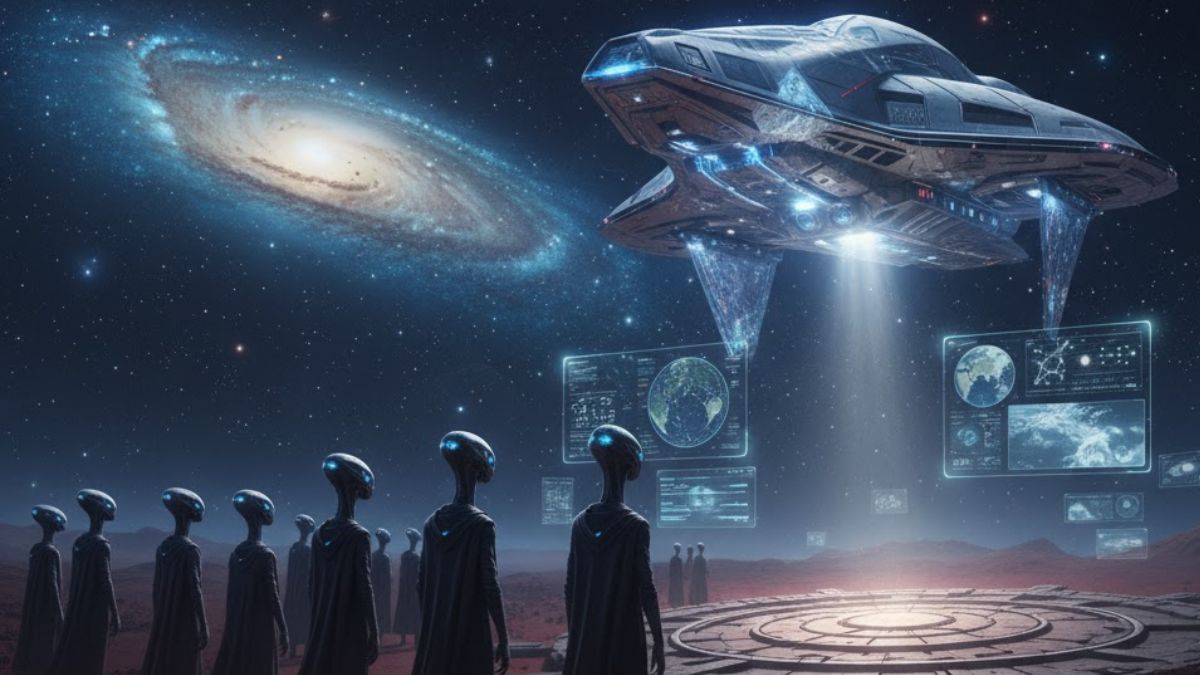
For a very long time, the idea of aliens and UFOs was something you only saw in science fiction movies. It was a fun topic for late-night TV shows and comic books, but most people didn’t take it seriously. If you talked about seeing a strange light in the sky, you might have been met with a laugh or a concerned look. It was a subject on the fringes of polite conversation.
But something has changed. Over the last few years, the conversation has shifted in a big way. It’s no longer just a topic for enthusiasts and conspiracy theorists. Now, governments, military leaders, and serious news networks are talking openly about Unidentified Aerial Phenomena, or UAPs. They are holding public hearings, releasing official reports, and declassifying videos of objects that their most advanced pilots cannot explain. It feels like a door that was once firmly shut is now being carefully cracked open.
This gradual change in the public conversation makes you wonder. Is this just a natural result of having better technology to spot strange things? Or is it something more deliberate? Are we, the public, being gently and slowly prepared for a bigger truth? Is this the long, careful road to what many call “Full Disclosure”—the official confirmation that we are not alone in the universe?
What does “Full Disclosure” actually mean?
When people talk about “Full Disclosure,” they are referring to a hypothetical future event. In this scenario, a powerful and trusted authority—like a world government or a global scientific body—would make a formal, public announcement. They would confirm that intelligent, non-human life exists and has been visiting Earth. This wouldn’t be a fuzzy video on the internet or a leaked document. It would be an undeniable, official statement backed by evidence, answering the age-old question: “Are we alone?”
For decades, this idea seemed like a fantasy. But the recent shift in tone from official sources has made it feel less like science fiction and more like a potential reality we are inching toward. The change has been so steady that it feels planned, like a slow-drip of information to get us used to the idea before the big reveal.
So, what are the signs that this might be happening? Let’s look at the evidence that suggests we are being acclimated to a new cosmic reality.
Why are Governments Suddenly Talking About UFOs Now?
For the longest time, if a government agency even mentioned UFOs, it was usually to dismiss them. The official stance was often one of denial or silence. The message was clear: this is not a subject for serious discussion. But that stance has completely reversed in a very short period.
Think about the United States government. In 2017, the New York Times published a bombshell article revealing a secret Pentagon program called the Advanced Aerospace Threat Identification Program (AATIP). This program was dedicated to studying UFO encounters by military personnel. This was not a leak from a fringe website; it was a major story in one of the world’s most respected newspapers. Suddenly, the conversation was out in the open.
Since then, we have seen the U.S. Department of Defense officially release and declassify several videos taken by navy pilots. These videos show objects performing maneuvers that defy our understanding of physics. The government has also held public congressional hearings where intelligence officials and former military pilots have testified under oath about their experiences. They speak of objects with no visible engines, that can travel at incredible speeds, and that can move effortlessly through the air, water, and even space. This is no longer a debate about blurry photos; it is a official discussion about a genuine mystery.
The key question is, why the sudden transparency? One possibility is that they have no choice. With so many military personnel coming forward and modern technology like advanced radar making these objects harder to ignore, the government can no longer pretend nothing is happening. Another, more intriguing possibility, is that this is a calculated move. By slowly releasing this information through official channels, they are normalizing the concept of UAPs. They are building a foundation of credible testimony and evidence, making the public more comfortable with the idea before sharing something even more profound.
How Has Hollywood Shaped Our Ideas About Aliens?
Long before governments started making official statements, our imaginations were being shaped by stories from Hollywood. For over half a century, movies and TV shows have been exploring the idea of alien life, and they have done a lot of the cultural preparation work.
In the beginning, aliens were often portrayed as monsters. Think of the terrifying creature in Alien or the destructive invaders in Independence Day. These stories tapped into our fear of the unknown. They asked the question, “What if they come to harm us?” But over time, the stories evolved. We started to see more nuanced and even friendly aliens.
Movies like E.T. the Extra-Terrestrial and Close Encounters of the Third Kind presented aliens as beings we could connect with, even befriend. More recent blockbusters like Arrival explore the complex challenge of communicating with a completely different intelligence. In that film, the aliens aren’t conquerors; they are visitors with a message to share. Even superhero movies, like the Avengers series, have introduced the concept of a vast, populated universe with many different kinds of life.
This decades-long exposure to alien themes in popular culture has done something important. It has made the concept of extraterrestrial life familiar to us. It has given us a shared language and a set of ideas to think about what contact might be like. While the government talks about the physics of UAPs, Hollywood has been working on our hearts and minds, exploring the emotional and social consequences of first contact. It makes you wonder if this cultural journey was just entertainment, or if it was also a way to gently expand our collective consciousness.
What Are These “UAPs” That Pilots Keep Seeing?
You might have heard the term UAP more often lately. It stands for “Unidentified Aerial Phenomena.” This new term is important. “UFO,” or Unidentified Flying Object, has carried a lot of cultural baggage for decades. It’s often associated with little green men and flying saucers, which makes it easy for people to dismiss.
UAP is a more clinical, scientific-sounding term. It doesn’t come with the same silly connotations. By using this new language, governments and scientists are reframing the conversation. They are saying, “This is a serious subject worthy of scientific investigation.” This shift in language is a classic tactic in preparing the public for a new idea. You change the words to change the perception.
The descriptions from the pilots who have encountered these UAPs are what make this topic so compelling. These are not unreliable witnesses; they are highly trained military aviators with years of experience. They fly the most advanced aircraft on the planet. When they see something they cannot explain, we should pay attention.
They report objects that break all the known rules of flight. These objects are seen moving at hypersonic speeds without any sonic boom. They can stop and change direction instantly, as if gravity has no effect on them. They have been observed flying in and out of the ocean without slowing down. They operate in ways that our current science and technology cannot replicate. The most common explanation from officials is that these could be advanced technology from a rival nation like China or Russia. But if that were true, it would mean one country has achieved a technological leap so great that it would make all other military technology obsolete. Many experts find that hard to believe. This leaves open other, more extraordinary possibilities.
Could This Just Be Secret Military Technology?
This is the most common skeptical argument, and it’s a perfectly reasonable one. It makes sense that countries are constantly developing new and secret aircraft. Couldn’t these UAPs just be top-secret drones or planes from the U.S. or another world power?
There are a few reasons why this explanation often falls short for researchers. First, the technology displayed by these objects is not just a little bit better than what we have; it is centuries ahead. The physics-defying maneuvers—like instant acceleration and the ability to operate equally well in air, space, and water—suggest a mastery of energy and propulsion that is beyond human scientific understanding.
Second, the history of these sightings goes back a very long time. There are reports from military pilots dating back to the 1940s, with objects described in very similar ways. Is it plausible that a single country has possessed this world-changing technology for over 70 years and never once used it for military or economic advantage? The secret would be unimaginably large, and it seems unlikely it could be kept for so long.
Finally, if these were secret American projects, why would the U.S. Navy be so publicly concerned about them? Why would they create formal reporting procedures for their own pilots to report encounters with their own technology? It would create a lot of unnecessary confusion and risk. While some UAPs will undoubtedly turn out to be secret man-made craft, the most perplexing cases seem to point toward something else entirely.
What Would Full Disclosure Mean for Our World?
Let’s imagine for a moment that Full Disclosure happens tomorrow. A global authority holds a press conference and presents undeniable proof that we are not alone. What would happen next? How would our world change?
The initial reaction would likely be a mixture of shock, fear, and wonder. There would be a lot of anxiety because the unknown is scary. People would have countless questions. What do they want? How long have they been here? How will this change my life? There might be short-term social unrest as people try to process this new reality.
But after the initial shock, the long-term effects could be profound. One of the biggest changes would be to our science and technology. Confirming that another intelligent species exists and has mastered interstellar travel would unlock a new age of scientific discovery. We would have proof that technologies we thought were impossible are, in fact, achievable. It would be the greatest catalyst for innovation in human history.
Perhaps the most significant change would be to our sense of identity. For all of human history, we have seen ourselves as the pinnacle of intelligence, the center of the universe. The discovery that we are just one of many intelligent species in a vast cosmos would be humbling. It could force us to see ourselves as part of a much larger cosmic community. This could have two effects. It could make our earthly conflicts—our wars, our political divisions, our borders—seem very small and pointless. It might unite humanity in a way nothing else ever has. On the other hand, it could also create new divisions between those who welcome the new reality and those who fear it.
Conclusion
The journey from the fringes of conspiracy to the halls of Congress has been remarkable. The steady drip of official reports, the credible testimony from military heroes, the shift in language from UFO to UAP, and our long cultural fascination with aliens—all of it feels like part of a larger process. It feels like we are being taken by the hand and led step-by-step toward a new understanding of our place in the universe.
Whether this is a deliberate preparation for Full Disclosure or simply a new era of governmental transparency about a real but unexplained phenomenon, the result is the same. We are living in a time when the impossible is becoming possible. The conversation has changed, and it’s never going back.
The evidence is mounting, the witnesses are credible, and the mystery is real. The biggest question is no longer “Are they real?” but “What happens next?”
FAQs – People Also Ask
1. What is the difference between a UFO and a UAP?
A UFO stands for “Unidentified Flying Object,” a term that has been used for decades and is often associated with alien spacecraft in popular culture. UAP, or “Unidentified Aerial Phenomena,” is a newer, more formal term used by governments and militaries to describe objects in the sky, water, or space that cannot be identified. UAP is meant to be a more serious, scientific term without the cultural baggage of UFO.
2. Has any government officially admitted that aliens exist?
No government has officially and unequivocally admitted that extraterrestrial life exists and is visiting Earth. However, several governments, including the United States, have officially admitted that UAPs are real, their origins are unknown, and they pose a legitimate national security concern. This is a significant shift from previous positions of total denial.
3. What was the U.S. government’s Project Blue Book?
Project Blue Book was a series of systematic studies of UFOs conducted by the United States Air Force from 1952 to 1969. Its goals were to determine if UFOs were a threat to national security and to scientifically analyze UFO-related data. The project concluded that most sightings were misidentified ordinary objects, but a small percentage remained unexplained.
4. Why do people believe there is a government cover-up about UFOs?
Many people believe in a cover-up because of the long history of government secrecy and dismissal of the topic, combined with credible witness testimony from military and intelligence officials who claim the government possesses more information than it has shared. High-profile cases where documents have been allegedly hidden or destroyed have fueled these beliefs.
5. What is the most famous UFO sighting?
One of the most famous and well-documented sightings is the 2004 “Tic Tac” incident. U.S. Navy pilots off the coast of San Diego encountered a white, oblong object (shaped like a Tic Tac breath mint) that performed incredible maneuvers, defying known physics. This event was confirmed by the U.S. government, with radar data and video to support the pilots’ claims.
6. Could UAPs be a natural phenomenon we don’t understand yet?
It’s possible. Some UAPs could be rare atmospheric phenomena, plasma formations, or other natural events that science has not yet categorized. However, the structured, intelligent flight patterns reported by pilots—such as objects moving against the wind or performing precise maneuvers—make a purely natural explanation difficult for many cases.
7. What would aliens look like?
Science suggests that if alien life exists, its appearance would be wildly diverse and shaped by its home planet’s environment. They might not look like the humanoid figures often shown in movies. They could be microbial, plant-like, or take a form we can’t even imagine, based on a completely different biology, like silicon-based instead of carbon-based.
8. How would world religions react to the discovery of alien life?
Reactions would vary greatly between and within different religions. Some might see it as a confirmation of God’s infinite creation, while others might struggle to fit it into their theological frameworks. Most major religions are adaptable, and scholars from many faiths have already begun to consider how their beliefs would align with the discovery of extraterrestrial intelligence.
9. How close is the nearest star system that could host life?
The nearest star system to Earth is Alpha Centauri, about 4.37 light-years away. One of its stars, Proxima Centauri, has a planet, Proxima Centauri b, that orbits within its “habitable zone,” where temperatures could allow for liquid water. However, we do not yet know if it has an atmosphere or can support life.
10. What is the Fermi Paradox?
The Fermi Paradox is the contradiction between the high probability that alien life should exist in the universe (given its vast size and age) and the complete lack of evidence for it. It’s often summarized by the question, “Where is everybody?” The paradox suggests that either our assumptions are wrong, or there is something preventing life from making contact.