

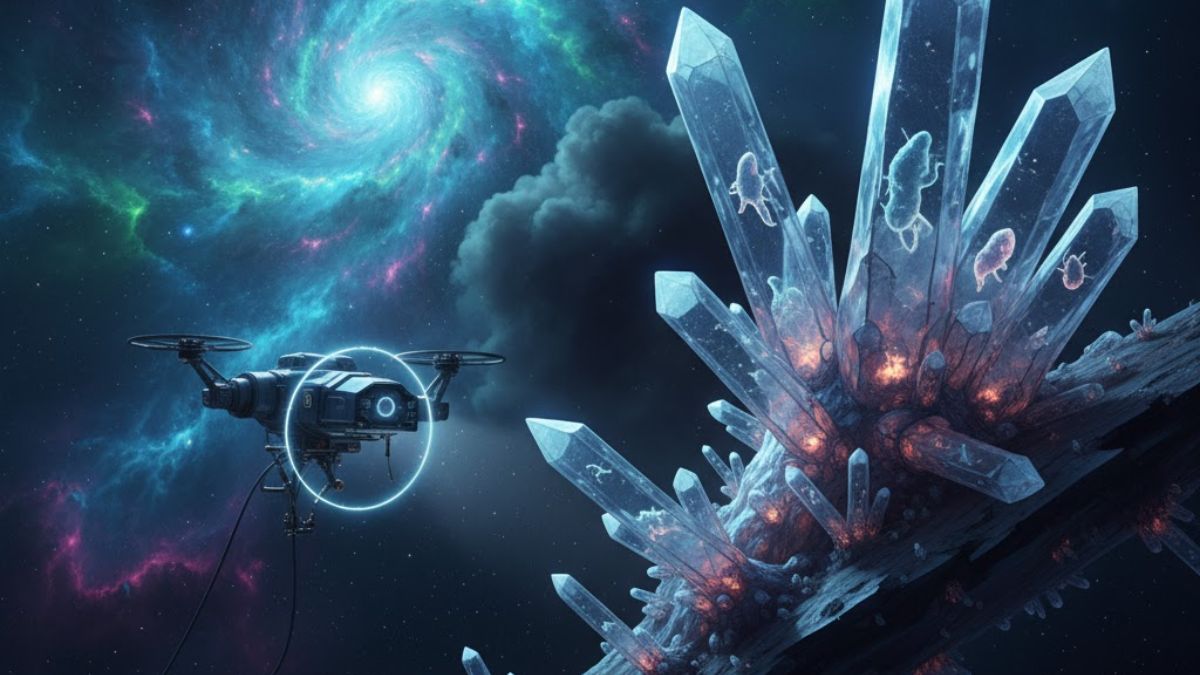
For a long time, when we have dreamed of finding life on other worlds, we have pictured a very specific scene. It is a world that looks a lot like our own. We imagine a planet with lush green forests, flowing blue rivers, and a bright, warm sun in the sky. This idea makes sense. We know that life thrives here on Earth, so it seems logical to search for other planets that are just like it. We call this the “Goldilocks Zone,” the perfect distance from a star where it’s not too hot and not too cold for liquid water to exist.
But what if this way of thinking is actually too narrow? What if we are being like a person who loses their keys at night and only looks for them under the streetlamp because that’s where the light is? It’s the easiest place to look, but the keys might be somewhere else entirely. Our search for life has been focused on this familiar, well-lit spot. We are only looking for life as we know it, for planets that are clones of Earth.
This leads us to a thrilling and puzzling question. Could life be flourishing in the most unexpected corners of the universe, in places we would consider hellish? Are we, in our search for a second Earth, completely overlooking the real cradles of alien life?
What is the “Goldilocks Zone” and why do we love it so much?
The Goldilocks Zone, or the habitable zone, is one of the most popular ideas in space science. Think of it like this. If you stand too close to a fire, you’ll get burned. If you stand too far away, you’ll get cold. But there’s a spot in the middle where the temperature is just right. For planets, this “just right” zone is where a planet is far enough from its star that its water doesn’t all boil away, but close enough that it doesn’t permanently freeze solid. Since water is essential for all life we know, this seems like the perfect starting point for our search.
We have found thousands of planets outside our solar system, known as exoplanets. Many of these are in their star’s Goldilocks Zone. This discovery always makes headlines and fills us with hope. It feels like we are getting closer to finding Earth’s twin. Our telescopes and methods are fine-tuned to spot these kinds of planets. They are the low-hanging fruit, the most obvious targets. But in our excitement, we might be ignoring a whole universe of other possibilities. What if life doesn’t need a sun-like star? What if it doesn’t even need a surface to walk on?
What if life doesn’t need a sun?
When we think of energy for life, we think of the sun. Plants use sunlight to grow, and animals eat those plants. But here on Earth, we have found entire ecosystems that thrive in total darkness. At the bottom of the deepest, blackest oceans, where no sunlight can ever reach, there are hot vents on the ocean floor called hydrothermal vents. They spew out mineral-rich, superheated water. And around these vents, life is abundant.
There are giant tube worms, strange clams, and all kinds of bizarre bacteria. These creatures don’t use the sun for energy. They use chemicals from the vent—a process called chemosynthesis. This proves that life is incredibly stubborn and creative. It doesn’t always need a nice, warm star. It can find a way in the cold and the dark.
Now, let’s take this idea into space. Jupiter, a giant gas planet, has a small moon called Europa. From the outside, it’s just a frozen, icy ball. But scientists are almost certain that beneath its thick crust of ice, there is a vast, global ocean of liquid water. This ocean might be twice the size of all of Earth’s oceans combined. What is keeping this water from freezing? Not the distant sun, but the gravitational pull of Jupiter itself. The immense gravity squeezes and stretches Europa’s core, creating heat through friction. This is called tidal heating.
So, on Europa, you have a dark, deep ocean, warmed from below by the moon’s own hot core. It is the perfect environment for hydrothermal vents, just like the ones in our own oceans. Could there be tube worms swimming in Europa’s dark seas? Or something even more incredible? This means a moon, orbiting a gas giant far outside the traditional Goldilocks Zone, could be one of the most promising places for life in our entire solar system. We are not just looking for planets anymore; we are looking at moons.
Could life survive on a world without a surface?
Our idea of life is also very tied to the ground. We imagine creatures walking, crawling, or flying on a solid surface. But what about the gas giants? Planets like Jupiter and Saturn have no solid surface to stand on. They are massive balls of gas, with atmospheres that get thicker and hotter the deeper you go, eventually crushing everything into a liquid or solid core. It sounds like a nightmare. How could anything live there?
Let’s think about atmospheres. On Earth, we find tiny bacteria floating high in the clouds. They are alive and drifting. Now, imagine a much bigger, more stable environment. Scientists have theorized that in the upper atmospheres of gas giants, there could be a layer where the temperature and pressure are just right. In this layer, there might be water droplets and organic chemicals.
Could there be life forms that simply float? Giant, balloon-like creatures that drift through the colorful clouds of Jupiter, feeding on chemicals in the air? It might sound like science fiction, but it is a real scientific possibility. These “floaters” could be very different from any life we know. They wouldn’t need land or oceans. Their entire world would be the sky. If we only look for planets with a solid surface, we would never find them. We have to expand our imagination to include life that is truly alien.
Is our definition of “life” too narrow?
This is the biggest question of all. Every living thing we know is based on carbon and needs water. Carbon is a fantastic atom for building the complex molecules of life, like DNA and proteins. Water is a wonderful solvent that helps these chemical reactions happen. So, we look for carbon and we look for water. This is called “carbon-chauvinism.” We are biased towards the kind of life we understand.
But what if other foundations for life are possible? Some scientists have seriously explored the possibility of silicon-based life. Silicon is right below carbon on the periodic table and can form similar bonds. On a very hot world, perhaps silicon could form the backbone of long, complex molecules, creating life that is based on rock and crystal. Such a creature would live in slow motion compared to us, or it might thrive in temperatures that would instantly incinerate us.
And what about a different liquid instead of water? On Saturn’s moon Titan, it is so cold that water is frozen solid, like rock. But Titan has rivers, lakes, and seas filled with liquid methane and ethane. It has a full liquid cycle, just like Earth’s water cycle, but with different chemicals. Could there be a form of life that uses liquid methane the way we use water? Its biochemistry would be utterly foreign. It would be a life form we wouldn’t even recognize at first glance. Our instruments, designed to find life like us, might pass right over it without a second thought.
Where should we be looking instead?
If we break free from our Earth-centered thinking, a whole new set of targets emerges. Suddenly, some of the most interesting places in our solar system are not the Mars-like deserts, but the frozen, distant worlds.
Europa is a prime candidate, as we discussed. But it’s not alone. Another Jovian moon, Ganymede, likely has a subsurface ocean sandwiched between layers of ice. Saturn’s moon Enceladus is even more exciting. It has giant geysers that shoot water vapor from its subsurface ocean directly into space. Our spacecraft have flown through these plumes and detected organic molecules. We have already sampled its ocean without even landing. This tiny, icy moon is actively telling us that it has the ingredients for life.
Then there’s Titan, with its thick atmosphere and methane lakes. It is a completely different laboratory for life. And what about planets that were kicked out of their solar systems altogether? These are rogue planets, wandering the cold, dark space between stars. With no sun, they are frozen worlds. But if they have a hot, radioactive core, like Earth does, they could have liquid oceans under a shield of ice, heated from within. A rogue planet could be a dark, solitary ark, carrying life across the galaxy.
Our search needs to become more clever. Instead of just looking for Earth-twins, we need to send probes to these icy moons. We need to develop new tools that can detect signs of life that isn’t like us—so-called “biosignatures” that don’t rely on oxygen or carbon dioxide. We need to look for unexpected chemical imbalances in an atmosphere or on a surface that can’t be explained by geology alone. The hunt is on, but we need to make sure we’re hunting for all kinds of game, not just the one we’re familiar with.
Conclusion
The universe is a place of infinite wonder and possibility. For centuries, we have imagined other lives on other worlds as reflections of our own. But the more we learn, the more we realize that life is probably much more strange, resilient, and diverse than we ever dreamed. By focusing only on planets like Earth, we are limiting our own chances of making the most profound discovery in human history. The keys to alien life are probably not under the streetlamp. They are waiting in the darkness, in the cold, in the clouds, and in the deep, daring us to look a little harder.
So, the next time you look up at the stars, ask yourself: Is the most common form of life in the universe the green planet kind, or is it something we haven’t even learned to see yet?
FAQs – People Also Ask
1. What is the most likely place to find life in our solar system?
Many scientists believe Jupiter’s moon Europa or Saturn’s moon Enceladus are the top candidates. Both are thought to have vast, liquid water oceans beneath their icy surfaces, warmed by the gravitational pull of their host planets.
2. Can life exist without water?
All life as we know it requires water. However, scientists are open to the possibility that other liquids, like methane on Titan or even liquid ammonia, could serve as a solvent for a completely different kind of biochemistry that we haven’t discovered yet.
3. What are biosignatures?
Biosignatures are signs that scientists look for to indicate the presence of life. These are usually chemicals that are hard to explain without biological processes, like a certain mix of oxygen and methane in a planet’s atmosphere, or specific organic molecules.
4. Why is Mars not the best candidate for life anymore?
While Mars is still a target for search of past microbial life, the current surface is cold, dry, and bombarded with radiation. The icy moons like Europa and Enceladus offer much more stable, protected, and potentially energy-rich environments in their subsurface oceans.
5. What is a rogue planet?
A rogue planet is a planet that does not orbit any star. It has been ejected from its solar system and wanders alone in interstellar space. Some could potentially have thick ice shells trapping heat from their cores, creating subsurface oceans.
6. How do we look for life on these distant moons?
Future missions plan to send landers and drills to moons like Europa. For Enceladus, a spacecraft could simply fly through its water plumes and analyze the sample for complex organic material or even cellular life directly.
7. What is silicon-based life?
It’s a theoretical type of life where silicon atoms replace carbon atoms as the fundamental building block. It’s speculative, but it suggests life could exist in extremely hot environments where carbon-based molecules would break down.
8. How many exoplanets have we found?
We have discovered over 5,000 confirmed exoplanets, and thousands more are candidates waiting for confirmation. They come in all sizes and types, many of which are very different from the planets in our own solar system.
9. Could there be intelligent life on these moons?
It’s considered very unlikely. The environments under the ice are dark and energy might be scarce, which would probably favor simpler, perhaps microbial or small animal-like life, rather than large-brained, technological civilizations.
10. What is the biggest challenge in finding alien life?
The biggest challenge is our own bias. We are looking for life as we know it. The real breakthrough will come when we develop the tools and the open-mindedness to recognize life as we don’t know it.