

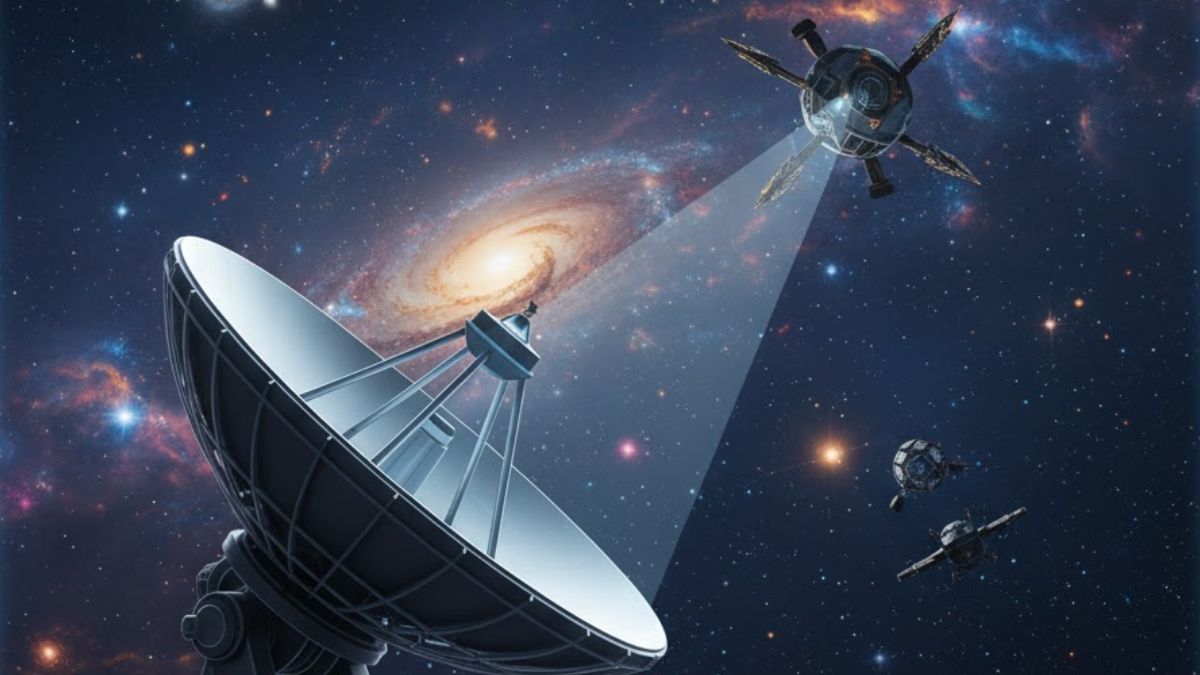
There’s a quiet moment, usually late at night, when you might look up at the stars. The sky is filled with tiny, twinkling lights, each one a distant sun. It’s a beautiful sight, but it can also feel a little lonely. We see all those stars and can’t help but ask one of the biggest questions of all: are we alone?
For decades, we’ve been trying to find an answer. Giant radio telescopes are pointed at the sky, listening for a signal that doesn’t belong to nature. Scientists are scanning distant planets, looking for signs of air or water that might support life. The search is like trying to hear a single whisper in a roaring hurricane. But what if, one day, we finally hear that whisper? What if we get a signal?
Finding a message from another world would be the most important discovery in human history. The news would spread across the globe in seconds. But the moment we receive the signal is just the beginning. The real story starts after the initial excitement fades. What happens next? How would it change our world, our beliefs, and our future?
What would it actually feel like to get a message from aliens?
The day we receive a confirmed signal from an intelligent civilization would be unlike any other. Imagine waking up to the news that every radio, television, and phone is buzzing with the same incredible headline: “We are not alone.” At first, there would be a wave of pure, global shock. The feeling would be a mix of excitement, fear, and disbelief. It’s a moment we’ve seen in movies, but the real thing would be far more powerful.
People would likely step outside and look up at the sky, knowing that someone else is out there. The world would feel both much bigger and much smaller at the same time. There would be celebrations, but also anxiety. We would have so many questions. Who are they? Where are they? Most importantly, why are they contacting us? The initial message might not even be something we can understand right away. It could be a complex mathematical sequence or a simple greeting. Decoding it would be our first great challenge, a global puzzle that every scientist would be working on.
This moment of contact would unite humanity in a way nothing else has. For a little while, national borders and earthly conflicts might seem less important. We would suddenly have a new identity, not as separate countries, but as citizens of Earth, one world speaking to another. But this unity would also be tested by the mountain of unknowns. The signal would prove we are not the only intelligent life, but it would open a door to a universe of new mysteries.
How would we even begin to talk back?
Once the initial shock wears off, the next huge task would begin: crafting a reply. This is not as simple as sending an email. The first problem is distance. The alien civilization could be hundreds or even thousands of light-years away. This means a single message and its reply could take centuries. We would be starting a conversation with our great-great-grandchildren in mind.
The second problem is language. How do you talk to a species that has no shared history, biology, or senses with you? They might not have eyes or ears. They might “see” through sound or “feel” magnetic fields. Our message would have to be built on the one thing we believe is universal: science and mathematics. The laws of physics are the same everywhere. Many scientists think we should send information about basic math, the structure of atoms, and a map of our solar system.
We would also have to decide what to say about ourselves. Do we send our entire history, with all its wars and triumphs? Do we send our art, our music, and pictures of our planet? This would be a delicate process. We would want to present the best of humanity, a peaceful and curious species eager to learn. The message would be a time capsule of our entire world, a project that would require every nation on Earth to agree. It would force us to decide, as one planet, who we are and what we want to say.
Would a message from space be friendly or a danger?
This is perhaps the biggest question that would fill everyone’s mind. Our stories about aliens are often split between friendly visitors like E.T. and invading armies like in Independence Day. So, which one is more likely? The truth is, we have no way of knowing, and that uncertainty would be the source of both fear and fascination.
On one hand, a civilization advanced enough to send a signal across the galaxy has likely also mastered technology we can’t even imagine. If they wanted to harm us, they probably could have done so already. Many scientists, like the famous Carl Sagan, believed that a species that has survived its own technological adolescence must have learned to control its aggressive instincts. Otherwise, it would have destroyed itself. Their message could be a gesture of friendship, an attempt to share knowledge and join a cosmic community.
On the other hand, we have to be cautious. Their motives might be beyond our understanding. Perhaps they see our planet as a resource. Maybe their way of thinking is so different that the concept of “friendship” doesn’t exist for them. This is why many experts argue that we should listen carefully for a long time before we even think about replying. We would need to study the signal for years, learning everything we can about where it came from and what it might mean. The message itself might tell us if they are peaceful. It could contain warnings, encyclopedias of knowledge, or even blueprints for new technology.
How would it change our everyday lives?
You might think that a message from aliens wouldn’t change what you have for breakfast, but its effect would slowly seep into every part of our lives. First, science would get a huge boost. Governments would pour money into astronomy, physics, and engineering. The need to build better telescopes and more powerful computers would drive innovation. We might see new technologies developed for space travel and communication that would also benefit life on Earth.
Our culture would transform. New art, music, and books would be inspired by this new reality. Our religions and philosophies would be challenged and would likely evolve. The knowledge that we are not the center of the universe, but one of many intelligent species, would be a profound shift in how we see ourselves. It could make us feel small and insignificant, or it could make us feel connected to a vast, incredible cosmos.
Schools would teach differently. History classes would have a new chapter: the day we made contact. Science classes would focus more on astrobiology and the search for life. Children would grow up in a world where knowing we are not alone is a simple fact. It would give a new generation a powerful reason to look to the stars and dream of a future among them. The very idea of what it means to be human would be forever changed.
What if the message isn’t what we expect?
We often imagine a message filled with complex science or peaceful greetings. But what if the signal is something else entirely? It could be a warning. Perhaps it’s a beacon telling other civilizations to stay away from a certain region of space because of some great danger. It could be a distress call from a dying world, a final attempt to preserve its knowledge before it vanishes forever.
Another possibility is that the message is not meant for us at all. We could be overhearing a communication between two other civilizations, like picking up a phone call not intended for our ears. The message might be a routine data transmission, a piece of alien television, or even their version of music. Decoding it could be incredibly difficult, like trying to understand a symphony if you have never heard sound before.
The most exciting, and also the most troubling, possibility is that the message contains information we are not ready for. It could be the plans for a technology that is too powerful for us to handle responsibly. It could be a truth about the universe that shatters our understanding of reality. The signal could be a test, to see if we are wise enough to handle advanced knowledge before we are invited to join the galactic community.
Conclusion
The first signal from an alien civilization would be the starting pistol for a new chapter in human history. It would answer one ancient question—”Are we alone?”—only to raise a thousand more. The journey beyond the signal would be our greatest adventure, pushing our science, testing our unity, and challenging our very identity.
It would be a slow, careful process of listening, learning, and eventually, speaking with a voice that represents all of humanity. We would no longer just be inhabitants of Earth; we would be a species that knows it has neighbors in the cosmos. This knowledge would bring both immense responsibility and incredible opportunity. It would remind us that our planet is our shared home, a tiny, fragile world in a vast and mysterious universe.
What kind of message do you think would be the most surprising for us to receive?
FAQs – People Also Ask
1. How would we know if a signal is from aliens?
Scientists look for signals that cannot be explained by natural causes, like a pattern of numbers or a narrow-band radio transmission that stands out from the background noise of space. They would verify it through multiple telescopes to be sure it’s real and not human-made.
2. What are the chances that alien life exists?
With billions of stars and planets in our galaxy alone, many scientists believe the chances are high that life exists elsewhere. The universe is simply too big for us to be the only living things in it, even if finding intelligent life is much harder.
3. Could aliens already be listening to us?
It’s possible. Human radio and TV signals have been leaking into space for about 100 years, creating a bubble of noise around Earth. Any advanced civilization within a hundred light-years could be detecting these signals right now.
4. What is the “Wow! signal”?
The “Wow! signal” was a strong, unusual radio signal detected in 1977 that lasted for 72 seconds. It looked exactly like what scientists expected an alien signal to be, but it was never heard again, and its origin remains a mystery.
5. Why would aliens use radio signals to communicate?
Radio waves travel well through space and are a simple, efficient way to send information over long distances. It’s a technology we understand, so it’s a logical place for us to start listening.
6. What is SETI?
SETI stands for the “Search for Extraterrestrial Intelligence.” It is a collective term for scientific projects that use radio telescopes and other tools to listen for signals from alien civilizations.
7. Could an alien message be dangerous?
Some people worry a message could contain a computer virus or harmful information. Most scientists think this is unlikely, as our technology is probably too different, but the content could be disruptive to our society and beliefs.
8. How far away could the aliens be?
They could be very far. The closest star system, Alpha Centauri, is over 4 light-years away. A civilization could easily be hundreds or thousands of light-years away, making a conversation very slow.
9. Has any world leader talked about aliens?
Some politicians and military officials have discussed the possibility, especially regarding Unidentified Aerial Phenomena (UAPs). However, there is no official confirmation from any government that they have evidence of alien life.
10. What would we call the aliens?
There is no official name. We would likely refer to them by the name of their star or planet until we learn what they call themselves. The term “extraterrestrial intelligence” or “ETI” is often used in science.