

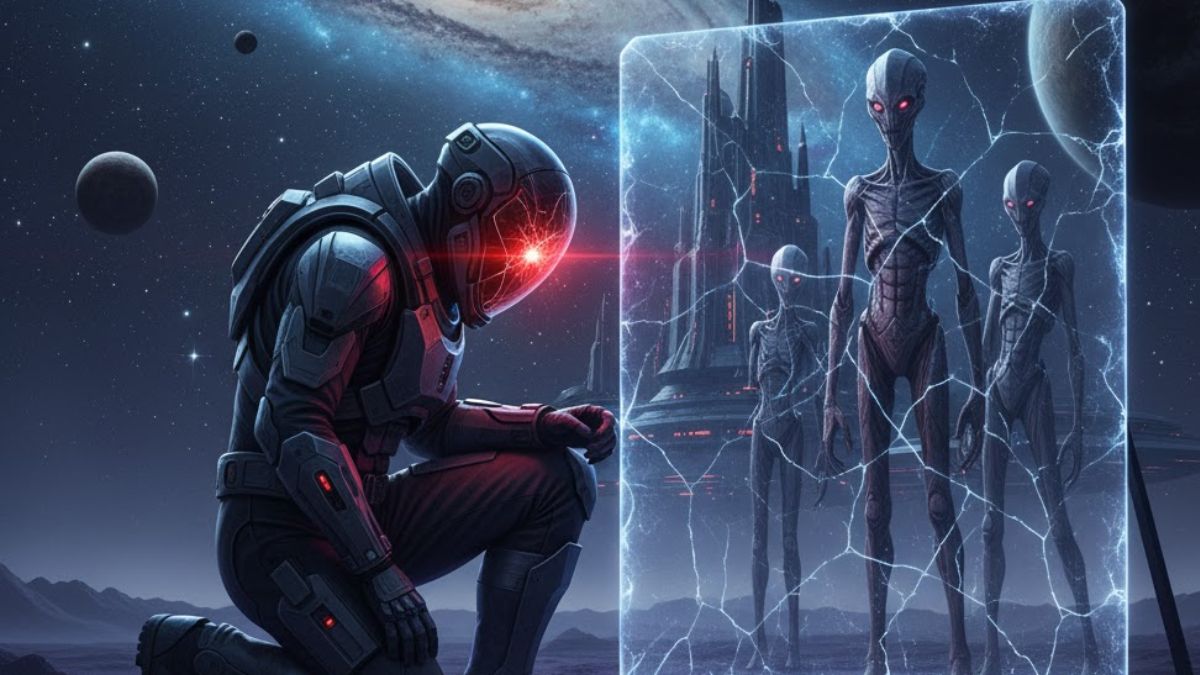
There’s a story scientists like to tell about an experiment with fish. A group of scientists placed a fish in a tank. They then introduced a strange, new object into the water—something the fish had never seen before. What did the fish do? It didn’t swim over to investigate. It didn’t try to understand the new thing. It hid. It saw the unknown, felt fear, and retreated to the safety of the familiar.
Now, think about us for a moment. What if we, as a species, are in a similar tank? What if the universe is full of things we can’t even begin to imagine, but our own minds are holding us back? We look up at the stars and wonder if we’re alone, but we might be missing the answer because of a very simple, very human emotion: fear.
This isn’t about little green men in flying saucers. This is about the very nature of reality and how we perceive it. Our brains are incredible machines, but they weren’t built to handle the infinite possibilities of the cosmos. They were built to keep us safe from predators, to help us find food, and to protect us from danger. Fear is a powerful part of that survival kit. But what happens when that survival instinct, that deep-seated fear of the unknown, stops us from seeing what’s right in front of us? Could it be acting like a pair of blinders, blocking our ability to perceive a reality that is far stranger than we think?
So, the big question we’re going to explore is this: Is our own fear the very thing that’s preventing us from making the biggest discovery in human history?
What is the biggest fear when we think about aliens?
When we imagine meeting aliens, our hearts often race for the wrong reasons. Think about the stories we tell. In movies, aliens often arrive with giant ships that darken our cities. They come to conquer, to eat, to destroy. They are monsters, and we are the potential victims. This idea is so common it feels almost natural.
But why is that? Why does the unknown have to be scary? A big part of it comes from our history. For thousands of years, if a human encountered something new and different—a new animal, a new tribe—it was often a threat. That which was unfamiliar could mean danger. It was safer to be suspicious, to be ready to fight or run. This instinct is baked into our DNA. It kept our ancestors alive.
Now, we have applied that same ancient fear to the idea of beings from other worlds. The fear isn’t really about the aliens themselves, because we don’t know anything about them. The fear is about the uncertainty. What are their intentions? Are they stronger than us? Will they take our planet? This fear of the unknown is perhaps the biggest barrier of all. It’s a wall our own minds have built, and until we understand it, we can’t even begin to see what might be on the other side.
How does our brain react to the completely unknown?
Our brain is like a brilliant but sometimes overly cautious manager. Its main job is to keep the body safe and running smoothly. To do this, it has a special system for dealing with danger called the “fight or flight” response. This system is managed by a part of the brain called the amygdala.
When you encounter something that your brain can’t immediately identify or understand—a shadow in a dark room, a strange sound at night, or the idea of a non-human intelligence—your amygdala can kick into high gear. It sends signals all over your body. Your heart beats faster. Your muscles tense up. Your senses become sharper, but they also become narrower. You stop thinking about complex ideas and you focus on one thing: is this a threat?
Now, imagine this happening not with a shadow, but with the concept of an alien reality. If our fundamental reaction to the idea of “other intelligence” is a fear response, it literally changes how we think. Our brain stops being open and curious. It becomes defensive. It looks for confirmation that the threat is real. It might ignore strange but peaceful possibilities because it’s too busy preparing for a fight. In this state of fear, our ability to perceive subtle clues or even accept evidence that doesn’t fit our scary stories can be completely blocked. Our brain, trying to protect us, might be shutting the door on understanding.
Could aliens be so different that we simply can’t see them?
This is one of the most fascinating ideas in science. We often imagine aliens as being somewhat like us—they might have a head, two eyes, and walk on two legs. But what if that’s just our imagination being lazy? What if life out there is so different that our brains refuse to process it?
Think about the colors we see. Our eyes can only see a tiny sliver of all the light that exists, called the “visible spectrum.” There’s infrared light, ultraviolet light, and radio waves all around us, but we are blind to them without special tools. Now, apply that idea to reality itself. What if there are entire dimensions or layers of existence that we are biologically blind to?
An alien intelligence might not be a physical creature that walks on a planet. It could be a cloud of gas, a living ocean, or a being made of pure energy. It might communicate not with sound or sight, but with magnetic fields or through dreams. It might live on a timescale so slow that a thousand of our years feels like a single second to them. If such a being existed, how would we even know? Our senses and our scientific instruments are designed to detect the reality we know. If something exists outside of that framework, our fear of the unknown might not even be the main problem. The problem might be that we lack the basic ability to perceive it in the first place. Our fear might just be the lock on a door we haven’t even found yet.
Has fear stopped us from discovering things in the past?
History is full of moments when fear tried to stop human progress, and curiosity won. For a long time, people were afraid of the ocean. They thought the world was flat and that sailors would fall off the edge. They drew sea monsters on their maps to show the dangers of the unknown. This fear kept people close to the shore for centuries.
Then, explorers like Columbus and Magellan decided to sail into that fear. They didn’t fall off the edge. They discovered new continents and changed our understanding of the world forever. The monsters weren’t real, but the discovery was.
The same thing happened when we first looked up at the sky. For a long time, people believed the Earth was the center of the universe. The idea that we were just one planet among many, orbiting an average star, was terrifying. It challenged everything people believed in. It was fear that made some people reject these ideas and even punish the scientists who proposed them. But eventually, curiosity overcame that fear. We built better telescopes, we sent probes into space, and now we know we are a tiny part of a vast, beautiful galaxy. Every time we have faced the unknown, the initial fear has been a hurdle, but it has never been a permanent wall.
What would happen if we could let go of our cosmic fear?
Letting go of fear doesn’t mean being reckless. It doesn’t mean we should send welcome messages into space without thinking. It means changing our mindset from one of suspicion to one of open, careful curiosity. It means training our brains to meet the unknown with questions instead of panic.
If we could do that, our entire approach to space and science would change. Scientists might start looking for signs of life in ways we haven’t considered before. Instead of just listening for radio signals, we might look for strange patterns in energy, or unexplained gravitational effects, or even anomalies in our own dreams and consciousness. We would be more willing to accept data that seems weird or doesn’t fit our current models.
On a personal level, it would be incredibly freeing. Imagine looking up at the night sky and not feeling a small twinge of anxiety, but a sense of wonder and excitement. The universe would stop being a dark, scary void and would become a place of infinite possibility. It would become a home for wonders we can’t even dream of yet. The biggest discovery might not be a spaceship landing on the White House lawn. It might be a quiet realization, a new understanding of physics, or a sudden ability to see a part of reality that was always there, just waiting for us to be brave enough to look.
Conclusion
The question of whether we are alone in the universe is one of humanity’s oldest. But the answer might not be found in a better telescope or a faster spaceship first. It might be found inside our own minds. Fear is a powerful, ancient instinct that has kept us safe, but it might also be the filter that stops us from seeing the full picture of reality. From the stories we tell to the way our brains are wired, we have built barriers against the unknown. The journey to understanding our place in the cosmos may not be a journey outward, but a journey inward, to see if we can quiet our fears long enough to finally see what has been there all along. What do you think the first sign of a truly alien reality will be, and will we be calm enough to recognize it?
FAQs – People Also Ask
1. Why are we so afraid of aliens?
We are afraid of aliens primarily because they represent the ultimate unknown. Our brains are hardwired to fear what we don’t understand as a survival mechanism, and popular culture often portrays aliens as hostile invaders, reinforcing this natural anxiety.
2. Is it possible that aliens are already here on Earth?
Some scientists suggest it’s possible that alien life exists in microscopic forms we haven’t detected, or that their nature is so different from ours that we lack the methods to perceive them, making it a theoretical possibility.
3. What would happen if we made contact with aliens?
Governments and organizations like SETI have loose protocols for contact, which involve verifying the signal, informing world leaders, and not responding immediately. The global reaction would likely be a mix of awe, fear, and scientific excitement.
4. Could aliens be peaceful?
Absolutely. An advanced alien civilization would have no logical need for our resources, which are common throughout the universe. Their advancement might depend on cooperation and knowledge, making peace more likely than aggression.
5. How do scientists look for aliens?
Scientists mainly use radio telescopes to listen for unnatural signals from space. They also look for biosignatures (signs of life) in the atmospheres of distant planets using powerful space telescopes.
6. What is the Fermi Paradox?
The Fermi Paradox is the contradiction between the high probability of alien life existing in the universe and the complete lack of evidence for it. One popular solution is that fear or other factors prevent civilizations from making contact.
7. Can our human brain even understand alien technology?
It might be very difficult. Alien technology, developed by a completely different species with a different way of thinking, could be as confusing to us as a smartphone would be to a caveman.
8. What are biosignatures?
Biosignatures are substances or patterns that suggest a planet might host life. Examples include certain gases in a planet’s atmosphere, like oxygen or methane, that are often produced by living organisms.
9. Why do most people imagine aliens as looking like humans?
This is likely due to a psychological effect called anthropomorphism, where we attribute human characteristics to non-human things. It’s easier for our brains to imagine something familiar than something truly alien.
10. Has any country officially admitted to UFOs being alien?
No government has officially and credibly confirmed that UFOs (now called UAPs) are of extraterrestrial origin. Most sightings have conventional explanations, though some remain unexplained due to a lack of data.