

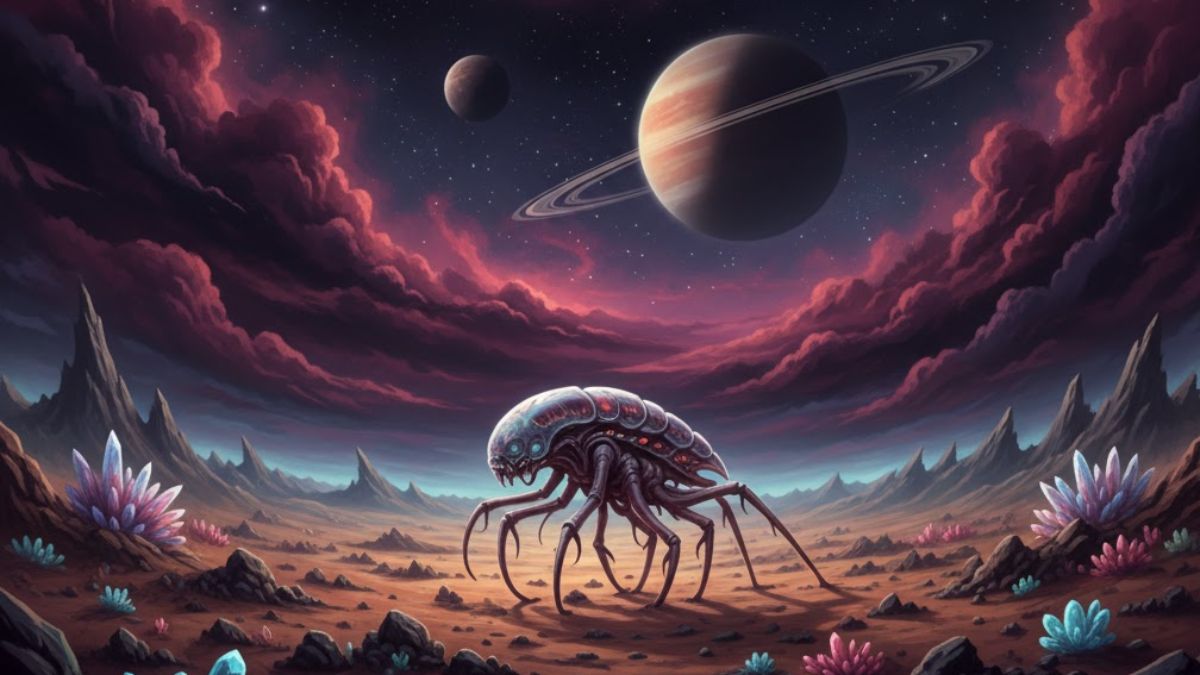
For as long as humans have looked up at the stars, we have asked one powerful question: are we alone? We send rovers to Mars to scratch at its dusty soil, looking for signs of ancient lakes and rivers. We point giant telescopes at distant planets, searching for a faint, watery glint that hints at oceans. In our search for cosmic company, we have always followed a simple rule: follow the water. We believe that where there is water, there could be life. It makes perfect sense, because here on Earth, every single living thing we know, from the tallest tree to the tiniest microbe, needs water to survive.
But what if our own Earthly experience is limiting our imagination? What if we are like sailors who have only ever known one ocean, assuming all other seas must be exactly the same? The universe is an unimaginably vast and creative place, filled with worlds that defy our wildest dreams. On our planet, water is the magic ingredient, but what if on another world, a completely different liquid, or even a gas, does the same job? What if life out there is so strange that it doesn’t need anything like water at all?
This idea pushes the boundaries of everything we think we know. It forces us to wonder if our search for life is too narrow. Could we be missing signs of life because we’re only looking for something that looks familiar to us? The possibility that alien life could exist without water opens up a universe of much more exciting and bizarre possibilities. So, let’s dive into this fascinating question and explore the incredible ways life might thrive in the cosmic dark.
What is it about water that makes it so special for life?
To understand why life elsewhere might not need water, we first need to see why it’s so crucial for us. Water isn’t just a drink; it’s a fundamental part of every cell in our bodies. Think of it as a universal workshop. It can dissolve more substances than almost any other liquid, which means it can carry nutrients into living cells and carry waste products out. It’s like a busy delivery truck constantly moving essential supplies around.
Water is also a fantastic temperature regulator. Big bodies of water, like oceans, heat up and cool down very slowly. This helps keep a planet’s climate stable, preventing wild temperature swings that could easily wipe out delicate life forms. Imagine a world where the temperature changes by hundreds of degrees in a single day; life as we know it couldn’t handle that. Water provides a buffer, a stable environment where chemical reactions can happen at a steady pace.
Furthermore, water is involved in the most important chemical reactions for life. The process that plants use to make food, photosynthesis, needs water. The process that our cells use to create energy also needs water. When you look at it this way, water is less of a simple drink and more of the stage, the director, and a key actor in the play of life on Earth. It’s no wonder scientists see it as the gold standard. But is it the only standard?
If not water, then what else could support life?
If we let our imaginations run free, the universe offers some amazing alternatives. Scientists who think about these possibilities, known as astrobiologists, have proposed some truly alien liquids that could take water’s place.
One of the top candidates is ammonia. You might know ammonia as a strong-smelling cleaning product, but in the right conditions, it can behave a lot like water. It’s made of nitrogen and hydrogen, and it’s a liquid at much colder temperatures than water. On a frigid world far from its sun, vast oceans of ammonia could exist. Like water, ammonia is a good solvent, meaning it could dissolve other substances and allow the complex chemistry of life to take place. Imagine strange, sluggish creatures swimming slowly in deep, cold ammonia seas, their biology built on a completely different chemical foundation than our own.
Another fascinating possibility is methane and ethane. We have actually seen this on another world in our own solar system! Saturn’s moon, Titan, is so cold that methane flows as a liquid, forming rivers, lakes, and even rain that falls from clouds. Methane doesn’t dissolve things as well as water, but it could still facilitate a very slow, very different kind of chemistry. Life on Titan would have to be incredibly patient, with biological processes happening at an achingly slow pace, but it is not impossible. It would be life in a deep freeze, utterly unlike the watery, warm life of Earth.
Then there are the really exotic ideas. What about life forms that don’t need a liquid at all? Could life exist in the thick, dense atmospheres of gas giants like Jupiter? Some scientists speculate about creatures that live like balloons, floating in the clouds, feeding on chemical energy in the air. Or perhaps life could be based in liquid silicon instead of carbon, thriving in the scorching heat of a volcanic world. When we step away from water, the menu of possibilities becomes vast and wonderfully strange.
What would alien life without water even look like?
Trying to picture this is a fun challenge. Life that doesn’t use water would be built from the ground up with a different blueprint. Its body wouldn’t be made mostly of water like ours. It might not have the same soft, squishy cells that we do. A creature living in liquid methane would need to have a very different internal chemistry. Its body might be built from sturdier, more rigid materials to withstand the cold. It might use a substance other than DNA to pass on information, or it might not use molecules at all in a way we would recognize.
Their sense of time could be completely different. On a cold world with slow chemical reactions, everything would move more slowly. A thought, a movement, a heartbeat—if it had one—could take hours or days. Conversely, on a super-hot planet with fast-paced chemistry, life might be a frantic, hyper-speed blur, living its entire life cycle in what we would consider a single day.
Their methods of getting energy would also be alien. On Earth, most life relies on the Sun, but in a dark ocean under a moon’s icy crust, life would need to use chemical energy from hydrothermal vents on the seafloor. A floating creature in a gas giant’s clouds might harvest electrical energy from lightning storms. They wouldn’t eat plants or animals as we know them; they might “eat” rocks, gases, or pure energy. Their appearance would be a direct result of their environment, potentially looking more like crystalline structures, floating jellyfish-like bags of gas, or even rocky, slow-moving slugs.
Where in our own solar system might we find this kind of life?
We don’t have to travel to a distant star to search for life that doesn’t rely on water. Some of the most promising places are right here in our cosmic backyard. Mars is the classic candidate, and while we look for signs of past water, there’s also a chance for life to exist in its very dry soil using tiny traces of water or even a different solvent entirely, hidden deep underground.
The real excitement, however, lies with the icy moons of the giant planets. Jupiter’s moon Europa is a famous candidate, but it’s suspected to have a vast, salty water ocean under its icy crust. A more intriguing candidate for non-water-based life is Saturn’s moon, Titan, which we already mentioned. With its thick atmosphere and lakes of liquid methane, it is a perfect laboratory for the kind of life that doesn’t need a single drop of water. It’s a world where the rules are completely different.
Another fascinating moon is Enceladus, also orbiting Saturn. It spews giant geysers of water vapor from a hidden ocean into space, showing that it has liquid water. But the point is, our own solar system shows us that environments can be wildly diverse. If life can find a way in these extreme places, it might be using a chemistry we haven’t even thought of yet. By studying these worlds, we are essentially testing the limits of life itself.
How are scientists looking for these different kinds of life?
The search is happening in two main ways: by sending spacecraft to other worlds and by using powerful telescopes to study planets orbiting other stars. When we send a rover to Mars, it doesn’t just look for water; it analyzes the soil chemistry for any unusual patterns that might hint at biological activity, even if it’s not water-based. Future missions to Titan, like the Dragonfly drone, will fly through its atmosphere and land on its surface, specifically designed to study the complex chemistry that could lead to life.
The other method is using telescopes to analyze the light from distant exoplanets. When a planet passes in front of its star, the starlight filters through its atmosphere. Scientists can study that light to figure out what gases are present. Right now, they are looking for “biosignatures,” which are signs of life, like oxygen or methane in Earth-like proportions. But as we expand our idea of life, we are also starting to think about “technosignatures,” which could be signs of technology, and “aggressive biosignatures,” which might be weird combinations of gases that don’t make sense unless something alive is producing them.
For example, if we found a planet with an atmosphere rich in ammonia and certain other gases that normally react with each other, it could be a sign that something on that planet is constantly producing them, much like life on Earth produces oxygen. The search is becoming more creative, looking for the unexpected rather than just a reflection of ourselves.
Conclusion
The question of whether alien life can survive without water is more than just a scientific puzzle; it is a test of our creativity. Water is a wonderful, life-giving substance, and it will always be the first place we look. But the universe is under no obligation to follow the rules we learned on our own planet. By imagining life based on ammonia, methane, or even stranger chemistries, we open our minds to the true potential of the cosmos.
The universe is probably teeming with life, but much of it might be so alien that we struggle to recognize it. It might be living in oceans we can’t swim in, breathing air that would be poison to us, and thinking thoughts we cannot comprehend. The search for this life is one of the greatest adventures humanity has ever undertaken. It forces us to look beyond our own experience and consider the incredible diversity of existence. So the next time you see a picture of a distant, cloudy exoplanet or a frozen moon, ask yourself: what kind of life could call that place home? The answer might be stranger than we can possibly imagine.
FAQs – People Also Ask
1. Why do scientists always look for water when searching for alien life?
Scientists look for water because all life on Earth needs it to survive. It is a known and essential ingredient for our kind of life, making it a logical and reliable starting point in the search for life elsewhere in the universe.
2. What is the most likely place to find non-water-based life in our solar system?
Saturn’s moon Titan is the most likely candidate, as it has lakes and rivers of liquid methane and ethane. Its cold environment and unique chemistry make it a prime location for life that operates differently from life on Earth.
3. Can life exist in a gas form?
While it seems very strange to us, some scientists theorize that life could exist in the dense clouds of gas giants, perhaps as floating, energy-harvesting organisms. However, this is highly speculative and we have no evidence for it yet.
4. What would aliens that breathe methane look like?
It’s hard to say, but they would be built for extreme cold and might have bodies made of sturdier materials. They could be slow-moving and might look very different from Earth’s animals, perhaps resembling crystalline structures or gelatinous floaters.
5. Is there any proof of alien life existing right now?
As of now, there is no confirmed proof that alien life exists anywhere. Scientists have found promising environments on other worlds, but they have not yet found any direct evidence of living organisms.
6. How can we detect life on planets that are light-years away?
We use powerful telescopes to analyze the atmospheres of distant planets. By looking for specific combinations of gases that are unlikely to occur without a biological source, we can find potential hints of life.
7. What is astrobiology?
Astrobiology is the scientific field that studies the origin, evolution, distribution, and future of life in the universe. It combines biology, chemistry, geology, and astronomy to understand how life begins and where it might exist.
8. Could life be based on something other than carbon?
Scientists have proposed silicon as a possible alternative to carbon, as it can also form complex molecules. However, silicon-based life would likely require extremely high temperatures and would look very different from any life we know.
9. What is the biggest challenge in finding non-water-based life?
The biggest challenge is that we don’t know exactly what to look for. Our tools and methods are designed to find life similar to Earth’s, so we might not recognize the signs of a completely different kind of biology.
10. If we found alien life, how would it change our world?
The discovery of any form of alien life, even microbes, would be one of the most profound events in human history. It would change our understanding of biology, our place in the universe, and philosophy and religion, showing that life is not a unique feature of Earth.