

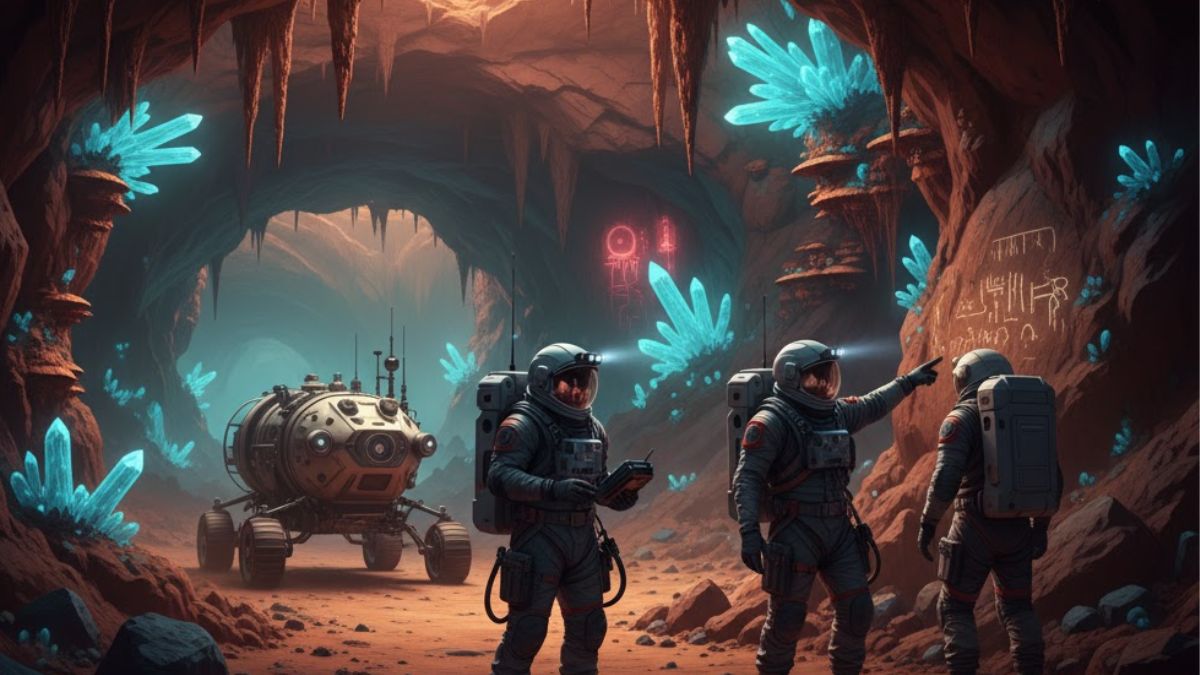
For centuries, people have looked up at the night sky and wondered about the little red dot known as Mars. Is it just a dusty, empty rock, or could it be hiding a secret? We’ve sent robots and orbiters to study its surface, and they’ve sent back pictures of a world that looks dry, cold, and still. It seems like a place where nothing could possibly live. But what if we’ve been looking in the wrong places all this time? What if the real story of Mars isn’t on its surface, but deep beneath it?
Think about some of the toughest life forms on Earth. We find amazing creatures living in the darkest parts of the ocean, far away from the sun’s light. We find bacteria thriving in boiling hot springs or buried deep in solid rock. Life has a incredible way of popping up in the most unexpected places, as long as it has just a few key things to survive. This makes scientists wonder if the same could be true for Mars. If life ever began there, the surface is now a very difficult place to live. But underground, it might have found a perfect safe haven.
This idea takes us on a journey to explore one of the most exciting possibilities in space science today. We are going to look at why the surface of Mars is so unfriendly, what amazing things we might find below the ground, and how scientists are planning to search for these hidden secrets. So, if the surface of Mars is a barren desert, could an entire world of life be waiting for us in the dark, underground caves of the red planet?
Why is the Surface of Mars So Unfriendly to Life?
To understand why life might be hiding underground, we first need to see why the surface of Mars is such a tough neighborhood. Imagine standing on Mars. The ground beneath your feet is rusty red dust and rock. The sky is often a pale pink color. It might look a little familiar, but the conditions are extremely harsh.
First, the air on Mars is very thin. It’s about one percent as thick as Earth’s air. This means there’s barely any oxygen to breathe. It also means there’s no protective blanket to hold onto the sun’s heat. Because of this, Mars is freezing cold. On a nice summer day near the equator, it might get up to a pleasant 70 degrees Fahrenheit, but at night, the temperature can plunge to -100 degrees. That’s colder than the coldest place on Earth.
Another big problem is radiation. On Earth, we are protected by a magnetic field and a thick atmosphere. These two things act like a shield, blocking out harmful radiation from the sun and outer space. Mars has lost its magnetic field, and its atmosphere is too thin to help. This means the surface is constantly bombarded with this radiation. It would be very dangerous for any living thing to be exposed to it for a long time.
Lastly, the soil itself is not very friendly. It’s not like the soil in your garden. Scientists have found that it contains chemicals called perchlorates. These are salts that can be toxic to many living organisms. When you combine the toxic soil, the deadly radiation, the freezing temperatures, and the lack of breathable air, the surface of Mars seems like the last place you would find life. It’s a challenging environment that would be very difficult for any creature to call home. This is exactly why scientists are so interested in looking below the surface, where conditions could be much more comfortable.
What Makes Underground Mars a Better Home?
If the surface is so bad, where could life possibly go? The answer might be right under our feet, or more accurately, right under the Martian soil. Going underground on Mars could solve almost all the problems the surface creates. It’s like finding a cozy, safe basement during a bad storm.
The most important thing underground provides is protection. Several meters of rock and soil would be a fantastic shield against the radiation that pours onto the surface. It would block those harmful rays, creating a much safer environment. This same layer of rock would also help to keep the temperature stable. On the surface, temperatures swing wildly from day to night. But underground, the changes are much smaller. It could create a place that stays at a relatively constant, and perhaps even warmer, temperature all the time.
Another exciting idea is the possibility of water. We know that liquid water cannot exist for long on the surface of Mars today. It would either freeze solid or boil away because of the low air pressure. However, scientists have strong evidence that there might be large deposits of water ice underground. There’s even a possibility of salty lakes, deep below the surface at the south pole. Water is the key ingredient for life as we know it. If there is liquid water underground, it would be a game-changer. It could provide a home for tiny organisms, just like groundwater on Earth supports vast ecosystems of microbes.
Think of it like a secret city. The surface is the harsh, uninhabitable outside world. But underground, there could be a network of tunnels, caves, and porous rocks filled with water, protected from the extremes, and maybe, just maybe, teeming with microscopic life. This hidden world could be the only place where life, if it ever began on Mars, was able to survive and even thrive after the planet’s surface became a desert.
Have We Found Any Entrances to an Underground World?
If we want to find this hidden underground world, we need a way in. How can we possibly explore what’s beneath the ground from millions of miles away? It turns out that we might not have to dig. Mars may have provided its own doorways, and our robots in space have already taken pictures of them.
These doorways are caves. From orbit, satellites like NASA’s Mars Reconnaissance Orbiter have spotted dark, circular holes on the Martian surface. These holes are called “skylights.” They are not just craters from impacts. They are openings to what appears to be large, underground caverns. In some images, you can see that the hole leads down into a dark, spacious room. We don’t know exactly how big these caves are or how far they go, but they are a direct passage into the subsurface.
These caves were likely created by ancient volcanic activity. Billions of years ago, when Mars was more geologically active, lava flows swept across the surface. When the outside of a lava flow cools and hardens into a tube, but the inside molten lava keeps flowing and then drains away, it leaves behind a long, hollow tunnel. We have similar lava tubes here on Earth, in places like Hawaii and Iceland. On Mars, the roofs of some of these giant tubes have collapsed in certain spots, creating the skylights we see from orbit.
These caves are the perfect place to start looking for life. They offer all the benefits of being underground—protection from radiation and stable temperatures—with an easy way for future rovers or even human explorers to enter. A cave could be like a natural habitat, a ready-made home for any Martian microbes. Sending a robot down into one of these skylights is a dream mission for many scientists, as it would give us our first real look into the hidden world of Mars.
What Kind of Aliens Could Be Living There?
When we hear the word “aliens,” we often picture little green men with big eyes, or strange creatures from science fiction movies. But the reality of what we might find on Mars is probably very different, and in its own way, just as amazing.
If there is life on Mars, it is almost certainly microbial. This means we are looking for tiny, single-celled organisms like bacteria or archaea. These are the simplest forms of life on Earth, and they are also the toughest. They can live in places without oxygen, in extreme heat or cold, and in total darkness. On Mars, these microbes would likely be “subsurface lithotrophic microorganisms.” That’s a complicated phrase, but it simply means they are tiny life forms that live inside rocks and eat rocks for energy.
Since there is no sunlight underground for photosynthesis, these microbes couldn’t be like plants. Instead, they would use a process called chemosynthesis. They would get their energy from chemical reactions. For example, they might feed on the iron, sulfur, or other minerals in the Martian rocks. They might even live off the hydrogen gas that can be produced when water reacts with certain types of rock. They wouldn’t need oxygen or light. They would just need rock, water, and a stable environment.
Finding even a single, tiny microbe on Mars would be one of the most important discoveries in human history. It would prove that life is not something unique to Earth. It would mean that the universe is likely filled with life. If we found that life on Mars is completely different from life on Earth, with a different biological structure, it would suggest that life started independently in two different places in our own solar system. This would mean that the recipe for life is probably common throughout the cosmos, and we are not alone. So, while they wouldn’t be little green men, these Martian microbes would be the most incredible aliens we could ever hope to find.
How Will We Search for These Hidden Martians?
Finding these tiny microbes hidden deep underground is not an easy task. Our current rovers, like Perseverance and Curiosity, are incredible machines, but they are designed to study the surface. They can drill a few inches into rocks, but they cannot reach the deep, protected underground environments where life is most likely to be. So, how will we search for these hidden Martians?
The next step is to send missions that are specifically designed to explore the subsurface. Space agencies are already planning for this. One idea is to send a rover that can go beyond simple drilling. It would need a drill that can reach several meters down, far enough to get below the radiation-sterilized top layer of soil. It could then bring up samples from a depth where microbes could potentially survive. Another, even more exciting mission, is to send a robot to one of the cave skylights we talked about. This robot could lower itself down into the cave on a tether, like a spelunker, and explore the cavern walls and floor directly.
The most promising plan involves bringing samples back to Earth. NASA’s Perseverance rover is already collecting tubes of rock and soil from the surface. A future mission will fly to Mars, pick up these sample tubes, and bring them back to our best laboratories. Here on Earth, scientists can study them with massive, sensitive equipment that is too big to send to Mars. They could look for subtle signs of life, like specific molecules or even fossilized microbes. If we can get samples from underground, perhaps from a future drilling mission, our chances of finding evidence of life would be even higher.
Ultimately, the search might require humans on the scene. Astronauts on Mars could make decisions and observations that robots cannot. They could explore caves in person, set up complex drilling operations, and analyze samples in a mobile lab. Sending humans to Mars is a huge challenge, but it may be the best way to finally answer the ancient question: Are we alone in the universe, or is our nearest planetary neighbor hiding a secret world of life just beneath the surface?
Conclusion
The surface of Mars tells a story of a world that grew quiet and cold. But the story beneath the surface might be completely different. It could be a story of survival, where life found a way to retreat into the depths, clinging to existence in pockets of water and safety. The idea that aliens could be living underground on Mars is no longer just science fiction. It is a serious scientific possibility based on what we know about life on Earth and the environment on Mars.
While these aliens are likely to be tiny microbes, their discovery would change everything. It would transform our understanding of our place in the cosmos. As we develop new technologies to dig deeper and explore the hidden caves of Mars, we get closer to uncovering the truth. The red planet has kept its secrets for billions of years, but its time of mystery may soon be over. If life is there, we are on the path to finding it.
So, what do you think? If we one day drill into a deep Martian cave and find a community of microbes living there, how would that change the way you see our planet and our universe?
FAQs – People Also Ask
1. Why is Mars called the red planet?
Mars is called the red planet because its surface is covered in a fine dust that is rich in iron oxide. This is the same compound that gives rust its reddish-brown color, making Mars appear like a bright red star in our night sky.
2. Is there any water on Mars?
Yes, there is water on Mars, but it is mostly frozen in the polar ice caps or locked away as water ice in the soil underground. There is also evidence suggesting there might be very salty, liquid water lakes deep below the surface at the south pole.
3. How long does it take to get to Mars?
The journey to Mars takes about seven to nine months with our current rocket technology. The exact time depends on the positions of Earth and Mars in their orbits around the Sun, which change constantly.
4. Could humans ever live on Mars?
It is theoretically possible for humans to live on Mars, but it would be extremely challenging. We would need to build sealed habitats with air to breathe, find a source of water, grow food, and protect ourselves from radiation and the cold temperatures.
5. What is the temperature on Mars?
The temperature on Mars is very cold. It averages around -81 degrees Fahrenheit. It can reach a high of about 70 degrees Fahrenheit near the equator in summer, but can drop to -200 degrees Fahrenheit at the poles in winter.
6. How many moons does Mars have?
Mars has two small, irregularly shaped moons named Phobos and Deimos. Their names mean “Fear” and “Dread” in Greek, and they are thought to be asteroids that were captured by Mars’s gravity long ago.
7. Have we found any signs of life on Mars yet?
We have not found any definitive signs of life on Mars yet. Our rovers have found evidence that Mars had the right conditions for life in its ancient past, like water and organic molecules, but we have not discovered any actual living organisms or fossils.
8. What are the biggest challenges of living on Mars?
The biggest challenges include the intense radiation, the lack of breathable air, the freezing temperatures, the toxic soil, and the psychological difficulty of being so far from Earth. Getting enough supplies and food would also be a major hurdle.
9. Can plants grow on Mars?
Not in the Martian soil as it is. The soil is toxic and lacks the necessary nutrients. However, plants could potentially be grown in sealed greenhouses using specially treated soil or hydroponic systems, using water extracted from the Martian ground.
10. Why are we so interested in Mars?
We are interested in Mars because it is the most Earth-like planet in our solar system. By studying Mars, we learn more about the history of our own planet, the potential for life elsewhere, and the possibilities for future human exploration and settlement beyond Earth.