

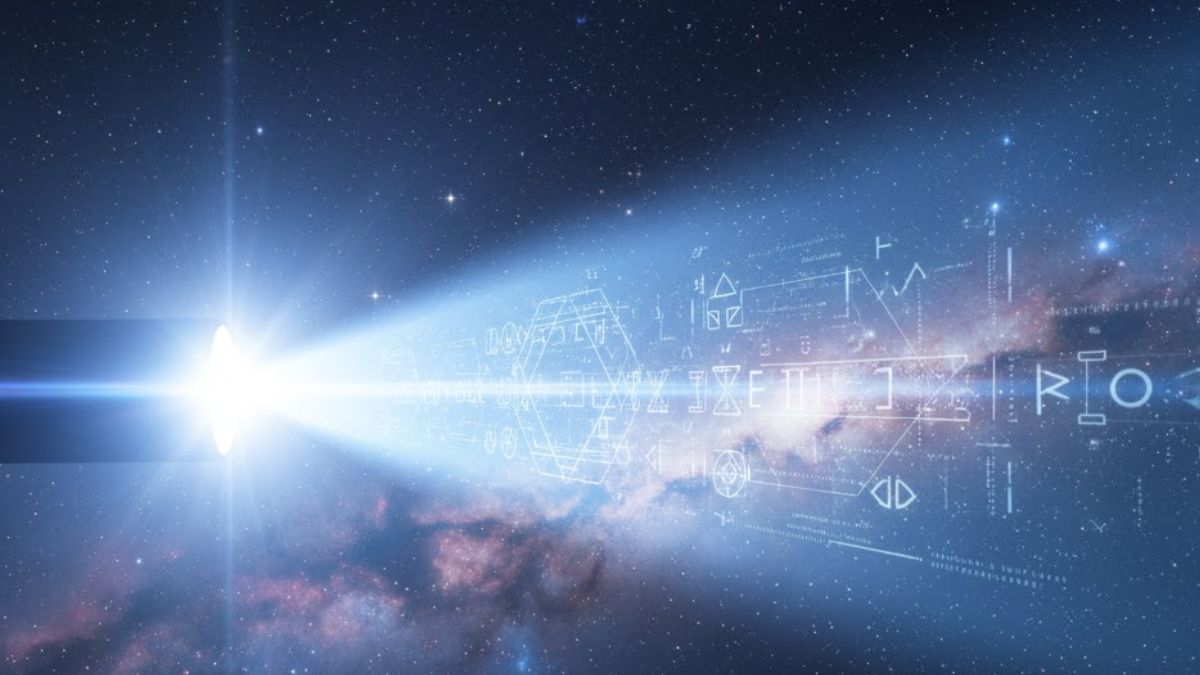
Think about the last time you felt the warmth of sunlight on your skin. That light traveled 93 million miles from the Sun, through the empty darkness of space, just to reach you. It’s something we see every day, so ordinary that we hardly ever stop to think about what light really is. We flip a switch and a room brightens. We see the stars twinkling at night and accept it as a simple fact of life.
But what if light is more than just brightness? What if every beam of light, from the one coming from your lamp to the one from a distant star, is carrying a secret story? Scientists have discovered that light isn’t just a blank, featureless wave. It’s packed with information, a complex code that tells us about where it’s been, what it’s touched, and what created it. It’s like a cosmic messenger, whispering secrets across the universe.
For centuries, humans have looked up at the sky and wondered what’s out there. Today, we have the tools to start listening to what the light is trying to tell us. So, how do we crack this cosmic code, and what incredible messages might we find hidden within the light itself?
What is Light, Really?
We often talk about light as if it’s a simple thing. You see it, and that’s that. But to understand its hidden messages, we need to know what we’re dealing with. Think of light as a tiny, energetic packet called a photon. These photons are the universe’s ultimate messengers. They don’t have any weight, and they travel at the fastest speed possible—the speed of light.
Now, imagine a photon as a super-fast delivery truck. This truck is carrying a very special piece of information about the object that sent it. This information isn’t written in words, but in color and energy. The color of light is determined by its wavelength, which is just a scientific way of describing the distance between the peaks of its wave. Blue light has short, tight waves, while red light has long, stretched-out waves. This simple concept of color is the first letter in light’s secret alphabet. By carefully studying the specific colors that make up the light from an object, scientists can start to read its story.
How Can Light Carry a Message?
Light’s ability to carry information comes from a special property it has. When light is created or when it passes through a gas, it leaves a unique fingerprint. This fingerprint isn’t a physical mark; it’s a pattern hidden within its colors. Let’s use a simple example. Think about a neon sign. It glows with a bright, specific color, like red or blue. That specific color is a message. It tells us what kind of gas is inside the sign’s tube. The electricity makes the gas atoms excited, and when they calm down, they release light of a very specific color.
This same principle works for stars and planets. The light from a star is like a bustling city of different colors all mixed together. But when that light passes through the atmosphere of a distant planet, the gases in that atmosphere—like oxygen, methane, or carbon dioxide—act like thieves. They steal very specific colors of light, leaving behind dark lines in the star’s colorful rainbow. Scientists, using tools called spectrometers, can see these dark lines. Each missing color is a clue. It’s like finding a set of fingerprints at a scene. By matching these “fingerprints” to known gases, we can say, “Aha! This planet’s air contains water vapor!” without ever going there.
What Are Scientists Listening For?
When we talk about listening to light, we are really talking about decoding these fingerprints. This field of science is called spectroscopy, and it is our most powerful tool for understanding the universe without leaving Earth. For a long time, astronomers simply looked at the brightness of stars and planets. Now, they “read” them. They spread the light out into a full rainbow, called a spectrum, and look for those tell-tale lines.
What messages are they finding? They can determine the temperature of a star. A star glowing blue is incredibly hot, while a red star is relatively cooler. They can figure out what the star is made of—hydrogen, helium, iron, and more. They can even tell if a star is moving towards us or away from us, and how fast, by seeing how the light’s colors are squeezed or stretched. This is like the Doppler effect you hear when a ambulance siren changes pitch as it races past you. The most exciting message might be the one that points to life. By finding the fingerprints of gases like oxygen and methane in the atmosphere of a distant Earth-like planet, we might one day find a message written in light that says, “Life is here.”
Could We Use Light to Talk to Aliens?
This is perhaps the most thrilling idea. If we can read the messages in starlight, could another civilization be doing the same? And more than that, could we intentionally send a message using light? The concept is at the heart of the search for extraterrestrial intelligence, or SETI. Instead of just listening for accidental messages in light, some scientists are also looking for signals that are deliberately sent.
Imagine a powerful laser beam pointed from another star system towards Earth. It could flash on and off in a complex pattern, like Morse code. This would be a clear sign of an intelligent message, because nature doesn’t create such perfect, repeating patterns in laser light. We are already doing something similar on a smaller scale. We have used giant radio telescopes to beam coded messages towards distant star clusters, hoping that an advanced civilization might one day point their instruments our way and decode our “hello.” Light, whether it’s the visible kind or other forms like radio waves, is the only practical way we have to send a message across the unimaginable distances of space.
What Secrets Does Ancient Light Hold?
The oldest light in the universe is still traveling, and it holds the biggest secret of all: the story of our cosmic origin. This light is called the Cosmic Microwave Background, or CMB. It is the faint afterglow of the Big Bang, the event that started everything. For the first 380,000 years after the Big Bang, the universe was a hot, dense fog of particles and light. Light couldn’t travel anywhere without immediately crashing into something.
As the universe expanded and cooled, it finally became transparent. The light from that moment burst free and has been traveling ever since. That light is all around us today. By mapping the tiny, tiny differences in the temperature of this ancient light, scientists can create a baby picture of the universe. This light tells us how old the universe is, what it’s made of, and how the first seeds of galaxies were planted. It is the ultimate hidden message, a letter from the very beginning of time, written in the simplest light, and we are just now learning how to read it.
Conclusion
Light is so much more than what lets us see. It is a constant stream of information flowing from every corner of the cosmos. From telling us what a distant world is made of, to carrying the faint echo of creation itself, light is the universe’s way of telling its story. Every time we look up at the night sky, we are surrounded by billions of these messages, all traveling at the speed of light, each with a unique tale to tell.
We have only just begun to learn the language. As our telescopes become more powerful and our understanding deepens, what other incredible messages will we find? Could the next one we decode finally answer the age-old question: are we alone?
FAQs – People Also Ask
1. How fast does light travel?
Light travels at an incredible speed of about 186,282 miles per second (299,792 kilometers per second). This means that light from the Sun takes roughly 8 minutes to reach Earth.
2. What is the main source of light in our solar system?
The Sun is the main and most powerful source of light in our solar system. Its nuclear fusion reactions generate immense amounts of light and heat that illuminate and warm all the planets.
3. Can we see all types of light?
No, human eyes can only see a tiny part of all the light that exists, called “visible light.” Other types, like radio waves, microwaves, infrared, ultraviolet, X-rays, and gamma rays, are invisible to us but can be detected with special instruments.
4. Why do stars twinkle?
Stars twinkle because their light has to pass through Earth’s moving and turbulent atmosphere. The air bends and distorts the starlight, making the star appear to shimmer and flicker.
5. How do scientists know what stars are made of?
Scientists use an instrument called a spectroscope to spread a star’s light into a rainbow-like spectrum. Dark lines in this spectrum act as chemical fingerprints, revealing which elements, like hydrogen or helium, are present in the star.
6. What is a light-year?
A light-year is the distance that light travels in one whole year. It is a measure of distance, not time. One light-year is about 5.88 trillion miles (9.46 trillion kilometers).
7. How does light tell us if a star is moving?
When a star moves towards us, its light waves get squeezed, making the light appear slightly bluer. When it moves away, the light waves are stretched, making it appear slightly redder. This is known as the Doppler effect.
8. What is the Cosmic Microwave Background?
The Cosmic Microwave Background (CMB) is the oldest light we can observe. It is the remnant heat and light from the Big Bang, filling the entire universe and providing a snapshot of what the cosmos was like in its infancy.
9. Can light be used for communication on Earth?
Yes, light is widely used for communication. Fiber optic cables use pulses of light to transmit vast amounts of information for internet, telephone, and television signals at very high speeds.
10. What color of light has the most energy?
Violet and blue light have shorter wavelengths and carry more energy. Red light has longer wavelengths and carries less energy. Beyond visible light, ultraviolet and X-rays have even more energy.