

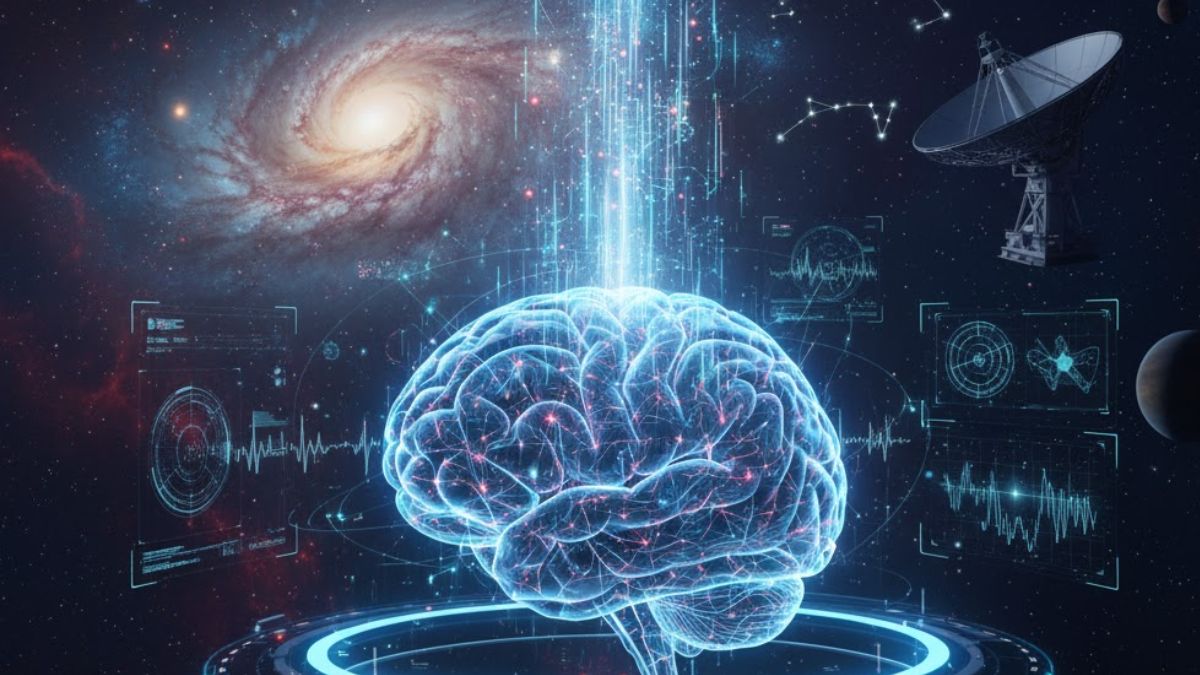
There’s a quiet moment we all experience sometimes. You’re lying in bed at night, and the world is completely still. In that silence, your own thoughts can feel incredibly loud and vivid. Where do they come from? Are they truly just yours? Now, let’s stretch that idea a little further. What if some of those flashes of insight, those sudden dreams, or even that feeling of being connected to something larger, weren’t entirely generated from within? What if, in a way we don’t yet understand, our minds were picking up signals from much, much farther away?
For decades, we have been searching the skies for signs of intelligent alien life. Giant radio telescopes scan the heavens, listening for a deliberate “hello” in the cosmic noise. This scientific search is based on a simple idea: an advanced civilization would likely use a technology we can detect, like radio waves. But what if we are looking for the wrong thing? What if the message isn’t coming through the air as a radio signal, but through space and time in a way we can’t yet measure? Some scientists and thinkers have proposed a fascinating, though controversial, theory. They suggest that the human brain itself might be a kind of biological receiver, capable of tuning into information from the universe.
This idea sits at the edge of science and philosophy. It asks us to consider that consciousness might not be a simple product of our brain’s biology, but something more mysterious and connected to the cosmos. This article will explore this captivating possibility. We’ll look at what science knows about the brain, how we currently search for aliens, and why the concept of the mind as a cosmic receiver is so compelling. So, the next time you have a brilliant idea out of the blue, could it be that you accidentally tuned into a signal from the stars?
What is the ‘Receiver’ Theory of the Brain?
To understand this idea, let’s start with a simple comparison. Think about your car radio. When you turn it on and select a station, you’re not creating the music inside the radio. The music—the signal—is already all around you, traveling invisibly through the air. The radio is built to detect that specific signal and translate it into the songs you can hear. The receiver theory of the brain suggests that our minds might work in a similar way.
According to this view, your brain doesn’t necessarily create consciousness from scratch. Instead, it might filter and process a consciousness that already exists, much like the radio translates a signal. Your brain, with its billions of neurons, could be a complex biological device that takes a vast, non-physical field of information and turns it into your personal experience—your thoughts, feelings, and sense of self. This would mean that consciousness is a fundamental part of the universe, like gravity or matter. If that’s true, then it’s not a huge leap to think that this universal field of consciousness could contain information from other minds, or other sources, across the vastness of space.
This idea was famously supported by the renowned scientist Dr. John Eccles. He believed the mind was more than just the brain. He proposed that the brain acts like a receiver, and the mind or soul is the signal it picks up. This would explain some of the great mysteries of human experience. For instance, why do identical twins, who share nearly identical DNA and brain structure, often have very different personalities and tastes? If the brain is just a receiver, it could be tuned to slightly different “stations,” producing different experiences. Why do people sometimes have sudden, profound insights or creative ideas that seem to come from nowhere? Perhaps, for a moment, their receiver tuned into a new and powerful source of information.
How Do We Normally Look for Alien Signals?
When we think about finding aliens, most of us picture a giant, white satellite dish pointed at the stars. This is the world of SETI, the Search for Extraterrestrial Intelligence. For over sixty years, scientists involved in SETI have been using powerful radio telescopes to listen for any pattern in the cosmic static that seems artificial. They are looking for a signal that stands out from the natural noise of the universe—a deliberate broadcast.
Imagine you are walking through a dense forest. All you can hear is the natural sound of the wind, birds, and insects. Suddenly, you hear a clear, rhythmic drumbeat. You would know instantly that it wasn’t made by nature; it was made by an intelligence. SETI scientists are doing the same thing, but on a cosmic scale. They are sifting through the radio waves coming from distant stars and galaxies, hoping to find that cosmic drumbeat. They assume that an advanced civilization would use a technology we can understand, like radio waves or laser beams, to communicate across space.
This method makes a lot of sense, but it also has its limits. It assumes that aliens communicate in a way that we can currently detect with our machines. What if a civilization is millions of years more advanced than us? Their technology for sending messages might be as far beyond our understanding as a smartphone is to a stone-age tool. They might use neutrinos, gravitational waves, or something we haven’t even discovered yet. Or, perhaps, they have found a way to communicate directly through the fabric of consciousness itself, a medium that wouldn’t require building any physical machinery at all.
What Are the Unexplained Powers of the Human Mind?
The receiver theory becomes more interesting when we look at some of the strange and unexplained abilities of the human mind. Throughout history, people have reported experiences that are very difficult to explain if the brain is only a closed system that produces its own thoughts.
Consider the concept of intuition, that “gut feeling” that sometimes guides us. You might suddenly think of a friend you haven’t spoken to in years, and a moment later, they call you. Is this just a coincidence, or could it be a faint signal picked up by your mind? There are countless stories of people who had a strong feeling of danger, avoided a certain flight or route, and later discovered it met with disaster. While many of these can be chalked up to chance, the sheer number of such reports makes you wonder.
Then there is the phenomenon of savants. These are individuals who, often despite significant mental disabilities, possess one area of incredible brilliance. Some can perform complex mathematical calculations in their head instantly, or play a piece of music perfectly after hearing it only once. Where does this ability come from? If the brain is just a computer made of meat, how does it access such profound knowledge without being taught? The receiver theory offers a potential explanation: perhaps their unique brain wiring allows them to tap more directly into a vast field of universal information, like a radio that gets a clearer signal than others.
Even the process of creativity and invention hints at this. Many great inventors and artists describe their best ideas as coming to them in a flash, fully formed, as if they were “downloaded” from somewhere else. The chemist August Kekulé famously discovered the ring-shaped structure of the benzene molecule after dreaming of a snake biting its own tail. It felt less like he figured it out and more like the answer was given to him. These moments of sudden genius challenge the idea that all knowledge is built slowly from experience, suggesting we might sometimes have access to a wider library of information.
Could Dreams Be a Window to the Cosmos?
Every night, we all enter a strange and vivid world. We dream. In our dreams, the normal rules of reality don’t apply. We can fly, talk to people who are no longer with us, and visit impossible landscapes. For scientists, dreams are mostly seen as the brain’s way of sorting through memories and emotions from the day. But what if they are also something more? Could dreams be a time when our brain-receiver is more open to picking up distant signals?
When we are asleep, the part of our brain that controls logic and focused attention is quiet. This might allow other, more subtle processes to come to the fore. It’s like turning down the volume on a loud, local radio station so you can hear a faint, distant one. In this state, perhaps our mind is more receptive to the background “hum” of the universe. This could explain why some people report prophetic dreams or dreams that seem to carry information they had no way of knowing.
There are many documented cases of artists and writers who have drawn inspiration from their dreams. Mary Shelley conceived the idea for her novel “Frankenstein” from a vivid nightmare. The famous scientist Niels Bohr said he developed his model of the atom after dreaming of the sun. While these could just be the brain creatively processing information, it’s intriguing to think that the relaxed, unfocused state of sleep might allow the brain to tune into a cosmic frequency where ideas and information are freely floating. If consciousness is universal, then the dream state might be our personal connection point to that vast network.
What Does Modern Science Say About Consciousness?
For a long time, mainstream science has held a straightforward view of consciousness. It’s called materialism. This view says that everything you are—your thoughts, your feelings, your awareness—is simply the result of electrical and chemical activity in the three-pound lump of tissue inside your skull. According to this, when the brain dies, consciousness simply ends, like a light switching off.
However, this materialistic view is starting to face some serious challenges. One of the biggest puzzles is the phenomenon of Near-Death Experiences, or NDEs. Thousands of people who have been clinically dead, with no brain activity, have reported incredibly vivid experiences. They describe floating outside their bodies, watching doctors work on them, and moving through tunnels of light. If consciousness is only produced by the brain, how can people have clear, structured memories from a time when their brain was completely shut down?
These reports have led some scientists, like Dr. Sam Parnia, to seriously study what happens to consciousness after death. The findings are forcing a rethink. The receiver theory fits well with these mysteries. It suggests that the brain doesn’t produce consciousness, but rather transmits it. When the brain is damaged or dies, it’s like a radio that breaks. The music doesn’t cease to exist; it’s just that the radio can no longer play it. The signal is still out there. This would explain how people can have conscious experiences when their biological receiver is offline—they are directly experiencing the signal itself.
Is There Any Physical Evidence for This Idea?
This is the toughest question for the receiver theory. How do you prove something that seems so spiritual with physical science? The main evidence right now is indirect, coming from the puzzles of quantum physics. At the very smallest level of the universe, the world of tiny particles behaves in very strange ways. Particles can be connected over vast distances, instantly affecting each other—a phenomenon called “quantum entanglement.” This suggests that the universe is fundamentally interconnected in a way we cannot see.
Furthermore, in quantum physics, the act of observation seems to affect reality. Particles exist in a blurry state of all possibilities until they are measured. This has led some physicists to propose that consciousness itself is a fundamental force that shapes the universe. If consciousness is built into the fabric of reality, then the idea that our brains are local receivers for this universal consciousness becomes much more plausible.
While we don’t have a machine that can detect an “interstellar thought,” the ongoing mystery of consciousness and the weirdness of the quantum world leave the door wide open for extraordinary possibilities. The evidence isn’t a smoking gun, but it’s a compelling reason to keep asking the question and to not dismiss the idea as pure science fiction.
Conclusion
The question of whether our brain is a receiver for interstellar signals takes us on a journey from the practical search for aliens to the deepest mysteries of our own existence. It’s a idea that blends science, philosophy, and a sense of wonder. While we may not have definitive proof, the concept offers a beautiful and humbling perspective. It suggests that we are not isolated beings trapped inside our skulls, but are fundamentally linked to a vast, possibly intelligent, universe.
This theory encourages us to value those quiet moments of intuition, the sudden spark of creativity, and even the bizarre landscapes of our dreams. It proposes that these might be more than just random neural fireworks; they might be whispers from the cosmos, faint signals that our incredible biological receiver is picking up. So, the next time you have a thought that seems to come from nowhere, maybe just pause for a second. Could it be that you are, for a fleeting moment, tuning into something truly cosmic?
What do you think—is your mind your own, or is it a channel for the universe?
FAQs – People Also Ask
1. What is the receiver theory of consciousness?
The receiver theory suggests that the brain does not create consciousness but instead acts like a radio receiver, tuning into a consciousness that is a fundamental part of the universe. It filters a universal field of awareness into our personal thoughts and experiences.
2. How do scientists search for alien life?
Scientists primarily use large radio telescopes to scan the sky for artificial patterns in radio waves, a project known as SETI (Search for Extraterrestrial Intelligence). They also look for signs of life by studying the atmospheres of distant planets for gases like oxygen or methane that could be produced by living organisms.
3. Can the human brain pick up radio waves?
No, the human brain cannot pick up man-made radio waves like those from a station. The receiver theory is a metaphor; it suggests the brain might access information through a medium we don’t yet understand, not that it works like a literal radio.
4. What is intuition and where does it come from?
Intuition is that immediate feeling or understanding of something without conscious reasoning. Science says it’s likely the brain processing information subconsciously. The receiver theory offers an alternative idea: that it could be our brain picking up subtle signals from the universal field of consciousness.
5. Are near-death experiences proof of life after death?
While not definitive scientific proof, the consistent and vivid reports from people who have had near-death experiences, including accurate observations while clinically dead, are a major challenge to the idea that consciousness is solely produced by the brain and have led to serious scientific study.
6. What is the hard problem of consciousness?
The “hard problem” is the question of how and why physical processes in the brain give rise to subjective, personal experience. We know which brain areas light up when we feel love, but we don’t know how those signals create the feeling itself. The receiver theory is one proposed solution.
7. Did any famous scientists believe in this theory?
Yes, several prominent figures have supported similar ideas. Nobel Prize-winning neuroscientist Sir John Eccles believed the mind was distinct from the brain. Pioneering mathematician Kurt Gödel and physicist Freeman Dyson also entertained ideas of a mind-like background to the universe.
8. How are dreams and creativity connected?
During dreams, the brain’s logical centers are less active, allowing for more free-flowing connections between ideas. This state can lead to creative breakthroughs, which some interpret as the brain being more open to receiving innovative ideas from a universal source of information.
9. What is quantum consciousness?
Quantum consciousness is a hypothesis that suggests quantum mechanical phenomena, like entanglement, are involved in the function of the brain and could explain the nature of consciousness. It proposes that the mind might operate on a quantum level, connecting it to the fundamental fabric of the universe.
10. Could artificial intelligence ever be conscious?
This is a hotly debated topic. If consciousness is purely a product of complex computation, then a sophisticated enough AI could become conscious. But if consciousness requires a biological receiver or is something fundamental that must be “tuned into,” then AI might never truly be aware, no matter how advanced it becomes.