

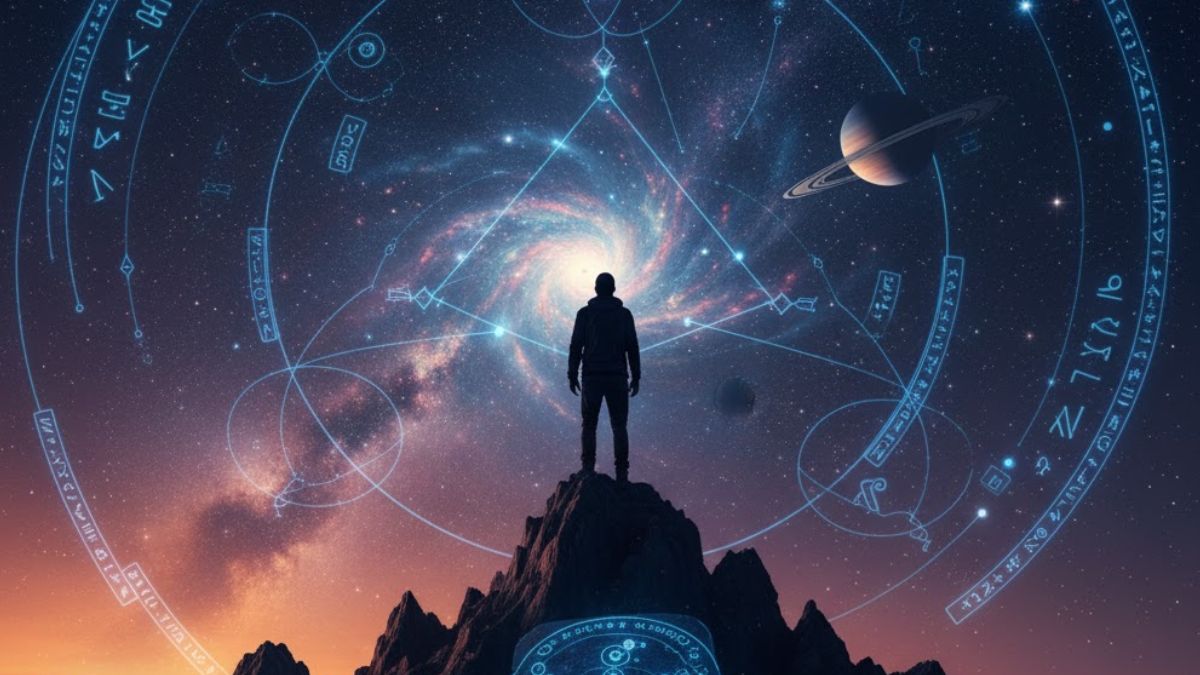
There is a quiet moment that happens for many of us, often on a clear night far from the glow of city lights. We look up, and the sky is not an empty black sheet. It is filled with countless tiny points of light, some bright, some faint, all shimmering. For a second, the busy thoughts in our heads quiet down, and a single, simple feeling takes over: wonder. It is a feeling that connects us to every human who has ever lived. Thousands of years ago, shepherds, farmers, and sailors stood under this same sky. They didn’t have telescopes or satellites, but they looked up at those same stars and felt that same pull of curiosity.
Today, we know a lot more about what stars actually are. We know they are gigantic balls of hot gas, nuclear furnaces burning millions of miles away. We have charts and maps and scientific names for them. But somehow, knowing the science doesn’t seem to erase that ancient feeling. In fact, it might make it stronger. Because when we learn that the light from a star like Polaris, the North Star, took over 400 years to reach our eyes, we are not just seeing a light in the sky. We are looking directly into the past. That light started its journey to Earth around the time Shakespeare was writing his plays.
This strange connection, this bridge between ancient wonder and modern science, leads to a fascinating question. Throughout history, humans have felt that the stars were more than just pretty lights; they seemed to have a message, a story, or a purpose. Could it be that this feeling is more than just imagination? Could the stars, in their own silent language of light and motion, actually be trying to tell us something? What if we just need to learn how to listen?
What Stories Did Ancient People See in the Stars?
Long before streetlights and smartphones, the night sky was humanity’s greatest storybook. Ancient people around the world didn’t just see random dots; they saw pictures. They connected the stars into patterns we call constellations, and each pattern held a myth, a lesson, or a piece of their culture. The constellation of Orion, the Hunter, is one of the most recognizable. The ancient Greeks saw a mighty hunter chasing a group of stars called the Pleiades across the sky. But on the other side of the world, the Maya of Central America looked at those same stars and saw a turtle. For the Aboriginal people of Australia, Orion’s belt was a group of young men fishing from a canoe.
These stories were more than just entertainment. They were a vital part of daily life. The stars were a giant calendar in the sky. The appearance of certain constellations would tell farmers when to plant their crops and when to harvest. For sailors, the stars were a map. By following the unchanging position of the North Star, they could navigate vast, unknown oceans. The stars were telling them very practical things about time and direction. But they were also telling deeper stories about creation, gods, and the meaning of life. They used the stars to explain the world around them and their place within it. The stars were a constant, guiding presence, offering both practical advice and spiritual comfort.
How Does Science Explain What Stars Really Are?
So, if ancient cultures heard messages in the stars, what is the modern, scientific translation? What are stars actually saying through the laws of physics? A star is born in a vast, cold cloud of gas and dust called a nebula. When a part of this cloud collapses under its own gravity, the material in the center gets squeezed so tightly that it becomes incredibly hot and dense. This triggers a process called nuclear fusion, where tiny atoms of hydrogen smash together to form helium. This reaction releases a colossal amount of energy in the form of light and heat. In its simplest form, a star is a giant, ongoing nuclear explosion, held together by its own gravity.
This process of nuclear fusion is the star’s voice. It is how a star communicates its very existence across the emptiness of space. The light that travels from a star to our eyes carries a wealth of information. Scientists can split this light into a rainbow, called a spectrum. By carefully studying this spectrum, they can learn the star’s recipe. They can tell what the star is made of, how hot it is, how old it is, and even how fast it is moving towards us or away from us. Every flicker of light, every color, contains a message about the star’s life and destiny. So, while a star isn’t sending a message in words, it is constantly broadcasting its life story. We just need the right tools, like telescopes and spectrometers, to decode that broadcast.
Could the Very Ingredients for Life Come from the Stars?
This might be the most profound message the stars have for us. Look at your own hand. Consider the air you breathe and the water you drink. What are you made of? Your body is built from elements like carbon, nitrogen, and oxygen. The iron in your blood gives it that red color. The calcium in your bones makes them strong. Where did all these essential ingredients for life come from? The astonishing answer is: from the hearts of long-dead stars.
When a star is living its life, it fuses hydrogen into helium. But for most of a star’s life, that is all it does. The real magic happens when a star dies. Small stars, like our Sun, will swell up and puff their outer layers into space, seeding the cosmos with new elements. But massive stars die in a much more dramatic way. They explode in a supernova. This incredible explosion is so powerful that it forges all the heavier elements in the universe. In that blinding flash, elements like gold, silver, and uranium are created and then scattered across galaxies. These stardust particles eventually come together in new clouds, forming new stars, new planets, and one day, us. This means that every single atom in your body, except for the hydrogen, was once inside a star that exploded billions of years ago. The stars are telling us that we are not just living under the cosmos; we are a part of it. We are literally made of stardust.
Is Anyone Else Out There Listening?
When we think about the stars trying to tell us something, our minds naturally jump to one of the biggest questions of all. Are we alone? With billions of stars in our galaxy, and billions of galaxies in the universe, it seems almost impossible that Earth is the only planet with life. Scientists are now actively trying to listen for messages. Projects like SETI, the Search for Extraterrestrial Intelligence, use giant radio telescopes to scan the heavens, hoping to pick up a signal that is clearly artificial—a pattern that could not be made by nature. It would be the ultimate message from the stars.
But even without a clear “hello,” the universe might already be giving us hints. Astronomers have discovered thousands of planets orbiting other stars. These are called exoplanets. Some of these distant worlds are in the “Goldilocks Zone” of their star, a place where it is not too hot and not too cold for liquid water to exist. Since water is essential for life as we know it, finding such planets is a strong clue that the conditions for life might be common. The stars are not sending us a direct radio broadcast yet, but by showing us that planets are everywhere, they are whispering that the possibility of other life is very, very real. The search itself is a way of listening to what the cosmos is suggesting.
What Can We Learn About Our Own Future by Watching the Stars?
Stars have life cycles, just like we do. They are born, they live for millions or billions of years, and they eventually die. By studying stars of different ages, we can piece together this cosmic life story. Our own Sun is a middle-aged star. It has been shining steadily for about 4.6 billion years, and it has about 5 billion more years to go. But its future, and therefore Earth’s future, is written in the fates of other stars we see. We can watch old, dying stars puff up into red giants, swallowing their inner planets. We can see the leftover cores of dead stars, called white dwarfs, glowing faintly with leftover heat. We can observe the incredible neutron stars and black holes that are left behind after a supernova.
This tells us that our Sun’s story is not forever. In the distant future, it will also swell into a red giant, making life on Earth impossible. This might sound scary, but understanding this process is a gift. It gives us a timeline. It motivates us to learn, to explore, and perhaps one day to travel to other stars. The stars are showing us the ultimate fate of our solar system, encouraging us to think long-term about our species’ journey. They are teaching us about change, impermanence, and the incredible cycles of creation and destruction that shape the entire universe.
Gazing at the stars today is a different experience than it was for our ancestors, but the feeling of connection remains. We now understand that the stars are not gods or spirits, but distant suns. Yet, in learning their scientific nature, their message has become even more profound. They tell us where we came from, revealing that we are made of the ashes of long-dead stars. They hint at the possibility of cosmic neighbors, suggesting we may not be alone in the vastness. And they show us the future, outlining the life cycle of our own Sun and solar system. The stars may not be trying to talk to us in words, but they are constantly communicating. They are sharing the story of the universe itself, a story of which we are a small, but wonderfully conscious, part. So, the next time you find yourself under a clear night sky, remember that you are not just a spectator. You are a part of this cosmic conversation. What do you think the next message from the stars will be?
FAQs – People Also Ask
1. Why do stars twinkle?
Stars twinkle because their light has to pass through Earth’s moving atmosphere before it reaches our eyes. The air is turbulent, bending and distorting the starlight, which makes it appear to flicker. Planets usually don’t twinkle as much because they are closer and appear as tiny disks, so the light is less affected by the air.
2. How many stars are in our galaxy?
Our home galaxy, the Milky Way, is estimated to contain between 100 billion and 400 billion stars. It’s impossible to count them all individually, so astronomers use the galaxy’s mass and other measurements to make a very educated guess.
3. What is the closest star to Earth?
The closest star to Earth is our Sun. The next closest star is a system called Proxima Centauri, which is about 4.24 light-years away. This means its light takes over four years to travel to us.
4. Can a star turn into a planet?
No, a star cannot turn into a planet. Stars and planets form in very different ways. A star forms from the collapse of a gas cloud and is massive enough to ignite nuclear fusion. A planet forms from the leftover dust and gas circling a young star.
5. What is a shooting star?
A shooting star isn’t a star at all. It is a small piece of space rock or dust, called a meteoroid, that burns up as it streaks through Earth’s atmosphere. The bright streak of light is the hot, glowing air around the burning particle.
6. What is the brightest star in the night sky?
The brightest star visible from Earth is Sirius, also known as the Dog Star. It’s actually a binary star system (two stars orbiting each other) and it appears so bright because it is relatively close to us and is intrinsically very luminous.
7. Why are some stars different colors?
The color of a star tells us about its temperature. Hotter stars glow blue or white, like Rigel. Medium-hot stars, like our Sun, glow yellow. Cooler stars appear orange or red, like Betelgeuse.
8. How do scientists know how far away a star is?
For closer stars, scientists use a method called parallax. They observe the star from two different points in Earth’s orbit around the Sun and measure its tiny apparent shift against the background of more distant stars. For very faraway stars, they use other methods involving the star’s brightness.
9. Will our Sun ever explode?
No, our Sun is not massive enough to end its life in a supernova explosion. Instead, in about 5 billion years, it will swell into a red giant, engulfing the inner planets, and then eventually shrink down to become a white dwarf.
10. Is there any sound in space?
Space is mostly a vacuum, so there is no air for sound waves to travel through. This means that the giant explosions of stars and other cosmic events are completely silent. However, scientists can convert the data from electromagnetic waves (like radio waves) into sound so we can “hear” them.