

For centuries, we have looked at the stars and wondered if we are alone. Every flicker of light in the night sky holds a question. What if, on a planet orbiting one of those distant stars, another form of life is looking back at us, asking the very same thing? The idea of meeting aliens has been the stuff of books and movies for a long time. But as our technology gets better, this wild idea starts to feel a little more possible. Scientists are now using powerful telescopes to scan the skies for signals, and we are even planning to send messages out into the cosmos, hoping someone will reply.
If that reply ever comes, our world would change forever. It would not just be a moment for scientists and world leaders; it would be a moment for every single person on Earth. Suddenly, we would have to think about questions we have never had to answer before. How do we say hello? How do we show we come in peace? And most importantly, how do we make sure that a meeting between two completely different kinds of intelligent life goes smoothly, without fear or misunderstanding?
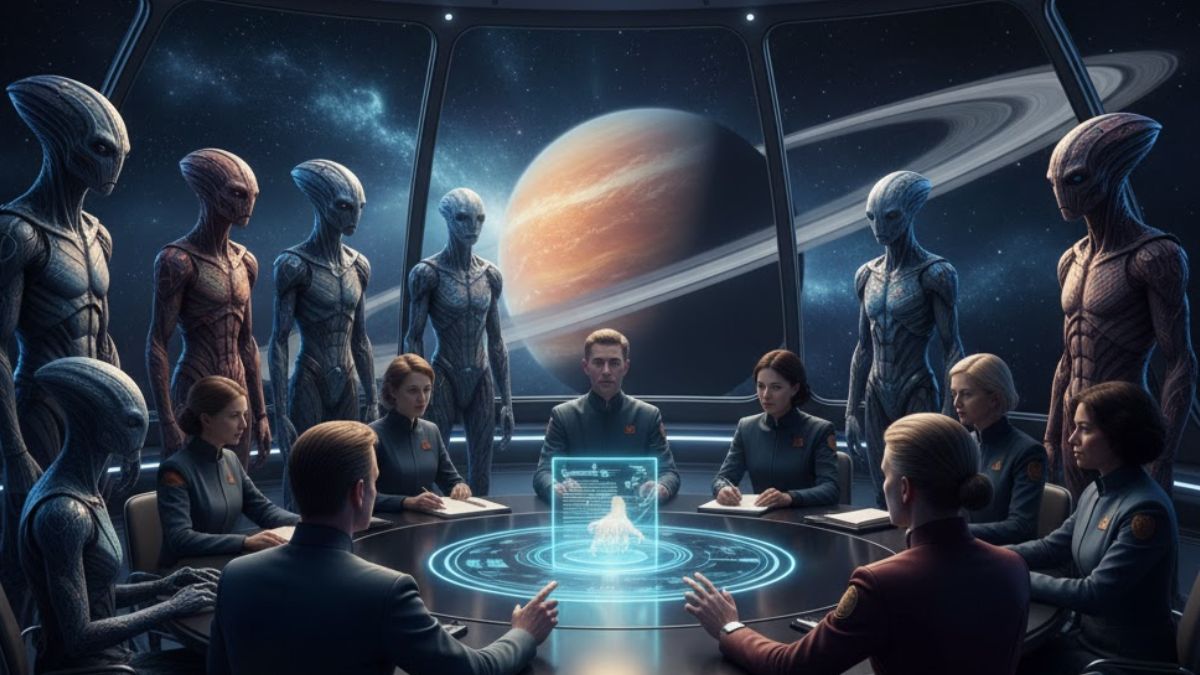
This leads us to a fascinating thought. Here on Earth, when two countries want to live peacefully or work together, they create a treaty. It is a formal agreement that sets the rules. So, if we made contact with an alien civilization, would we need something similar? Could we sit down at a giant cosmic table and draft a treaty between humans and aliens? What would that even look like, and what would we need to talk about first?
What would we even talk about with an alien species?
The first conversation with an alien species would be the most important chat in all of human history. Before we could even think about a treaty, we would have to find a way to communicate. They would not speak English or Spanish or Chinese. Their way of thinking and their understanding of the universe might be completely different from ours. The first goal would simply be to establish a basic language, perhaps using mathematics and science, which are often called the universe’s common languages.
Once we could say “hello,” the real talking would begin. The most critical topic would be our intentions. Both sides would need to answer a simple but huge question: “Are you a friend or a foe?” We would have to find a way to show that we mean no harm. At the same time, we would be incredibly curious. We would want to know where they are from, what their world is like, and what they know about the universe that we do not. A treaty would be built on the answers to these first, fragile conversations. It would be our way of turning that initial “hello” into a lasting and safe relationship.
What would be the first rule in a human-alien treaty?
If we were to imagine the very first rule in a cosmic agreement, it would almost certainly be about peace. Think of it as a giant “Do Not Harm” sign for the entire solar system. This rule would be the foundation for everything else. Both sides would promise not to attack each other. They would agree not to invade each other’s worlds or try to destroy each other’s ships. This might sound like something from a movie, but it is a very real and serious concern.
This first rule would also likely include something called a “non-interference” clause. This means that both humans and aliens would agree not to interfere with each other’s development. They would not try to take over our governments or change our culture on purpose. We would be allowed to grow and learn as a species on our own terms. For the aliens, this might mean we promise not to land our ships in their cities and cause panic. This basic rule of peace and respect would be the most important step in building trust between two civilizations that know almost nothing about each other.
How would we handle sharing our solar system?
Our solar system is a big place, but it is our home. If aliens arrived, we would have to figure out how to share the neighborhood. This would be a tricky part of any treaty. We would need to decide who can go where. For example, we might agree that Earth is strictly for humans. Mars, which we are already trying to visit, might be a place where both species can do research, but with strict rules.
The treaty would probably create cosmic “rules of the road.” Just like we have traffic lights and lanes on our roads, we would need rules for space travel. This would prevent accidents between their advanced ships and our satellites and space stations. We might also have to talk about resources. Could they mine an asteroid? Could we? The Moon has water ice; who does that belong to? A treaty would help draw a map, not of ownership, but of responsibility, making sure that both sides can explore and live without constantly bumping into each other.
Would we share our science and technology?
One of the most exciting possibilities of meeting an alien species is the knowledge we could gain. A civilization capable of traveling between stars would have science and technology far beyond anything we can dream of. They might have answers to diseases, solutions for clean energy, or a deeper understanding of physics. The question is, would they share this with us?
A treaty could include an agreement for sharing knowledge. It would be like a cosmic library card. In return for their advanced science, we might offer them something they find valuable. Perhaps they are fascinated by the unique biology of life on Earth, or maybe they are interested in our art and music. However, this sharing would have to be done very carefully. Giving a powerful new technology to a species that is not ready for it could be dangerous. The treaty would need to set up a slow and safe way for this exchange to happen, ensuring it benefits everyone without causing harm.
What if we don’t understand each other’s way of life?
This might be the biggest challenge of all. An alien species might not think like us at all. They might not value the same things. What if they do not understand the concept of a promise or a treaty? What if their idea of “friendship” is completely different? Their biology could be so strange that our very presence is painful to them, or vice versa. These misunderstandings could lead to conflict, even if no one wants to fight.
A good treaty would have to account for these differences. It would need to include ways to solve problems when we simply do not understand each other. We might agree to set up a special team of experts from both sides—a cosmic translation service—not just for language, but for culture and behavior. This team would work to explain why certain actions are offensive or what certain gestures mean. The main goal of the treaty would be to create patience and a commitment to keep talking, even when things get confusing or frustrating.
Who would get to sign the treaty for Earth?
This is a very practical problem. On Earth, we have nearly 200 countries. If a giant alien ship landed, who would walk out to shake their hand? Would it be the President of the United States? The Secretary-General of the United Nations? A team of scientists? There is no single leader for the entire planet, and this could cause a lot of arguments right here at home.
For a treaty to be fair, it would have to represent all of humanity. This means leaders from many countries, along with top scientists, lawyers, and even philosophers, would probably have to work together to form one Earth team. This would be our first test: to see if we can unite as one species to speak with a single voice to the cosmos. Creating this team would be just as difficult as writing the treaty itself, but it would show the aliens that we are a civilized and organized planet ready for a cosmic relationship.
Conclusion
The idea of a treaty with an alien civilization forces us to think about the biggest questions. It makes us imagine a future where humanity is no longer alone, and it challenges us to consider what kind of neighbor we would be in a vast, universal community. While such an agreement is still a dream, thinking about it teaches us a lot about ourselves. It shows us what we value: peace, curiosity, cooperation, and our own safety.
Perhaps the most important lesson is that before we can hope to agree with another civilization, we must first learn to agree with each other here on Earth. The dream of a cosmic handshake encourages us to be better, to be wiser, and to see our entire planet as one home. So, what do you think? If you had a chance to write one rule for a treaty with aliens, what would it be?
FAQs – People Also Ask
1. Has any country planned for first contact with aliens?
A few countries, like the United States and France, have had unofficial protocols in the past, mainly for how scientists should handle a potential alien signal. However, there is no single, globally agreed-upon plan for what to do if we make contact.
2. What is the Fermi Paradox?
The Fermi Paradox is the puzzling question of why, if the universe is so big and old, we have not found any evidence of other intelligent life. It highlights the contradiction between the high probability of alien life and our lack of contact with it.
3. Could aliens be dangerous to humans?
It is possible, which is why scientists like Stephen Hawking warned about announcing our location loudly. An advanced civilization might not see us as equals, or their biology could accidentally carry harmful germs, much like when Europeans first came to the Americas.
4. What is the Drake Equation?
The Drake Equation is a formula used to estimate the number of active, communicative alien civilizations in our galaxy. It considers factors like the rate of star formation and the fraction of planets that could support life.
5. How are scientists searching for aliens right now?
Scientists primarily use two methods. SETI (Search for Extraterrestrial Intelligence) listens for radio or laser signals from space. Meanwhile, telescopes like the James Webb Space Telescope study the atmospheres of distant planets for signs of life, like oxygen or methane.
6. What would aliens look like?
Aliens could look like anything. They might not even be carbon-based life forms like us. They could be microscopic, giant, gaseous, or even silicon-based, perfectly adapted to the unique environment of their home planet.
7. What is ‘first contact’?
First contact is the term for the first moment that humanity communicates with or meets an extraterrestrial intelligence. It is considered one of the most significant events that could ever happen to our species.
8. Why would aliens want to make a treaty with us?
They might want to avoid a costly conflict, ensure their own safety while studying us, or establish rules for sharing resources in our solar system. They may value peaceful coexistence just as much as we would.
9. What is planetary protection?
Planetary protection is a set of guidelines followed by space agencies to prevent other planets from being contaminated by Earth germs and to prevent Earth from being contaminated by potential alien microbes brought back by our spacecraft.
10. How long would it take to get a message to aliens?
It depends on how far away they are. Even if aliens lived in our closest star system, Proxima Centauri, a radio message sent today would take over four years to get there, and their reply would take another four years to return to us.