

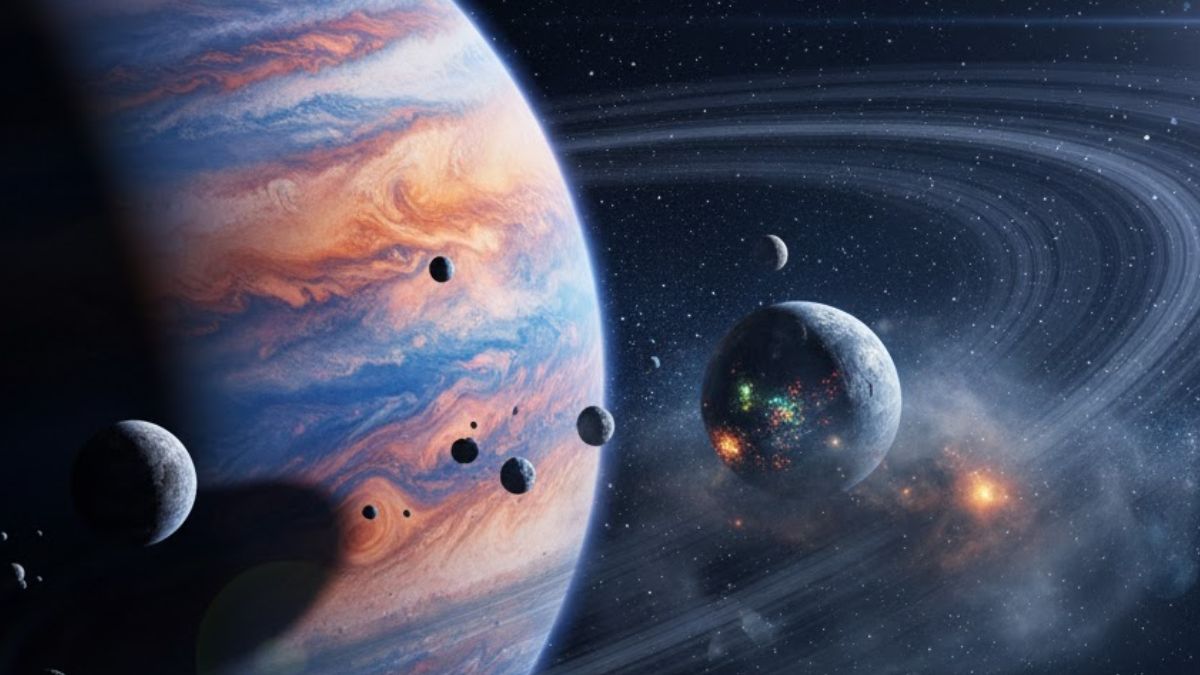
Our night sky is filled with pinpricks of light, most of them stars shining steadily from incredible distances. But a few of those lights are different. They don’t twinkle as fiercely. They are planets, and they are much closer to home. For a long time, when we thought of planets, we pictured the rocky worlds like Earth and Mars, or the gas giants like Jupiter and Saturn, all orbiting our Sun.
But there’s a bigger picture, a more exciting one. Astronomers have discovered thousands of planets orbiting other stars. And many of these are not like the planets in our solar system at all. The most common type they’ve found are called “Gas Giants.” These are enormous planets, much larger than Jupiter, made mostly of gas. And the truly amazing part? Many of these giants don’t orbit alone. They have their own families of moons, worlds that orbit a planet instead of a star. We call these collections “mini solar systems.” This opens up a thrilling possibility. What if, on a moon orbiting a giant planet in another star system, there is a hidden world teeming with life? This idea takes us on a journey to the secret worlds orbiting giants.
So, if a planet like Jupiter is too hostile for life, could one of its quiet, hidden moons be the perfect home?
What exactly is a gas giant planet?
Think of our own Sun for a moment. It’s a huge, hot ball of glowing gas. Now, imagine a planet that is built in a similar way, but much, much smaller and without the internal fire to shine as a star. That is essentially a gas giant. These planets are not solid like Earth. You couldn’t land a spaceship on them because there’s no ground to land on. If you tried to fly into one, you would just sink deeper and deeper into a thick, swirling soup of hydrogen and helium gas, with crushing pressures and violent storms.
In our own solar system, we have two famous examples: Jupiter and Saturn. Jupiter is so massive that all the other planets in the solar system could fit inside it. It has a famous, giant storm called the Great Red Spot, which is bigger than our entire planet Earth and has been raging for hundreds of years. Saturn, with its beautiful, wide rings made of ice and rock, is another stunning gas giant. These planets are the kings of our cosmic neighborhood. When we look out into the galaxy, we find that planets like these are everywhere. Many of them orbit their stars in what we call the “habitable zone” or “Goldilocks zone.” This is the region where the temperature from the star is just right—not too hot and not too cold—for liquid water to potentially exist on a planet’s surface. And since water is essential for life as we know it, this is a very exciting place to look.
How can a moon be better for life than a planet?
This seems like a strange idea. We live on a planet, so it’s natural to think planets are the best places for life. But a moon orbiting a gas giant could have some special advantages. First, let’s think about the energy a moon receives. It gets light and warmth from its sun, just like we do. But it also gets energy from the planet it orbits, the gas giant. The giant’s gravity pulls and squeezes the moon’s interior. This creates friction and heat, a process known as tidal heating. This means that even if a moon is far from its star and the sunlight is weak, it could still be warm enough for life because it is being heated from the inside.
A perfect example in our own solar system is a moon of Jupiter called Europa. Scientists are almost certain that beneath its thick, icy crust, Europa has a vast, global saltwater ocean. This ocean is kept liquid not by the Sun, but by the tidal heating from Jupiter’s immense gravity. Where there is liquid water, there is a chance for life to begin and survive. Furthermore, the gas giant can act as a giant shield. Its strong gravity can attract and absorb comets and asteroids that would otherwise crash into the moon, causing mass extinctions. So, while the gas giant itself is a terrifying, gaseous inferno, its moons could be quiet, protected, and warm oceanic worlds, quietly hiding the ingredients for life.
What would it be like to stand on the surface of such a moon?
Let’s use our imagination for a moment. Picture yourself standing on a moon orbiting a gas giant in another star system. The first thing you would notice is the sky. It would be dominated by the giant planet. It would look enormous, filling a large part of the heavens. You might see its swirling bands of clouds, its great storms, and its magnificent rings arching overhead. A day on this moon would be strange. The sun would rise and set, but the giant planet would hardly move in the sky. It would always be there, hanging in the same place because the moon would be tidally locked, always showing the same face to its planet, just like our Moon always shows the same face to Earth.
The light would be incredible. During your “day,” you would have sunlight. But at “night,” when you are on the side of the moon facing away from the sun, it wouldn’t be dark. The giant planet would be reflecting the light of its star, creating a permanent, soft “planetshine” that could be dozens of times brighter than a full Moon on Earth. You could read a book by this light. The ground beneath your feet might be ice or rock. If you were on a moon like Europa, you would be standing on a layer of ice that is miles thick, with a hidden ocean below. You might feel the ground tremble slightly from the gravitational pull of the giant. It would be a world of stunning beauty and constant, dramatic change in the sky above you.
Could these hidden moons have alien oceans?
The possibility is one of the most exciting in modern astronomy. In our own solar system, we have strong evidence for subsurface oceans on several moons. Europa, as we mentioned, is the prime candidate. But there’s also Enceladus, a small moon of Saturn. Enceladus shoots giant geysers of water vapor and ice crystals into space from cracks in its icy surface. Spacecraft have flown through these plumes and detected organic molecules, which are the building blocks of life. Another moon of Saturn, Titan, is even more fascinating. It has lakes and rivers on its surface, but they are not filled with water. They are filled with liquid methane and ethane, like natural gas on Earth. Yet, scientists believe Titan also has a hidden underground ocean of liquid water.
If this is possible in our own solar system, around our own gas giants, then the potential around the gas giants in other star systems is immense. A large moon with the right combination of tidal heating and a thick insulating ice shell could maintain a liquid ocean for billions of years. That is more than enough time for life to emerge and evolve. We don’t yet have telescopes powerful enough to see these moons directly around distant planets, but we know the physics works. The universe seems to have a recipe for creating hidden, watery worlds, and it appears to be a very common recipe.
What kind of life could exist on these distant moons?
When we think of aliens, we often picture little green men or strange creatures from science fiction movies. But the life on these hidden moons would probably be much more humble, at least at first. In the dark, sunless ocean of a moon like Europa, there would be no plants. There is no sunlight for photosynthesis. So, life would have to find another source of energy. On Earth, we find such life at the bottom of our deep oceans near hydrothermal vents. These are cracks in the ocean floor where superheated, mineral-rich water gushes out.
Bacteria at these vents don’t use the sun. They use chemicals from the vent, like hydrogen sulfide, in a process called chemosynthesis. These bacteria form the base of a whole food chain that includes giant tube worms, strange clams, and unique kinds of shrimp. Life on a hidden moon would likely be similar. We might find vast fields of microbial life, or perhaps more complex creatures that feed on them. They could be slow-moving, blind creatures that sense their world through touch or sound in the perpetual darkness. They might be unlike anything we have ever seen, perfectly adapted to a world of ice, rock, and a warm, dark sea, living under the constant, gentle pull of a giant planet.
How do scientists search for these secret worlds?
Finding a moon the size of Earth orbiting a planet trillions of miles away is an incredible challenge. The main method we use to find distant planets, called the “transit method,” involves watching for a tiny dip in a star’s brightness. This dip happens when a planet passes in front of the star, blocking a little bit of its light. Finding a moon around that planet is like trying to see a mosquito flying in front of a car’s headlight when you are standing a mile away.
Scientists look for tiny clues within the data. When the planet transits, the moon might cause a second, even smaller dip in the light, either just before or just after the planet. The moon’s gravity can also tug on the planet, causing the transit to happen a few seconds early or late. By carefully analyzing these minute changes, astronomers can infer the presence of a moon. While no moon around an exoplanet has been definitively confirmed yet, there are several strong candidates. Future telescopes, like the James Webb Space Telescope, will have the power to study the atmospheres of some exoplanets. If they find signs of water, oxygen, or methane in the atmosphere of a gas giant that is in the habitable zone, it could be a huge hint that the planet has a life-bearing moon.
Conclusion
The search for life beyond Earth is no longer focused just on finding another Earth-like planet. The universe has shown us a more mysterious and perhaps more common path. Hidden away in the gravitational embrace of giant planets are countless secret worlds—moons with warm hearts, hidden oceans, and the potential to cradle life. They are worlds of double sunrises and eternal planetary glows, of ice shields and deep, dark seas. They remind us that life is tenacious and that the universe is full of surprises.
As our technology improves, we are getting closer to peeling back the ice and revealing what lies beneath on these distant moons. The question is no longer if such worlds exist, but what we will find when we finally discover them.
Do you think the first sign of alien life we find will be in the ocean of a moon like this, rather than on a planet?
FAQs – People Also Ask
1. What is a gas giant made of?
A gas giant is primarily made up of hydrogen and helium, the two lightest and most common elements in the universe. It doesn’t have a solid surface like Earth; instead, it’s a massive ball of gas that gets denser and hotter the deeper you go.
2. Can we live on a gas giant like Jupiter?
No, it would be impossible for humans to live on a gas giant. There is no solid ground to stand on, the atmospheric pressure is crushing, the winds are incredibly violent, and the temperatures are extreme.
3. What is the habitable zone?
The habitable zone is the region around a star where the temperature is just right—not too hot and not too cold—for liquid water to potentially exist on the surface of a planet. It is often called the “Goldilocks zone.”
4. How many moons could a gas giant have?
There is no set limit. In our solar system, Jupiter has 95 known moons and Saturn has 146. A gas giant in another star system could have even more, forming a complex mini solar system of its own.
5. Does Jupiter’s moon Europa have an ocean?
Yes, scientists have strong evidence from spacecraft and telescopes that Europa has a global ocean beneath its icy crust. This ocean may contain more than twice the amount of water found in all of Earth’s oceans combined.
6. What is tidal heating?
Tidal heating is the warming of a moon’s interior caused by the gravitational tug-of-war from its parent planet. As the moon is stretched and squeezed by gravity, friction is created, which generates heat and can keep underground oceans liquid.
7. Have we found any exomoons yet?
As of now, astronomers have not officially confirmed the discovery of any moons orbiting planets in other star systems (exomoons). However, there are a few promising candidates, and the search is ongoing with more powerful telescopes.
8. Could there be life on Titan?
Titan is a candidate for harboring life, but it would be a very different kind of life than on Earth. It could have lifeforms that use liquid methane instead of water, or there could be more familiar life in its suspected subsurface water ocean.
9. Why is liquid water so important for life?
Water is a fantastic solvent, meaning it can dissolve many different substances. This allows it to transport nutrients into cells and carry waste out. All known life on Earth requires water to function, so it’s the first thing scientists look for.
10. What is the James Webb Space Telescope looking for?
The James Webb Space Telescope is looking at the atmospheres of distant exoplanets. By studying the starlight that filters through these atmospheres, it can detect the presence of gases like water vapor, carbon dioxide, and methane, which could hint at habitable conditions or even signs of life.