

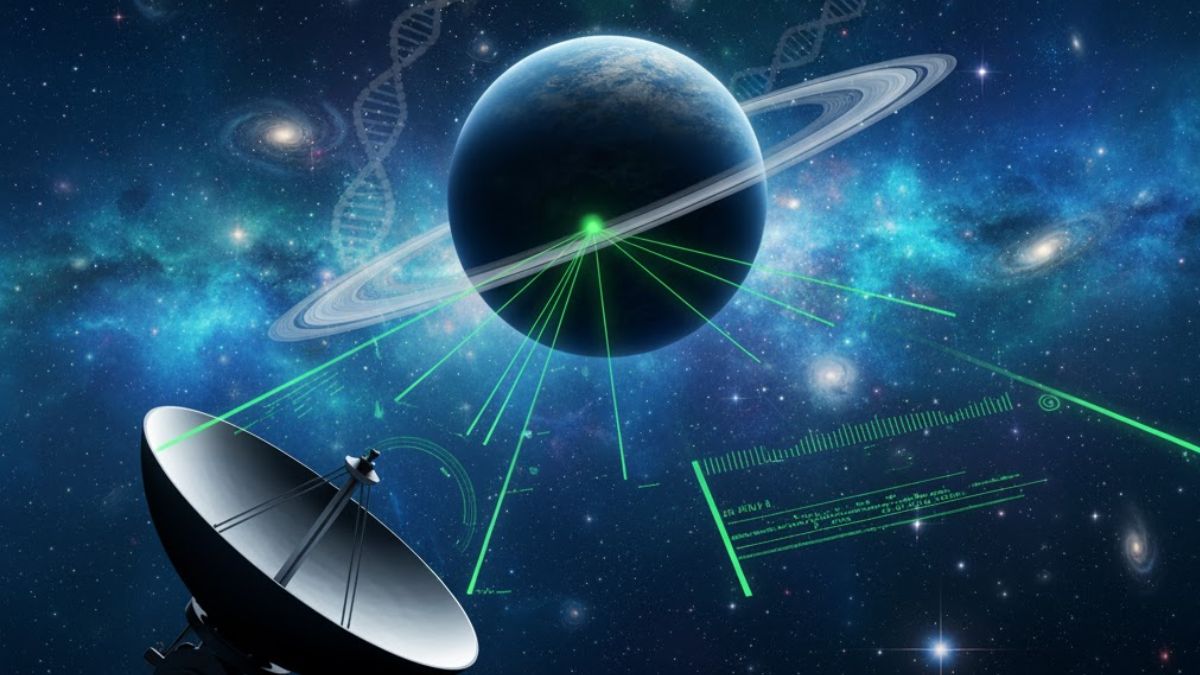
The night sky is a vast, dark canvas dotted with tiny points of light. Each one is a star, and many of those stars are suns, just like our own. For centuries, we could only wonder if other planets circled those distant suns, and if any of them could be home to life. Today, we know the answer to the first part. Thousands of these “exoplanets”—planets outside our solar system—have been discovered. They are everywhere. Now, scientists are tackling the next, even more thrilling question: Are we alone?
Finding these worlds is one thing, but figuring out what they are like from trillions of miles away is a whole different challenge. You can’t just point a telescope and see a little green man waving back. The planets are too far, too small, and too dim compared to their brilliant host stars. So, if we can’t see them directly, how can we possibly search for signs of life? The answer lies not in photographs, but in physics, chemistry, and the faintest whispers of light.
Scientists become cosmic detectives, looking for clues in the data. They use the world’s most powerful telescopes and clever techniques to analyze the light coming from, or passing through, these distant worlds. By breaking this light down into its components, they can learn about a planet’s air, its temperature, and even the potential for it to have liquid water. So, how exactly do they turn starlight into a story about a potential living world?
What is a Biosignature and Why is it Like a Cosmic Clue?
Think about walking through a forest. You don’t see any animals at first, but you find clues everywhere. You see footprints in the mud, a half-eaten leaf, and a faint sound in the distance. These signs tell you that life is present, even if it’s hiding. Scientists searching for life on exoplanets are doing the same thing, but from an incredible distance. They are looking for “biosignatures.”
A biosignature is any substance or signal that provides scientific evidence of past or present life. It’s not a guarantee of life, but it’s a powerful clue that makes scientists take a much closer look. On Earth, the biggest biosignature is our atmosphere. Our air is filled with oxygen and has a little bit of methane gas. This is a strange and unstable mixture. Oxygen is very reactive and quickly breaks down other gases like methane. The only reason they exist together in our air is because life—plants, algae, and some bacteria—constantly pumps out oxygen, while other life, like cows and bacteria in swamps, constantly produces methane.
If an alien astronomer far away were to look at our Earth, they wouldn’t need to see our cities or our oceans. By simply analyzing the light that passes through our atmosphere, they could detect this unusual combination of gases. They would see a planet whose air is out of balance, and that would be a huge red flag that something interesting—probably life—is happening here. So, for scientists, finding a similar unbalanced atmosphere on a distant world is one of the most exciting goals.
How Do We Find Planets We Can’t Even See?
Before we can search for life, we have to find the right planets to look at. Stars are blazingly bright, and planets are just dark, cold rocks or gas balls reflecting a tiny bit of that starlight. It’s like trying to see a firefly sitting right next to a giant spotlight. So, astronomers use two main tricks to find these hidden worlds, and both involve watching the star very, very carefully.
The first method is called the “transit method.” Imagine a planet passing directly in front of its star, from our point of view. When this happens, the planet blocks a tiny fraction of the star’s light, causing a very small, temporary dip in the star’s brightness. It’s like a mini-eclipse. By measuring these repeated, regular dips in brightness, astronomers can not only discover the planet but also figure out how big it is and how long its year is. NASA’s Kepler Space Telescope used this method to find thousands of planets, and NASA’s TESS mission is doing the same right now.
The second method is the “wobble method,” or the radial velocity method. A planet doesn’t just orbit a star; the star also moves a little bit because of the planet’s gravity. Think of it as a small dog and a large person spinning around while holding a rope. The person (the star) also moves in a small circle, not just the dog (the planet). This tiny movement of the star causes its light to stretch and squeeze very slightly. By detecting these tiny changes in the starlight, scientists can find the planet and estimate its mass. Together, these methods give us a catalogue of distant worlds to investigate further.
What Can Light Tell Us About an Alien World?
Once we find a planet using the transit method, the real detective work begins. This is where we search for those all-important biosignatures. When a planet transits, or passes in front of its star, a tiny bit of the star’s light filters through the planet’s atmosphere. The atmosphere acts like a filter, absorbing specific colors of light while letting others pass through.
Scientists use an instrument called a spectrograph to spread this filtered starlight out into a rainbow, called a spectrum. But this rainbow has dark lines in it. Each gas in the planet’s atmosphere leaves a unique fingerprint—a specific pattern of dark lines. By reading these fingerprints, scientists can tell exactly what gases are present in that alien sky.
For example, if they see the fingerprint of sodium, they know sodium is there. If they see the fingerprint of water vapor, they know the atmosphere contains water. The dream, of course, is to see the combined fingerprints of oxygen, methane, and other gases that, together, strongly suggest biological activity. This technique, called transmission spectroscopy, is our most powerful tool for sniffing out the air of distant worlds. The James Webb Space Telescope, the most advanced space telescope ever built, is using this very technique right now to study the atmospheres of some of the most promising exoplanets.
Is Oxygen the Only Sign of Life We Look For?
While oxygen is a very exciting biosignature, a smart cosmic detective doesn’t rely on just one clue. Oxygen alone isn’t a sure sign of life. There are some non-living processes that can create oxygen in an atmosphere. For instance, if a planet has a lot of water vapor high in its atmosphere, sunlight can break it apart and release some oxygen. So, scientists look for multiple lines of evidence.
They call this a “suite of biosignatures.” They might look for the simultaneous presence of oxygen and methane, which is a very hard combination to explain without life. They also look for other gases that don’t belong, like certain man-made pollutants called CFCs, which would be a stunning sign of an advanced civilization. Another key thing they look for is a “red edge.”
On Earth, plants reflect a lot of infrared light, which is invisible to our eyes. If you look at a forest with an infrared camera, it looks incredibly bright. This is called the vegetation red edge. If an alien world had widespread plant life, it might have a similar signature that makes the planet appear to “glow” in infrared light at a specific wavelength when it passes behind its star. So, the search is for a whole story written in light and gases, not just a single clue.
What Makes a Planet “Habitable” in the First Place?
Before we get too excited about a biosignature, we first have to ask if the planet is even in a place where life as we know it could exist. This is the concept of the “habitable zone,” often nicknamed the “Goldilocks Zone.” Imagine a bowl of porridge—one is too hot, one is too cold, and one is just right. The habitable zone is the distance from a star where the temperature is just right for liquid water to potentially exist on a planet’s surface.
Water is essential for all life on Earth, so it’s the logical starting point for our search. If a planet is too close to its star, it would be scorching hot, and any water would boil away. If it’s too far, it would be freezing cold, and water would only exist as ice. A planet in the habitable zone, however, could have the stable, moderate temperatures needed for liquid water oceans, lakes, and rivers. It’s important to remember that being in the habitable zone doesn’t mean a planet has life or even has water. It just means the conditions are theoretically right for liquid water, which makes it a prime candidate for a more detailed search for biosignatures.
Could We Ever See an Exoplanet Directly?
All the methods we’ve talked about so far are indirect. We’re seeing the effect of a planet on its star, not the planet itself. But what if we could actually take a picture of one? This is the ultimate goal, and it’s incredibly difficult. The challenge is the overwhelming glare of the host star. It’s like trying to see a speck of dust next to a bright light bulb from a mile away.
To solve this, scientists are building special instruments called coronagraphs. A coronagraph is a tiny mask inside a telescope that blocks out the blinding light of the star, allowing the much fainter light from the planet to be seen. Future giant telescopes, like the planned Habitable Worlds Observatory, will use advanced coronagraphs to directly image Earth-sized planets in the habitable zones of nearby stars.
If we can directly image a planet, we can learn so much more. We could potentially see surface features over time—not cities, but maybe the difference between oceans and continents. We could study how its appearance changes with seasons, perhaps watching ice caps grow and shrink. This would give us a wealth of information to combine with the atmospheric data, building a much more complete picture of whether that world could be alive.
What If We Find Something We Don’t Understand?
The universe is a strange place, and life elsewhere could be very different from life on Earth. What if we find a planet with a bizarre atmosphere full of gases we can’t explain? What if the biosignatures we discover don’t match anything we were looking for? This is a very real possibility, and it would be both thrilling and challenging.
Scientists are already thinking about this. They are studying “agnostic biosignatures”—signs of life that don’t assume it’s like Earth life. This could mean looking for an atmosphere that is so wildly out of chemical equilibrium that it’s the only logical explanation. Or, it could mean looking for specific, complex structures in the light that suggest organized, molecular complexity that wouldn’t happen naturally. A discovery like this would force us to rethink our definition of life itself. It would be a puzzle that would occupy scientists for generations.
The search for life on distant worlds is a slow, careful process. It’s a story written in the faintest dips of starlight and the hidden fingerprints in a rainbow. With every new telescope and every new discovery, we are learning to read that story better. We are training ourselves to see the cosmic footprints, to hear the whispers in the light. The question is no longer if there are other worlds, but whether we share any of them with other living things. And with each passing year, we get a little closer to finding the answer.
FAQs – People Also Ask
1. How many exoplanets have been discovered so far?
Scientists have confirmed the discovery of over 5,000 exoplanets, and thousands more are waiting to be confirmed. New planets are being found all the time by telescopes both in space and on the ground.
2. What is the closest exoplanet to Earth?
The closest known exoplanet is Proxima Centauri b, which orbits the star Proxima Centauri, the closest star to our Sun. It’s about 4.2 light-years away and is located in its star’s habitable zone.
3. Can the James Webb Telescope see life on other planets?
The James Webb Space Telescope cannot see life directly. However, it is our most powerful tool for analyzing the atmospheres of exoplanets, looking for the chemical biosignatures that might be produced by living organisms.
4. What is a “super-Earth” planet?
A super-Earth is a class of planet that is larger than Earth but smaller than the ice giants Uranus and Neptune. The term refers only to its size, not its habitability; a super-Earth could be a rocky world, a watery world, or a gaseous mini-Neptune.
5. Why is liquid water so important for life?
On Earth, water is the universal solvent that allows essential chemical reactions for life to occur. It helps transport nutrients, regulates temperature, and provides a stable environment for complex molecules to form and interact.
6. How long would it take to travel to the nearest exoplanet?
With our current technology, it would take tens of thousands of years to reach Proxima Centauri b. We are nowhere near having the technology for a human mission to an exoplanet, which is why we rely on telescopes to study them.
7. What is the difference between an exoplanet and a planet?
The term “planet” typically refers to the eight major bodies orbiting our Sun. An “exoplanet” is simply a shortening of “extrasolar planet,” meaning any planet that orbits a star other than our Sun.
8. Could there be life on moons instead of planets?
Absolutely! Some moons in our own solar system, like Jupiter’s Europa and Saturn’s Enceladus, have vast underground oceans that could potentially harbor life. Scientists are very interested in finding exomoons around distant exoplanets for this reason.
9. What does “habitable zone” really mean?
The habitable zone is the region around a star where the temperature is theoretically right for a planet to have liquid water on its surface, assuming it has a suitable atmosphere. It does not guarantee that the planet is actually habitable.
10. Have we found any exoplanets with water?
Yes, scientists have detected water vapor in the atmospheres of several exoplanets. However, these are mostly large, hot, gas giant planets similar to Jupiter. Detecting water on a small, rocky Earth-sized planet is a major goal for future telescopes.