

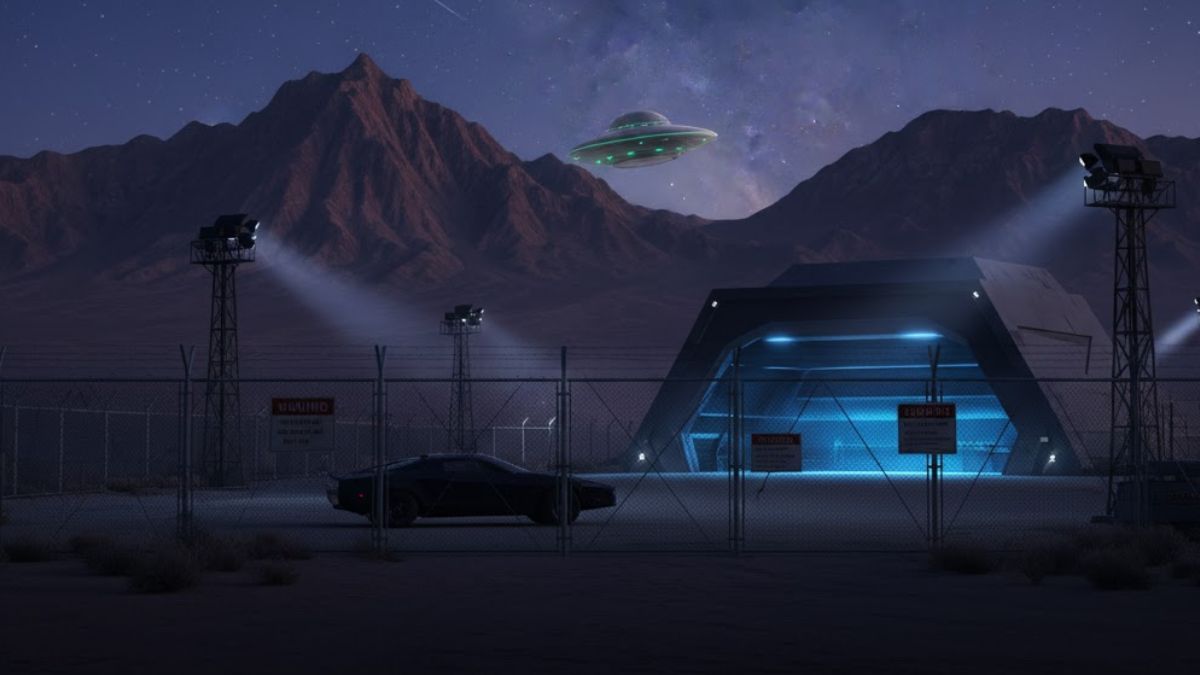
There’s a place in the Nevada desert that doesn’t appear on any public map. It’s guarded by signs that warn of deadly force, and the airspace above it is so restricted that even straying too close in a small plane can prompt a military interception. For decades, this place has been the star of countless movies, books, and wild conspiracy theories. Its name is Area 51, and it has become a modern legend.
But what is the real story behind those heavily guarded gates? Is it a top-secret laboratory for studying alien technology, complete with crashed flying saucers and little green men? Or is it something else entirely, something more grounded in our world but still incredibly secretive? The mystery is what pulls us in, the human desire to know what’s being hidden just out of sight.
This journey will take us through the dusty history, the confirmed facts, and the incredible fiction surrounding America’s most famous secret base. We’ll separate the wild stories from the documented truth and look at what the government has finally admitted. So, what secrets are truly being kept inside the fences of Area 51?
Where is Area 51 and how did it all start?
To understand Area 51, we have to go back to the middle of the 20th century. The year was 1955, and the United States was in the thick of the Cold War, a tense standoff with the Soviet Union. The biggest fear was falling behind in technology, especially in the race to build the best airplanes and spy planes. A remote, dry lake bed in Nevada, known as Groom Lake, was selected by the U.S. Air Force and the Central Intelligence Agency (CIA) as the perfect testing ground.
Its location was ideal for secrecy. Surrounded by mountains and vast, empty desert, it was naturally shielded from prying eyes. The government could test new aircraft far away from public view and, more importantly, away from Soviet spies. The area was simply designated as “Area 51” on old atomic energy commission maps, and the name stuck. Work began immediately to build a simple airstrip and basic facilities. The first project to call this place home was one of the most important in aviation history: the U-2 spy plane.
This is where the first seeds of the UFO stories were planted. The U-2 could fly higher than any other aircraft at the time. While commercial planes flew around 20,000 feet, the U-2 soared above 70,000 feet. So when commercial pilots looked up and saw the sun glinting off this incredibly high-flying plane, they had no idea what it was. As far as they knew, nothing man-made could fly that high. They would report seeing strange, unidentified objects in the sky, and the government, wanting to keep the U-2 a secret, would often deny any knowledge. The secret aircraft being tested at Area 51 were, in fact, the very UFOs people were reporting.
What is the government’s official story about Area 51?
For almost half a century, the U.S. government’s official position on Area 51 was simple: it did not exist. If you asked a Pentagon official about it, they would likely say they had never heard of the place. It was a secret that everyone knew, but no one in authority would confirm. This blanket of silence only made people more curious and convinced that something monumental was being hidden.
This changed in 2013. In a surprising move, the CIA declassified a massive set of documents that officially acknowledged Area 51’s existence and its true purpose. The government finally admitted that yes, Area 51 is a real, active military base. According to these documents, its primary mission was to serve as a testing and development site for classified aircraft. The U-2 and its successor, the super-fast SR-71 Blackbird, were developed and tested there. Later, the stealth fighter known as the F-117 Nighthawk, which looks like something from a science fiction movie, was also tested at the base.
The government’s official story is that Area 51 was, and still is, a cutting-edge aviation laboratory. It’s a place where the next generation of spy planes and stealth aircraft are built and flown years before the public ever learns about them. The secrecy wasn’t to hide aliens, but to maintain a military advantage over rival nations. If your enemy doesn’t know what kind of technology you have, they can’t defend against it. So, the official fact is that Area 51 is a top-secret military research base for experimental aircraft, not a museum for alien spaceships.
What are the most popular alien stories about Area 51?
Now we come to the part that has fueled countless late-night discussions and Hollywood blockbusters: the alien stories. The most famous of all is the incident in Roswell, New Mexico, in 1947. The official story from the military at the time was that a “flying disc” had crashed, but they quickly changed their statement, saying it was just a weather balloon. Many people didn’t believe this and theorized that the military had recovered a crashed alien spacecraft and its crew.
The story goes that the wreckage, and even the alien bodies, were eventually shipped to Area 51 for study. This led to the belief that a secret facility within the base, often called “Sector 4” or “The Hangar,” was where government scientists reverse-engineered the alien technology. This, theorists say, is how we made such huge leaps in technology so quickly. They point to things like laser beams, integrated circuits, and Kevlar as inventions that possibly came from studying otherworldly devices.
Another major figure in these stories is a man named Bob Lazar. In 1989, Lazar came forward claiming he had worked as a physicist at a site near Area 51 called S-4. He said his job was to back-engineer the propulsion systems of nine alien spacecraft. He described the fuel source as a stable, heavy element that doesn’t naturally occur on Earth. While his story made him a celebrity in the UFO community, it was heavily disputed. Officials denied he ever worked there, and there was no record of his educational background. Despite the doubts, Lazar’s detailed descriptions of the base and the crafts cemented the idea of alien technology at Area 51 in popular culture forever.
What do we know for sure about what goes on there?
While we can’t know everything that happens behind the gates, we can piece together a solid picture from declassified information, historical records, and the accounts of former employees. We know for sure that Area 51 is the United States’ primary flight testing facility for “black projects.” These are classified military programs that are hidden from the public and even from most of Congress.
The evidence for this is strong. The development of the U-2, A-12, and F-117 aircraft are all now publicly acknowledged missions of the base. We also know that the base has its own airport, housing, and support facilities for a large number of people. Satellite images, though limited in detail, show a sprawling base with long runways, hangars, and other buildings that are constantly being updated and expanded.
People who have worked there describe a place of intense secrecy. Employees are flown in on unmarked planes from a terminal in Las Vegas. They are not allowed to discuss their work with anyone, not even their families. The security is incredibly tight, with armed guards, motion sensors, and closed-circuit cameras monitoring every move. So, what we know for sure is that it is a real base where America’s most secret airplanes are born. The work done there is considered so vital to national security that it is protected by an immense wall of secrecy.
Why is it so hard to get close to Area 51?
You might think you could just take a road trip to see Area 51 for yourself. The reality is very different, and it’s designed that way. The base is protected by a private security force famously known as the “camo dudes.” These are guards who dress in camouflage and patrol the perimeter in white jeeps. They watch you from hilltops with powerful binoculars and cameras, documenting anyone who comes near.
The land around the base is federal property, and the warnings are no joke. Signs are posted everywhere stating that the use of deadly force is authorized. While it’s unlikely a guard would shoot a tourist for taking a picture, trespassers can be arrested and face huge fines and prison time. The airspace above is a restricted military operations area, meaning any unauthorized aircraft that enters can be forced to land or even be shot down.
The closest you can legally get is a spot called the “Black Mailbox” (which is actually white) or a ridge known as “Freedom Ridge,” which was once open to the public but is now closed. From these vantage points, you might see distant lights at night or hear the faint sound of a jet engine, but that’s about it. The extreme difficulty in getting close is a huge part of the mystery. It tells us that whatever is happening inside is considered important enough to be defended like a national treasure.
Could the truth be a mix of both ideas?
This is the most fascinating question of all. Is it possible that the official story and the alien stories are both partially true? The government has admitted to lying about the base’s existence for decades. They also lied about the U-2 being a UFO. This history of deception makes it hard for some people to trust the official narrative completely. If they lied about that, what else are they lying about?
It’s not impossible to imagine that a place built to test the most advanced aircraft on Earth might also be used to study other extraordinary things. If an unknown object—whether it’s from another country or something else entirely—were to crash, a secure facility like Area 51 would be the logical place to take it. The base has the security, the scientific expertise, and the isolation to handle almost anything.
While there is no publicly available, hard evidence to prove that alien technology is stored there, the possibility remains a powerful “what if.” The truth about Area 51 might be a spectrum. On one end, we have the confirmed, incredible human technology that seems alien to us. On the other, there is the tantalizing, unproven possibility that we are not alone, and that the biggest secret of all is still being kept.
Conclusion
Area 51 is a real place with a documented history of creating some of the most amazing flying machines ever seen. It is a symbol of human ingenuity and the lengths nations will go to protect their secrets. The alien stories, while unproven, are a testament to our boundless imagination and our deep desire for mystery. They fill the gaps in our knowledge with fantastic possibilities. In the end, Area 51 is both a military base and a cultural icon, a place where the facts are strange enough, but the fiction is even stranger. The silence from the desert continues to make us wonder, if they are just testing airplanes, why do they need so much secrecy?
What do you think is the most likely secret still hidden within Area 51?
FAQs – People Also Ask
1. Can you visit Area 51 as a tourist?
No, you cannot visit Area 51 itself. It is a highly restricted military facility. However, you can visit the nearby town of Rachel, Nevada, and look at the base from distant, public viewpoints, but trespassing onto the property is illegal and dangerous.
2. Has anyone ever broken into Area 51?
There are no verified accounts of anyone successfully breaking into the central, secure areas of Area 51. There have been instances of people trespassing on the outer perimeter lands, but they have been quickly apprehended by security forces.
3. What is the “Storm Area 51” event?
In 2019, a joke Facebook event called “Storm Area 51, They Can’t Stop All of Us” went viral, suggesting that millions of people could run into the base to “see them aliens.” This led to a real-life gathering of a few thousand people in the nearby town of Rachel for a festival, but no one actually stormed the base.
4. Why is Area 51 so secretive?
The secrecy is maintained to protect advanced military technology and research projects. If other countries knew what new aircraft or surveillance systems were being developed, they could create defenses against them, eliminating the United States’ strategic advantage.
5. Are there really aliens in Area 51?
There is no publicly available credible evidence, such as official government documents or verifiable photographs, that proves the existence of aliens or alien spacecraft at Area 51. The U.S. government attributes the UFO sightings to secret military aircraft tests.
6. What is the weather like at Area 51?
The climate at Area 51 is typical of the high Nevada desert. It features hot, dry summers and cool, windy winters. The remote location and dry lake bed make it an ideal place for flight testing year-round.
7. How big is Area 51?
The exact size is classified, but the restricted airspace around the Groom Lake facility is estimated to be over 900 square miles, which is larger than the state of Rhode Island. The base itself is a significant complex with multiple runways and buildings.
8. What is the difference between Area 51 and the Nevada Test Site?
The Nevada Test Site is a large area north of Las Vegas where the U.S. government conducted nuclear bomb tests during the Cold War. Area 51 is a separate, smaller facility located within the Nevada Test and Training Range, focused on aircraft testing.
9. Do employees live at Area 51?
Employees do not permanently live at the base. They are believed to be flown in on weekly shifts from Las Vegas on classified flights. The base does have dormitories and amenities to support people during their work shifts.
10. What would happen if you tried to sneak into Area 51?
You would likely be detected long before reaching any sensitive areas. You would be arrested by armed security forces, face federal trespassing charges, and could be sentenced to fines and prison time. The use of deadly force is legally authorized, making it an extremely risky act.