

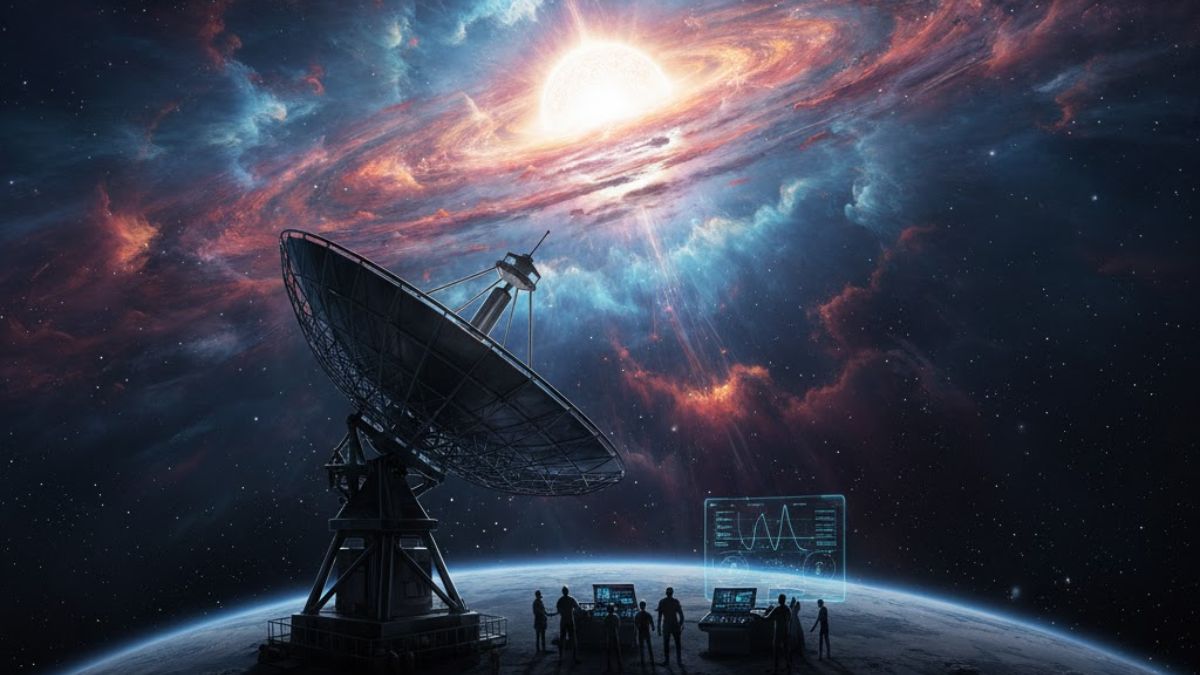
There is a silence in space that is deeper than any we can know on Earth. But every now and then, that silence is broken by a cosmic event of such immense power that it shouts across the universe. One of the most powerful of these events is the death of a star. It’s not a quiet fading away. It is a brilliant, violent, and final act that can outshine entire galaxies for a few precious weeks. In its last moments, a dying star sends out a message written in light, energy, and ripples in the fabric of space itself.
This message travels for millions, even billions of years. It crosses vast, empty stretches of darkness, a lonely signal from a long-gone sun. By the time it reaches us, the star that created it is already ancient history, its remains scattered to form new worlds or collapsed into a dark cinder. We are simply receiving its final broadcast, a delayed letter from a distant past.
But here is a thought that makes this even more incredible. If we can build machines to listen for these cosmic goodbyes, who else might be listening? Are we the only ones in this vast universe tuning in to the last songs of dying stars?
What exactly happens when a star dies?
A star is a giant, stable ball of hot gas, spending its life in a constant battle. On one side, gravity is trying to squeeze it into a tiny ball. On the other side, the nuclear fusion in its core, which is like a continuous giant hydrogen bomb, pushes outward. For most of a star’s life, these two forces are perfectly balanced. But every star only has a limited amount of fuel. When it starts to run out, this balance is shattered, and the star’s fate is sealed.
The death of a star depends entirely on how massive it is. A star like our Sun will not go out with a giant bang. In about five billion years, it will use up its core fuel and swell into a red giant, swallowing the inner planets, probably including Earth. After that, it will gently puff its outer layers into space, creating a beautiful, glowing cloud called a planetary nebula. All that will be left is a hot, dense core called a white dwarf, which will slowly cool down over trillions of years, like a dying ember in a cosmic campfire.
But for stars much more massive than our Sun, the end is far more dramatic. Their final moments are what we call a supernova. When their core fuel is exhausted, gravity wins the battle in a single, catastrophic instant. The core collapses in less than a second. Then, a tremendous shockwave blasts the star’s outer layers into space in an unimaginably powerful explosion. For a short time, that one star can shine brighter than all the other hundreds of billions of stars in its galaxy combined. It is in this brilliant, fleeting flash that the star’s last message is written.
What kind of message does a supernova send?
The message of a dying star is not written in words or a language. It is a complex story told through different forms of energy. The first and most obvious part of the message is light. A supernova creates a blinding flash of visible light that telescopes on Earth can see from incredible distances. But that is just the beginning. The explosion also creates a flood of invisible energy.
There is a tremendous amount of gamma rays and X-rays, which are forms of light with much higher energy than our eyes can see. Scientists have special telescopes in space to detect these. The explosion also creates a huge number of tiny, ghost-like particles called neutrinos, which fly out at nearly the speed of light. In 1987, when a star went supernova in a nearby galaxy, detectors on Earth picked up a burst of these neutrinos hours before the light of the explosion arrived.
Perhaps the most modern part of this cosmic message is something we have only recently learned to read: gravitational waves. A supernova is such a violent event that it actually shakes the fabric of space and time, sending out ripples, much like a stone thrown into a pond. Giant, sensitive instruments like LIGO and Virgo are now able to detect these ripples, giving us a whole new way to listen to the universe. So, the star’s last message is a multi-part signal, sent through light, particles, and ripples in space.
How do scientists ‘listen’ to these dying stars?
Scientists don’t use giant microphones to listen to space. Instead, they use a whole suite of high-tech instruments, each designed to read a different part of the star’s message. Think of it like a cosmic emergency broadcast that is being picked up by many different types of radios at the same time.
First, there are optical telescopes. These are the ones most people are familiar with. They collect the visible light from the explosion. Astronomers all over the world constantly scan the skies, looking for new points of light that appear where there was nothing before. When one is found, an alert goes out, and telescopes everywhere, including powerful ones in space like the Hubble or James Webb, swing into action to study it.
Then, there are satellites that act as our eyes for invisible light. Telescopes like NASA’s Swift and Fermi are in orbit, specifically designed to catch the initial burst of gamma rays and X-rays from a supernova. This high-energy light gives scientists clues about the physics of the explosion itself. To detect the neutrinos, scientists build huge, sensitive detectors deep underground, like Super-Kamiokande in Japan. These tanks are filled with pure water and lined with sensitive lights that can detect the tiny flash created when a neutrino interacts with an atom in the water.
Finally, for the gravitational waves, there are facilities like LIGO in the USA and Virgo in Italy. These are not telescopes in the traditional sense. They are L-shaped structures with long, vacuum-sealed tunnels. They use lasers to measure tiny, tiny changes in the length of the tunnels, changes smaller than an atom, caused by a gravitational wave passing through Earth. By combining all these different ways of listening, scientists can piece together the complete story of a star’s final moments.
Could a supernova message be a signal for someone else?
This is where science meets a truly fascinating possibility. We know that a supernova is a natural event. But its properties make it a very interesting cosmic signal. It is extremely bright, it can be seen from very far away, and it is a very distinct, one-time event. Because of this, some scientists have suggested that a supernova could be used as a sort of universal lighthouse.
Imagine a very advanced civilization that wants to get the attention of the entire galaxy. How would they do it? A radio signal sent from their planet would be weak and focused. But what if they could somehow trigger a supernova in a controlled way? It would be a flash that everyone in the galaxy could see. It would be a way of saying, “We are here,” on a galactic scale. This is, of course, a highly speculative idea, but it is a compelling one. A supernova’s natural message is so powerful that it could, in theory, be used as an artificial beacon.
Another idea is that an advanced civilization might not create a supernova, but they would certainly be listening for them. Just like us, they would understand that supernovas are key events that create the heavy elements needed for life and planets. Monitoring them would be a fundamental part of understanding the universe. So, if we are both looking at the same cosmic event, we are, in a way, sharing an experience across the stars, even if we are separated by millions of years and light-years of space.
What would an alien civilization learn from this message?
If another civilization is out there, listening to the same dying stars that we are, what would they learn? First and foremost, they would learn the same fundamental physics that we are learning. The light from a supernova tells a detailed story about the elements that were inside the star. As the star explodes, it acts like a giant cosmic forge, creating many of the heavy elements that make up our world.
The iron in your blood, the calcium in your bones, and the oxygen you breathe were all created inside a star and then scattered across space by a supernova explosion long ago. By reading the message of the dying star, any intelligent species would come to a stunning realization: we are all made of starstuff. They would understand that the atoms that form their own planets and their own bodies came from these cosmic explosions. This is a universal truth that any technologically advanced species would eventually discover.
Furthermore, they would use supernovas as cosmic mile markers. A certain type of supernova, called a Type Ia, always explodes with the same intrinsic brightness. This makes it a “standard candle.” By seeing how bright it appears from their location, they can calculate how far away it is. This is exactly how our astronomers discovered that the universe is expanding at an accelerating rate. An alien civilization would use the same technique to map the size, shape, and history of the universe, likely arriving at the same cosmic picture that we have.
Conclusion
The death of a star is far from an ending. It is a moment of incredible creation and communication. It seeds the galaxy with the building blocks for new planets and new life. And it sends out a final, powerful message—a complex story of its death written in light, particles, and gravity—that travels through the cosmos for eons.
We have just learned how to tune our instruments to receive this message. We are like people who have just invented the radio, suddenly hearing voices from continents away. As we continue to listen, we not only unravel the secrets of how stars live and die but also join a potential cosmic community of listeners. Every time we point a telescope at a supernova or detect its ghostly neutrinos, we are participating in a universal act of learning. It makes you wonder, when we record the next great stellar explosion, who else, in the deep and silent dark, is recording it too?
FAQs – People Also Ask
1. What is a supernova?
A supernova is the gigantic explosion of a very massive star at the end of its life. For a short time, it can become brighter than its entire galaxy, blasting its material out into space.
2. Will our Sun ever go supernova?
No, our Sun is not massive enough to end its life as a supernova. Instead, in about 5 billion years, it will expand into a red giant and then fade away, leaving behind a white dwarf.
3. How often does a supernova happen?
Scientists estimate that a supernova occurs somewhere in the universe roughly every second. In our own Milky Way galaxy, we expect one to happen about every 50 years, but dust often blocks our view.
4. Can a supernova destroy Earth?
A supernova would have to be very close, within about 50 light-years, to cause significant harm to Earth. There are no stars that close to us that are capable of becoming a supernova, so we are safe.
5. What is left behind after a supernova?
After a supernova, the core of the star collapses. Depending on its mass, it can become an incredibly dense neutron star or, for the most massive stars, collapse completely into a black hole.
6. What is a neutron star?
A neutron star is the super-dense, collapsed core of a massive star that went supernova. Just a teaspoon of its material would weigh billions of tons on Earth.
7. What are gravitational waves?
Gravitational waves are ripples in the fabric of space-time, caused by the most violent events in the universe, like two black holes colliding or a star going supernova.
8. Have we ever seen a star explode?
The last supernova seen clearly in our Milky Way galaxy was in 1604, observed by Johannes Kepler. In 1987, a supernova was visible in a nearby galaxy called the Large Magellanic Cloud, which was the brightest one seen in modern times.
9. What is a white dwarf?
A white dwarf is the hot, dense core that remains after a Sun-like star has shed its outer layers. It is the final stage for most stars in the universe, and it slowly cools down over billions of years.
10. How do supernovas help create life?
Supernovas are responsible for creating and scattering most of the heavy elements in the universe, including iron, carbon, and oxygen. These elements later become part of new stars, planets, and eventually, living organisms.