

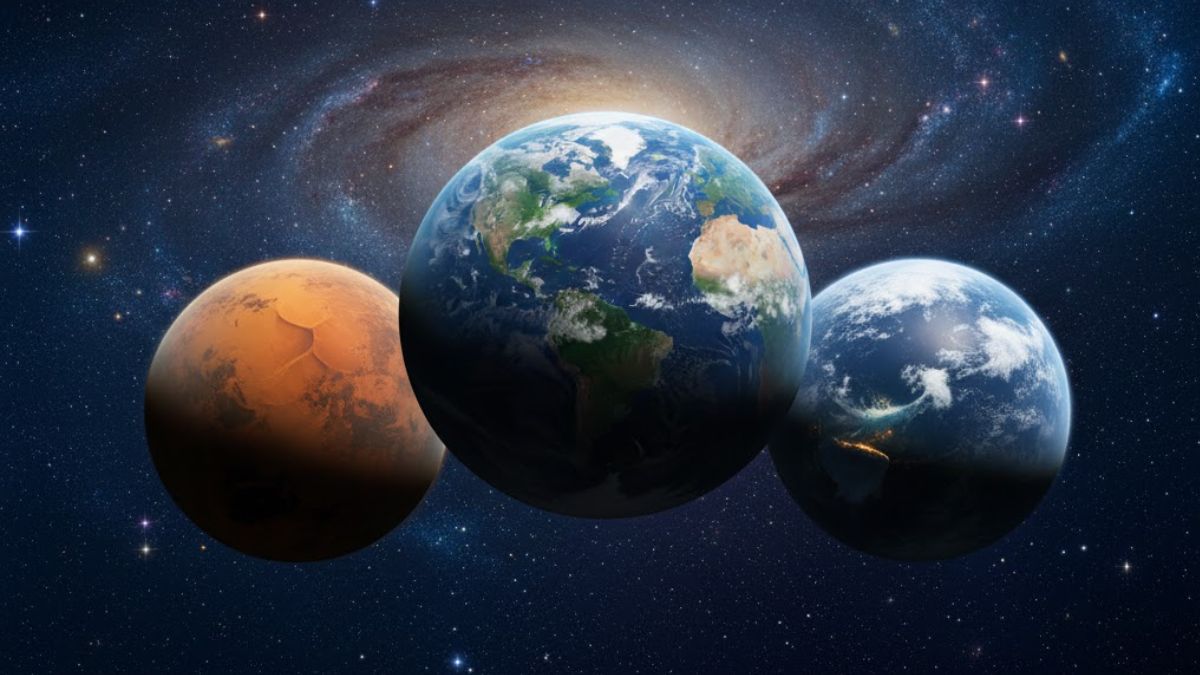
For most of human history, we could only look at the stars and wonder. Are there other worlds out there? Is our Earth, teeming with life and covered in blue oceans and green lands, truly one of a kind? For a long time, we had no answers. The planets in our own solar system, while fascinating, were either scorching hot or freezing cold gas giants, or rocky deserts without a breath of air.
But then, about thirty years ago, everything changed. Astronomers began to find planets orbiting other stars, worlds we now call exoplanets. Today, we know of thousands. Among this incredible cosmic menagerie, the most exciting discoveries are the ones that remind us of home: the Earth-like planets. These are not exact copies of our world, but they share some key ingredients that make scientists lean in closer and ask, “Could life exist there?”
So, what makes a planet “Earth-like,” and which of these distant worlds are the most promising candidates we’ve found so far? Let’s journey across the galaxy and meet some of our planet’s most intriguing cousins.
What exactly do we mean by an ‘Earth-Like’ planet?
When scientists talk about an Earth-like planet, they are not usually saying they’ve found another Earth with forests, oceans, and cities. That would be an incredible discovery, but our telescopes aren’t that powerful yet. Instead, they are looking for planets that check a few very important boxes. First, the planet should be rocky, like Earth, Mars, or Venus, and not a giant ball of gas like Jupiter. A solid surface is a key starting point for life as we know it.
The second, and perhaps most crucial, box is the location. Every star has a “Goldilocks Zone,” or what scientists call the Habitable Zone. This is the area around a star where it’s not too hot and not too cold for liquid water to potentially exist on a planet’s surface. If a planet is too close to its star, any water would boil away. Too far, and it would freeze solid. But in that “just right” zone, water could flow. Since water is essential for all life on Earth, finding it elsewhere is our biggest clue in the search for life. An Earth-like planet, then, is a rocky world, sitting in that comfortable habitable zone of its star.
Kepler-186f: The first Earth-sized world in the habitable zone
One of the biggest milestones in this search was the discovery of Kepler-186f in 2014. Imagine a world about five hundred light-years away, orbiting a star that is a little smaller and redder than our Sun. Kepler-186f was a landmark because it was the first planet we ever found that was almost exactly the size of Earth and sitting squarely in its star’s habitable zone.
Before this, we had found larger “super-Earths” in habitable zones, but finding one so similar in size to our own planet was a giant leap. Its size makes it very likely to be a rocky planet, just like Earth. The star it orbits, however, is a red dwarf. This means the sunlight on Kepler-186f would be quite different from ours. If you were standing on its surface, the sky might have a perpetual reddish-orange glow, like an endless sunset. We do not know for sure what its atmosphere is like or if it has water, but its discovery proved that planets with the right size and the right location do exist in our galaxy. It showed us that Earth is not a unique oddity, but perhaps one of many.
TRAPPIST-1e: A planetary system packed with promise
If Kepler-186f is an only child, then TRAPPIST-1e is part of an incredibly crowded and exciting family. About forty light-years away, a very cool, tiny red dwarf star named TRAPPIST-1 is home to not one, not two, but seven rocky planets that are all roughly the size of Earth! Three of these planets—d, e, and f—are firmly in the star’s habitable zone.
TRAPPIST-1e often gets the most attention. Scientists have been able to study this system in more detail than many others. Based on their measurements of the planets’ densities, they believe TRAPPIST-1e is almost certainly a rocky world. It receives a similar amount of energy from its star as Earth does from the Sun, making its surface temperature potentially just right for liquid water. Because the planets are so close to their dim star, a year on TRAPPIST-1e passes in just a few Earth days. If you lived there, you might see several of your sister worlds hanging in the sky, appearing larger than our Moon. The big question mark is the behavior of its red dwarf star, which is known for violent flares that could threaten a young atmosphere.
Proxima Centauri b: Our closest exoplanet neighbor
The story of Proxima Centauri b is thrilling because it is our next-door neighbor in the vastness of space. Just over four light-years away, it orbits Proxima Centauri, the closest star to our Sun. Finding an Earth-sized planet in the habitable zone right on our cosmic doorstep was a stunning discovery.
Because it is so close, scientists hope that future telescopes might be able to get a direct look at this world and analyze the gases in its atmosphere, searching for signs of life. However, Proxima Centauri b faces some challenges. Its star is a very active red dwarf, blasting it with powerful radiation and flares. The planet is also likely “tidally locked,” meaning one side always faces the star in perpetual daylight, and the other is in eternal night. This could create extreme weather patterns. But life is tenacious. It could potentially survive in a thin band between day and night, or deep underwater. Its proximity gives us our best chance to one day find out.
What about TOI-700 e? A recent and important discovery
The TESS space telescope, the successor to the Kepler mission, has also been making incredible finds. In 2023, it confirmed the planet TOI-700 e, a rocky world about 95% the size of Earth. It orbits within the habitable zone of its quiet red dwarf star, TOI-700. What makes this system special is that TOI-700 e is actually the second planet discovered in the star’s habitable zone! Another planet in the same system, TOI-700 d, was already known.
This discovery of multiple Earth-sized planets in one star’s habitable zone is incredibly exciting. It tells us that some stars might be lucky enough to have more than one world with the right conditions for life. The fact that the star is quiet, without violent flares, also increases the chances that these planets could have held onto their atmospheres, making them some of the most promising targets for future study.
How do we even find these distant worlds?
You might be wondering how we can possibly find planets that are so far away we cannot even see them directly. It is like trying to spot a firefly sitting right next to a giant searchlight from thousands of miles away. Astronomers use clever, indirect methods. The most successful has been the “transit method.” When a planet passes in front of its star from our point of view, it causes a tiny, predictable dip in the star’s brightness. It is like a mini-eclipse. By carefully measuring these tiny dips, we can not only find the planet but also determine its size and how long it takes to orbit its star.
Another method is the “wobble method,” or radial velocity. A planet does not just orbit a star; the star also wobbles slightly due to the planet’s gravity. By detecting this subtle wobble in the star’s light, scientists can calculate the planet’s mass. By knowing both the size (from the transit) and the mass (from the wobble), we can figure out the planet’s density and determine if it is a gassy world like Neptune or a rocky one like Earth.
Could these planets really have life?
This is the billion-dollar question. Finding a rocky planet in the habitable zone is a fantastic first step. It means the potential is there. But having the right address does not guarantee someone is home. For life to exist, especially complex life, many other things need to line up. The planet needs a protective magnetic field to shield it from harmful radiation from its star. It needs a stable atmosphere with the right mix of gases. It needs to have water, not just frozen or as vapor, but as liquid on the surface.
Most of the Earth-like planets we have found orbit red dwarf stars. These stars are common, but they can be temperamental. Their intense flares could strip away a planet’s atmosphere over time. Furthermore, many of these planets are likely tidally locked, which could make their environments very different from Earth’s. The search is now shifting from just finding these planets to studying their atmospheres. With powerful new telescopes like the James Webb Space Telescope, we are beginning to look for the chemical fingerprints of gases like oxygen, methane, and carbon dioxide, which could be hints of a living world.
Conclusion
Our search for Earth-like planets has moved from the realm of science fiction to solid science in just a few decades. From the landmark discovery of Kepler-186f to the crowded family of TRAPPIST-1 and our close neighbor Proxima Centauri b, we now know that our galaxy is likely filled with billions of rocky worlds orbiting in the comfortable habitable zones of their stars. Each one is a new world with its own story, its own mountains, valleys, and skies. They may not look exactly like Earth, but they represent the most promising places we know of to continue our ancient quest to answer a profound question: Are we alone in the universe? The journey to find out is just beginning.
What do you think we will find when we finally peer into the atmosphere of one of these worlds and see what it is truly made of?
FAQs – People Also Ask
1. How many Earth-like planets have been discovered?
Scientists have confirmed a handful of truly Earth-like planets that are both rocky and in their star’s habitable zone, like Kepler-186f and TRAPPIST-1e. However, there are thousands more candidates waiting to be confirmed, and estimates suggest there could be billions of such planets in our Milky Way galaxy alone.
2. What is the most Earth-like planet found so far?
While there is no single winner, many astronomers point to planets like TRAPPIST-1e and TOI-700 e as strong contenders. They are both rocky, Earth-sized, and orbit within their star’s habitable zone, with the added benefit that their stars are relatively quiet, which is better for potentially hosting life.
3. Can we travel to these Earth-like planets?
With our current technology, it is impossible. The closest one, Proxima Centauri b, is over four light-years away. This means it would take our fastest spacecraft tens of thousands of years to get there. For now, we study them using powerful telescopes from a great distance.
4. Why do we look for planets in the habitable zone?
The habitable zone is the region around a star where the temperature is just right for liquid water to exist on a planet’s surface. Since water is fundamental to all life as we know it on Earth, finding it on another planet is the best starting point in our search for life elsewhere.
5. What is the difference between an exoplanet and an Earth-like planet?
An exoplanet is simply any planet that orbits a star other than our Sun. An Earth-like planet is a specific type of exoplanet that is rocky and orbits within its star’s habitable zone, making it potentially similar to Earth in key ways.
6. Do these planets have oxygen in their atmosphere?
We do not know for sure yet. Detecting the specific gases in the atmospheres of such small, distant planets is extremely difficult. New telescopes are working on this right now. Finding significant oxygen would be a very exciting clue, as on Earth, it is largely produced by life.
7. What kind of stars do these planets usually orbit?
The majority of the Earth-like planets we have discovered so far orbit small, cool stars called red dwarfs. These stars are the most common type in our galaxy, making them easier to find planets around.
8. Could there be life forms very different from Earth’s?
It is possible. Life on other planets might not need water or oxygen at all and could be based on completely different chemistry. However, since we only know of one example of life (on Earth), it makes sense to first look for environments similar to ours.
9. How long does it take to find and confirm an Earth-like planet?
The process can take several years. First, a telescope like TESS or Kepler detects a potential planet by seeing it transit in front of its star. Then, astronomers spend more time observing it with other telescopes to confirm the discovery and gather more data about its mass and composition.
10. What is the James Webb Telescope’s role in finding these planets?
The James Webb Space Telescope is a powerful new tool that is not designed to find new planets but to study the ones we have already found. Its main job is to analyze the light filtering through a planet’s atmosphere to determine what gases are present, searching for hints of a habitable world or even biosignatures.