

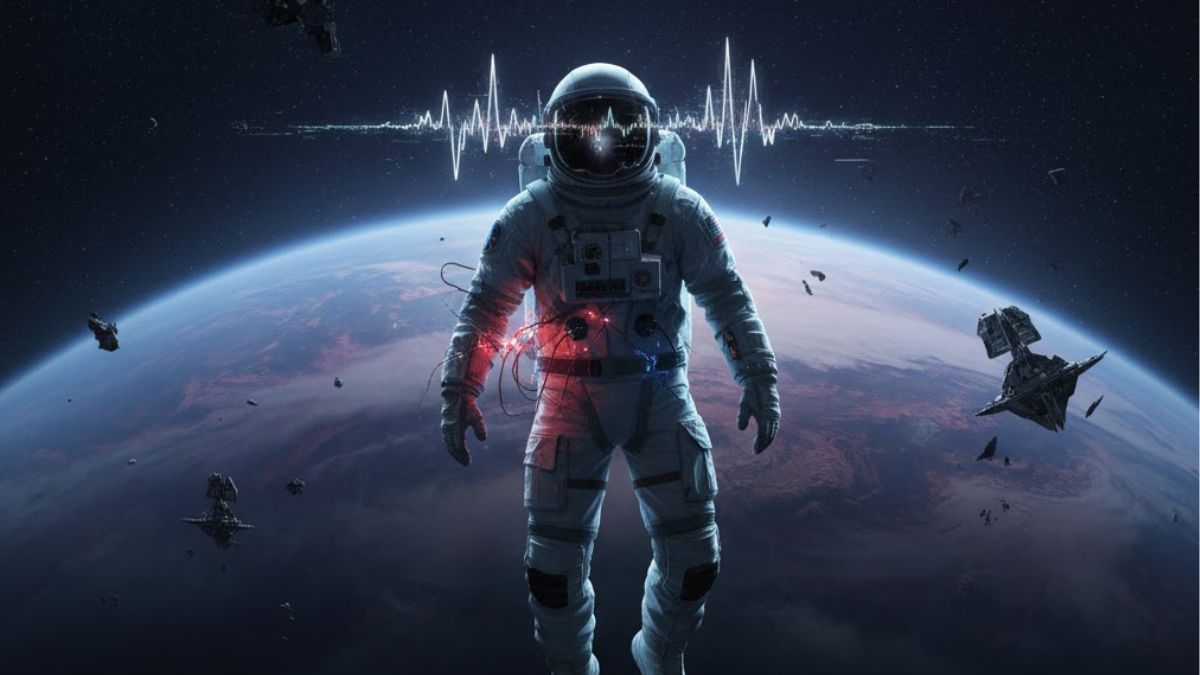
There’s a moment during every big spacewalk that captures everyone’s attention. We see an astronaut floating in the deep black of space, attached to the International Space Station by only a thin tether. Their helmet looks out into the universe, and we hear the crackle of their voice as they describe the incredible view of Earth below. This communication, this vital link, is what makes space exploration feel close and personal to us. It’s a reassuring sound that tells us everything is okay up there.
But what if that link was suddenly cut? What if, for a few tense minutes, the world heard nothing but static from an astronaut on a dangerous mission? This isn’t the plot of a science fiction movie. It’s a real and planned part of space travel that happens more often than you might think. There are specific, crucial moments when NASA intentionally turns off the public’s microphone, and the live feed from the astronaut’s camera goes dark. The transmissions, from our perspective, go missing.
This article will pull back the curtain on these silent moments. We’ll explore the real reasons why these communication blackouts happen, what the astronauts are actually doing when we can’t hear them, and why this silence is a sign of careful planning, not a sign of trouble. So, what is really happening when the voices from space suddenly disappear?
What happens when an astronaut’s microphone goes silent?
The most common reason we lose an astronaut’s audio is surprisingly simple: privacy. Think about your own job. Even in the most exciting workplace on Earth, you have private conversations. You might talk to your boss about a problem, discuss a personal matter with a colleague, or just need a quiet moment to concentrate. Astronauts are no different. They are highly trained professionals doing an extremely difficult job, and they need the same kind of privacy we all do.
The live audio and video feed that the public sees is often on a several-minute delay. This gives mission control a buffer, a chance to catch any private information before it is broadcast to the entire world. But sometimes, for very sensitive discussions, they need to switch to a completely private channel. When an astronaut is talking to a doctor about a minor health issue, having a deep personal conversation with their family, or working through a complex technical problem with an engineer on the ground, the public line goes quiet. This “missing transmission” is a sign of respect for the crew’s well-being and allows for honest, unfiltered conversation that is essential for the mission’s success and the astronauts’ mental health.
Why would mission control want to keep a spacewalk secret?
This idea might sound a little mysterious. After all, space exploration is a global, public endeavor. But the truth is, not every moment is meant for a live audience, especially during a spacewalk, which is one of the most dangerous activities an astronaut can undertake. Imagine trying to fix a delicate, billion-dollar satellite while wearing a bulky glove, with the entire world listening to your every breath and muttered thought. The pressure would be immense.
Mission control uses private communication to protect the astronauts from this pressure. It allows them to focus entirely on the task without the feeling of being on a global stage. The ground team can give clear, direct instructions, and the astronaut can ask questions or voice concerns without fear of being misunderstood by the public. This ensures their safety and the success of the mission. It’s not about secrecy; it’s about creating a safe and efficient working environment, much like a surgeon asking for quiet in an operating room.
Are there places in space where communication is impossible?
Yes, absolutely. This is one of the most fascinating reasons for communication blackouts, and it has to do with the fundamental laws of physics. Radio waves, which are the invisible signals that carry our voices and data through space, travel in straight lines. They also need a clear path. The International Space Station orbits the Earth once every 90 minutes. This means the astronauts experience a sunrise and a sunset 16 times every single day.
During each orbit, there is a period of about 15 to 20 minutes when the space station flies over the part of the Earth that is opposite to the main communication satellites. In this position, the planet itself blocks the signal. The giant, solid body of Earth stands directly between the space station and our receivers. No signal can pass through thousands of miles of rock and metal. So, during this time, communication is naturally lost. The astronauts know to expect this, and they often use this quiet period to do less critical work or simply to enjoy the breathtaking view from their unique office window.
What about the famous “dark side of the Moon” blackout?
This is perhaps the most iconic example of a communication blackout in history. During the Apollo missions that landed humans on the Moon, the spacecraft had to travel behind the Moon. When it did, the entire Moon—a massive, rocky body over 2,000 miles wide—stood directly between the astronauts and Earth. For about 45 minutes, every single radio signal was completely blocked. The world heard nothing but silence.
Imagine the tension in mission control during those long minutes. The fate of the astronauts was entirely in their own hands. They had to fire their engine perfectly to slow down and enter lunar orbit, all while being completely cut off from any help or advice from Earth. It was a planned and expected blackout, but that didn’t make it any less nerve-wracking. When the spacecraft finally emerged from the far side of the Moon and the crackle of the astronaut’s voice returned, it was a moment of pure triumph, a signal that a critical and dangerous maneuver had been successful.
Could a solar storm cut off an astronaut’s signal?
This is a very real and serious concern for future missions to Mars and beyond. The Sun is not a constant, calm star. It has periods of intense activity, and during these times, it can unleash massive explosions of energy and particles called solar storms. When these particles travel through space and hit the Earth’s magnetic field, they can cause beautiful auroras, but they also create tremendous interference for radio signals.
A powerful solar storm could completely drown out the weak radio signals from a spacecraft with a torrent of static. It would be like trying to hear a whisper in the middle of a roaring hurricane. For astronauts on their way to Mars, a prolonged communication blackout caused by a solar storm could be a serious problem, leaving them isolated for days or even weeks. NASA and other space agencies are constantly monitoring the Sun’s activity to predict these events and plan missions accordingly, but it remains one of the biggest challenges of deep space travel.
Do astronauts ever just need a quiet moment?
We often think of astronauts as superhumans, constantly conducting experiments and fixing equipment. But we must remember that they are people, too. They live on the space station for six months or longer, far away from their families, friends, and the simple comforts of Earth. The space station is a noisy place, filled with the constant hum of machines and the demands of a strict schedule.
Sometimes, an astronaut might float over to the famous Cupola window, a large, multi-paneled window that offers a stunning, panoramic view of our planet. They might just look out at the beautiful, silent Earth drifting below them. In these deeply personal moments of reflection and wonder, they are not talking to mission control. They are not on a public microphone. From our perspective on the ground, their transmission is “missing.” But in reality, they are recharging their spirit, connecting with the profound reason they became astronauts in the first place, and that is perhaps the most important communication of all—a quiet conversation with the universe.
Conclusion
The mystery of the missing astronaut transmissions isn’t really a mystery at all. It’s a story of privacy, safety, and the simple realities of physics. The silent moments are not something to fear; they are a carefully managed part of the complex ballet of spaceflight. They allow for private talks, critical focus, and personal reflection, all while our planet’s rotation and the Sun’s power occasionally remind us of the immense challenges of living off our world. The next time you watch a live space feed and it suddenly goes quiet, you’ll know that it’s not a cause for alarm, but a sign that the mission is proceeding exactly as planned.
With plans for longer journeys to the Moon and Mars, these communication blackouts will become longer and more frequent. It makes you wonder, as we venture farther into the silent cosmos, how will we handle the profound isolation that comes with being truly out of touch?
FAQs – People Also Ask
1. How do astronauts communicate with Earth?
Astronauts communicate using radio waves. They have microphones in their helmets and use antennas on their spacecraft to send and receive signals to and from a network of satellites and giant ground-based antennas on Earth.
2. Why is there a delay in communication with space?
Radio waves travel at the speed of light, which is incredibly fast, but space is vast. It takes about 1.3 seconds for a signal to travel from the Moon to Earth. For Mars, the delay can be anywhere from 4 to 24 minutes, depending on the planets’ positions.
3. Can astronauts use the internet in space?
Yes, but it’s not like the internet at home. The space station has a connection, but it is much slower and has a high delay. Astronauts use it mainly for emails, to check specific websites, and to talk with their families.
4. What was the longest communication blackout in space history?
The longest planned blackouts were during the Apollo missions behind the Moon, lasting about 45 minutes. For future Mars missions, communication could be blacked out for weeks if a major solar storm occurs during the journey.
5. How do astronauts talk to each other during a spacewalk?
Astronauts on a spacewalk are connected to each other and to the spacecraft via a system called the Extravehicular Communication System. They can talk to each other, to astronauts inside the station, and to mission control on Earth through their spacesuit radios.
6. Can people on Earth listen to private astronaut conversations?
No, the private conversations between astronauts and mission control are not broadcast to the public. They are kept on secure, encrypted channels to protect the crew’s privacy and the sensitive details of the mission.
7. What happens if communication is lost during an emergency?
Astronauts are extensively trained for this possibility. They have detailed procedures and checklists on board for every conceivable emergency, allowing them to handle the situation on their own until communication can be restored.
8. Why do we sometimes see a live video feed but no audio?
This is usually a simple technical issue, like a problem with the audio mixer on the ground or a decision by the broadcast director to show the video without the concurrent operational audio, which might be private.
9. Do other countries have their own communication networks for space?
Yes, other space-faring nations like Russia (Roscosmos), China (CNSA), and the European Space Agency (ESA) have their own ground station networks to communicate with their spacecraft and astronauts.
10. How will communication work for a mission to Mars?
Communication with Mars will rely on incredibly powerful antennas on Earth and satellites orbiting Mars. However, the long delay means conversations will be like sending text messages back and forth, not a live, two-way chat.