

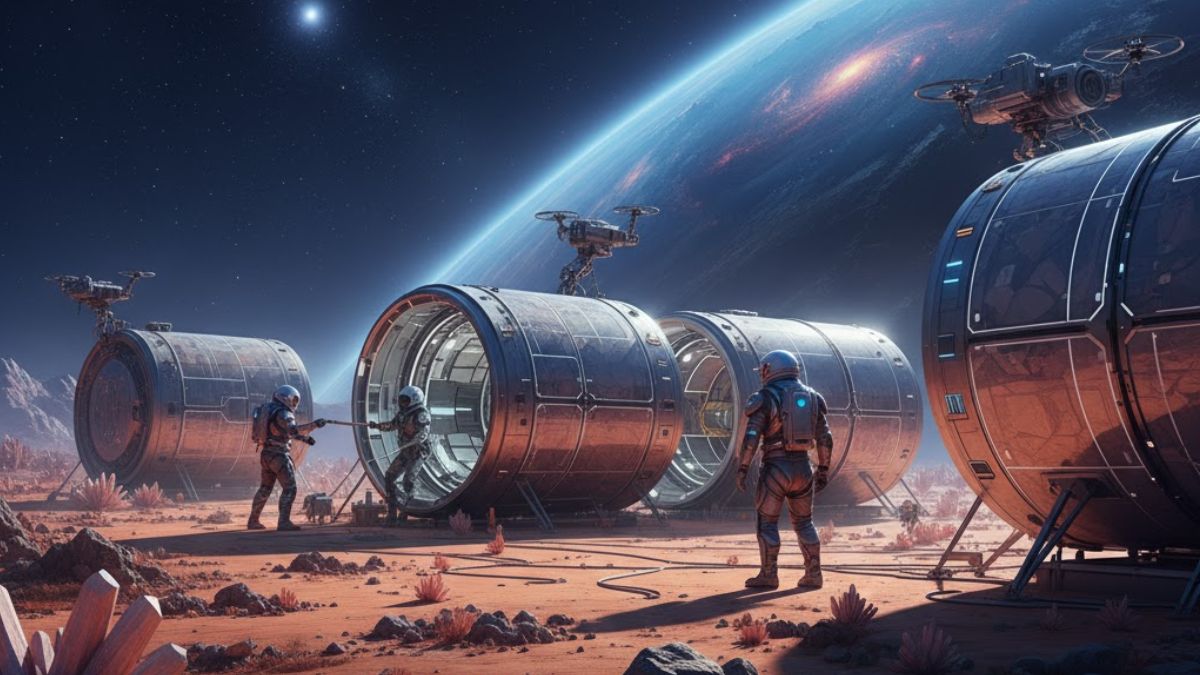
For thousands of years, humans have looked up at the night sky and seen not just pinpricks of light, but possibilities. Those points of light are other worlds—planets and moons that are part of our cosmic neighborhood. Today, this ancient dream is inching closer to reality. We are no longer just dreaming about other worlds; we are actively planning how to live on them.
Building a home on another world is the greatest engineering challenge we can imagine. It’s not like packing a tent for a camping trip. It’s about creating a completely safe, self-contained environment in a place that is actively trying to harm you. These places have no air to breathe, extreme temperatures, and often dangerous radiation. The question isn’t just if we can do it, but how.
So, how do you build a house on a world with no wood, no water, and a poisonous atmosphere? The answers are as fascinating as they are complex, blending science fiction with real-world science. What if the perfect building material was already there, waiting for us on the ground beneath our boots?
Why can’t we just bring a house from Earth?
What is the biggest danger of living on another planet?
If you stepped onto the surface of the Moon or Mars without a spacesuit, it wouldn’t be the lack of air that killed you first. It would be the lack of pressure. In space and on most other worlds, there is essentially no air pressure. Your body needs the weight of Earth’s atmosphere pushing on it to keep your fluids in a liquid state. Without it, they would begin to boil. This is just one of the many deadly hazards we face.
The first and most important job of any space habitat is to be a strong, airtight bubble that creates a safe, Earth-like pressure inside. But pressure is only the beginning. Space is filled with invisible radiation from the sun and distant stars. On Earth, our thick atmosphere and magnetic field act as a giant shield, protecting us. The Moon and Mars have no such global magnetic field, and Mars has a very thin atmosphere. This means anyone living there would be constantly bombarded by radiation, which can increase the risk of cancer and other illnesses over time. A habitat must be a shelter, a shield against this invisible rain.
Then there are the temperature swings. On the Moon, where there is no atmosphere to hold heat, the temperature can swing from a scorching 127 degrees Celsius during the day to a bone-chilling -173 degrees Celsius at night. A habitat must have incredible insulation and a powerful heating and cooling system to keep its inhabitants safe from these extremes. It’s a life-support system that has to work perfectly, every second of every day.
How could we build a house with local materials?
The idea of shipping bags of cement and boxes of windows from Earth to another planet is impossible. The cost of launching materials from Earth’s gravity is far too high. The solution, known as In-Situ Resource Utilization (or just “using local stuff”), is the key to making space habitats affordable and sustainable.
Imagine you are on the Moon. The ground beneath your feet, called lunar regolith, is a fine, dusty soil. Scientists believe we can use this soil to build our homes. We could use special 3D printers, powered by solar energy, that squirt a binding liquid onto the regolith to print walls layer by layer, right on the spot. These wouldn’t be flimsy walls; the regolith, once hardened, is strong and offers excellent protection from radiation and tiny meteorites.
On Mars, the situation is even more interesting. The Martian soil contains minerals that could be used to make real bricks. Researchers have found that by compressing Mars-like soil with a lot of force, you can create solid bricks without needing any extra water or heat. It’s like the soil has its own built-in glue. We could also use the planet’s own resources in other ways. The large amounts of sulfur in the Martian soil could be heated and used as a cement to hold regolith bricks together, creating very strong structures.
What would a space habitat look like from the inside?
From the outside, the first habitats on the Moon or Mars will probably look simple—perhaps like a series of large, connected tubes or domes, half-buried under the soil for extra protection. But inside, the story is different. The goal is to make a place that doesn’t just keep people alive, but lets them live well.
The interior would be a carefully managed ecosystem. Plants would be grown not just for food, but to help recycle the air. They would take in the carbon dioxide we breathe out and release fresh oxygen for us to breathe. Water would be endlessly recycled—the water you drink one day might have been part of your shower the week before, purified and used again.
To fight the feeling of being cooped up in a metal can, designers are thinking about how to use light and space. Large screens might show live views of the outside landscape or recordings of Earth’s forests and oceans. The lighting would change to mimic a natural day and night cycle, helping to keep our body clocks on track. Every single item, from a spoon to a sheet of paper, would have a purpose and be part of a closed-loop system where nothing is wasted.
Could we live in lava tubes on the Moon or Mars?
One of the most exciting ideas for a future habitat doesn’t involve building a structure at all, but rather moving into one that nature has already made. Both the Moon and Mars are covered in evidence of ancient lava flows. When lava flows on the surface, the top can cool and harden into a roof, while the molten rock underneath continues to flow, eventually draining away and leaving behind a long, hollow tunnel called a lava tube.
On Earth, these tubes can be large enough to walk through. On the Moon and Mars, because of the lower gravity, they are believed to be enormous—some large enough to contain entire cities. A lava tube is the perfect ready-made home. Its rocky roof, which can be hundreds of feet thick, provides a natural and superb shield against radiation, temperature swings, and meteorite impacts.
We could seal the ends of a lava tube and pressurize the entire cavern. This would give us a huge, stable, and safe space to build a settlement without having to construct the outer shell ourselves. It’s like finding a pre-built underground bunker, just waiting for us to move in and make it cozy.
What about the psychological challenges of living in a habitat?
Building the physical structure is only half the battle. The human mind is another thing we must learn to protect in space. Imagine being thousands or millions of miles from Earth, living with the same small group of people for years, with no way to go outside for a walk or feel the sun on your skin. The psychological strain would be immense.
To keep people healthy and happy, habitats will need to be designed with mental well-being in mind. Private spaces where a person can be alone will be very important. Virtual reality could offer an escape, allowing someone to “walk” through an Earthly forest or visit their family back home. A reliable, fast connection to Earth for video calls with loved ones would be essential.
The community itself would become like a small family. Shared tasks, like tending to the hydroponic garden or maintaining the life support systems, would give people a sense of purpose. Celebrating holidays, having movie nights, and finding ways to have fun together would be as critical to survival as having enough oxygen. The habitat must be a home, not just a machine for living.
Building habitats on other worlds is a puzzle with thousands of pieces. We have to be architects, engineers, farmers, and psychologists all at once. We are learning how to use the dust of other planets as our bricks and the hidden caves of the Moon as our foundations. It’s a project that pushes the very limits of human creativity and courage.
This journey is not about escaping Earth, but about extending the human experience far beyond our cradle. It’s about becoming a multi-planet species. As we solve these incredible challenges, we also learn new ways to take care of our own planet and each other.
If you could design the first home on Mars, what is the one thing from Earth you would make sure it had inside to make it feel like home?
FAQs – People Also Ask
1. How long would a space habitat last?
A well-built habitat would be designed to last for decades, but it would need constant maintenance and monitoring. Parts would wear out and need to be replaced, and systems would need to be upgraded over time, much like a complex building on Earth.
2. Can plants really grow on the Moon or Mars?
Not in the outside soil, but inside habitats we can create controlled environments. Using hydroponics (growing plants in water with nutrients) and special lights, we can grow many vegetables and plants successfully, which provides food and helps recycle the air.
3. What is the biggest challenge in building a space habitat?
The biggest challenge is creating a completely sealed, self-sustaining system that reliably provides air, water, food, and protection from radiation and extreme temperatures, all while being built with local materials to save cost.
4. How would we get water on the Moon or Mars?
On the Moon, water ice is believed to exist in permanently shadowed craters at the poles. On Mars, we could extract water from the soil, which contains water ice, or from underground ice deposits that we know exist.
5. Why don’t we just build a dome on Mars?
A simple glass dome would not be safe. It wouldn’t protect against radiation or meteorites. Any future dome-like structure would need to be heavily reinforced, covered in soil for shielding, and made of incredibly strong materials to hold the air pressure in.
6. How many people could live in the first space habitat?
The first habitats would be very small, likely designed for just a few astronauts—maybe four to six people—as a proof of concept. Later, as we build more and larger structures, settlements could grow to house dozens or even hundreds.
7. Would we have internet on the Moon or Mars?
Yes, but with a significant delay. A signal from the Moon takes about 1.3 seconds to reach Earth, and from Mars it can take between 4 and 24 minutes depending on the planets’ positions. So, you couldn’t have a live video chat with someone on Earth from Mars.
8. What would happen if a habitat got a hole in it?
Habitats would be built with multiple, separate sections that can be sealed off from each other automatically. If a small hole appeared, alarms would sound, and the damaged section would be isolated while the leak is repaired, much like on a submarine.
9. Could we have children in a space habitat?
This is a very complex question that scientists are still studying. The effects of lower gravity and higher radiation on human development from conception to birth are not yet fully understood, and it presents one of the biggest long-term challenges for creating permanent settlements.
10. How much would it cost to build a habitat on Mars?
The cost would be astronomically high, likely in the hundreds of billions or even trillions of dollars when you consider all the research, development, and missions required. This is why governments and private companies around the world would likely need to work together.