

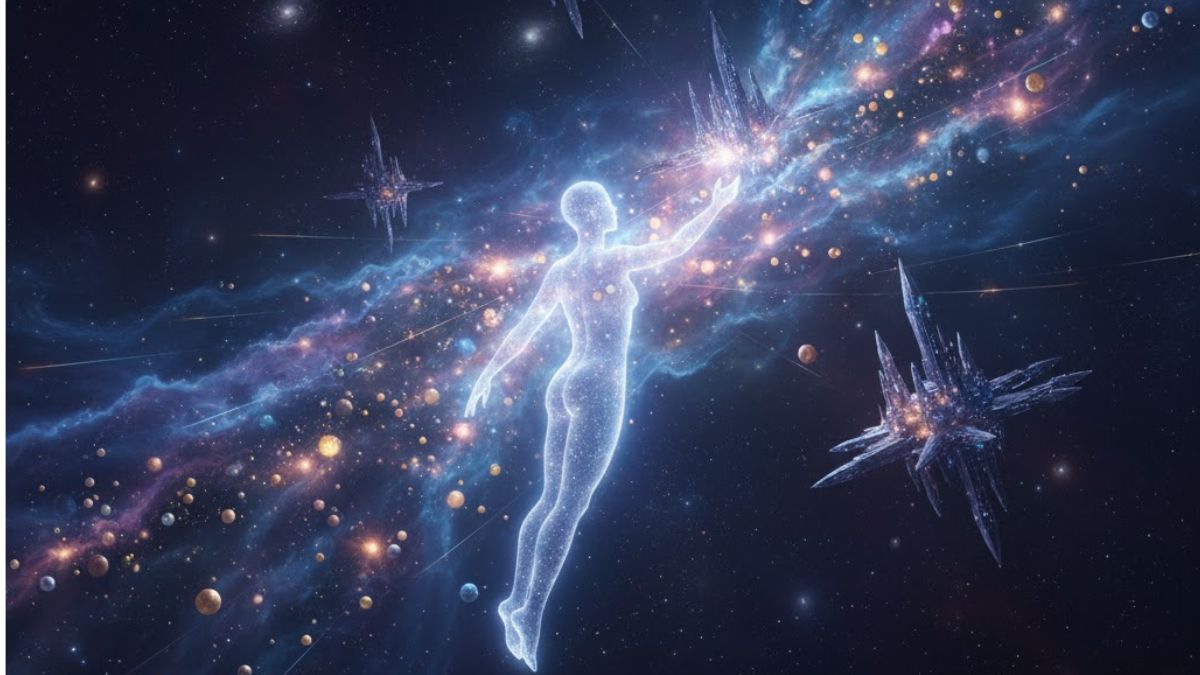
There’s a quiet feeling that sometimes visits people. It’s that sudden sense of wonder when you look up at a sky full of stars. It’s a strange feeling of being very small, but also feeling a deep, mysterious connection to that vast, dark expanse. It’s more than just appreciating a pretty view. It feels like a memory, or a homesickness, for a place you’ve never actually been.
This feeling is at the heart of a beautiful and ancient idea. What if this sense of connection isn’t just a feeling? What if it’s a clue? Some philosophers, spiritual thinkers, and even scientists have explored a fascinating theory. They suggest that our souls, the very essence of who we are, might not have originated on Earth. They propose that we are, in a very real sense, from somewhere else.
This article will explore this captivating idea that our souls are from other worlds. We won’t get lost in complex jargon. Instead, we’ll walk through the thoughts and questions that make this theory so compelling. If we are not from here, where did we come from? And why does the night sky sometimes feel so much like home?
What does it mean to say our souls are from the stars?
This idea is often called the Starseed theory. It doesn’t suggest that our physical bodies were born in another galaxy. Our bodies are very much made from the elements of Earth. But the theory asks us to consider that the spark of life within us—our consciousness, our soul, or our spirit—could have a different origin.
Think of it like this. Imagine you are a seed. You are planted in the soil of a beautiful garden. You grow there, you take in water and sunlight from that garden, and you become a flower. The flower is made from the garden’s soil. But the original blueprint for that flower, the unique information that made it a rose and not a daisy, was inside the seed long before it ever touched the earth. In this metaphor, Earth is the garden, and your body is the flower. Your soul is that original seed, which came from somewhere else entirely.
This is a powerful thought that changes how we see ourselves and our place in the universe. It suggests that we are not just visitors on a planet, but visitors in the entire universe, having a human experience. So, what is it that makes this idea feel so resonant for so many people?
Why do some people feel a deep connection to the night sky?
For many, the draw of the stars is more than a hobby; it’s a deep, emotional pull. It’s a feeling that can be hard to put into words. Some people describe a sense of peace when they gaze at the Milky Way. Others feel a thrilling excitement, a longing for adventure among the constellations.
This feeling is often strongest in children. They look up with wide, curious eyes, instinctively knowing there is magic up there. As we grow older, we get busy with life on Earth, but that underlying feeling often remains. It shows up in our stories, our movies, and our dreams. We tell tales of heroes traveling to distant galaxies, of finding new homes and meeting new forms of life.
Perhaps these stories are not just fiction. Maybe they are echoes of a deeper memory. If our souls have a history that spans the cosmos, then looking at the stars is like looking at a family photo album from a time we can’t quite remember. The connection feels real because, on some level, it is. We are literally made of stardust, the same atoms forged in ancient stars. So why couldn’t our consciousness also have a cosmic heritage?
Is there any science that could support this idea?
When we talk about souls, we step into a realm that traditional science has a hard time measuring. Science deals with the physical, the observable, the repeatable. A soul, by its very nature, is not something you can put under a microscope. However, some interesting scientific concepts create openings where such a theory could, possibly, fit.
One of the biggest mysteries in science is the nature of consciousness itself. Scientists can map the brain and see which parts light up when we feel love or fear. But they cannot explain why we have a subjective experience at all. Why does it feel like something to be you? This is known as the “hard problem of consciousness.” No one knows where consciousness comes from.
Some physicists and philosophers have proposed that consciousness might be a fundamental property of the universe, like space and time. This means it’s not created by the brain, but rather, the brain might be a receiver of consciousness, like a television receiving a signal. If consciousness is a universal field, then our individual souls could be unique packets of this consciousness that have always existed, perhaps choosing to experience life on Earth for a while.
Another concept from physics is the multiverse theory. This suggests our universe might be just one of an infinite number of universes, all with different physical laws. If that’s true, the possibilities are endless. Our souls could have originated in a universe with completely different rules, a place where existence is nothing like what we know here. While this isn’t proof, it shows that our understanding of reality is expanding in ways that make once-impossible ideas seem a little more plausible.
What do ancient cultures and religions say about the soul’s origin?
The idea that we come from somewhere beyond this world is not new. It’s a thread that runs through many ancient beliefs and wisdom traditions. Long before telescopes, people looked to the heavens and saw the home of gods, ancestors, and spirits.
In many shamanic traditions, for instance, it is believed that a shaman can journey to other worlds or dimensions to retrieve lost parts of a person’s soul. This implies that the soul is not permanently fixed to the body and can travel to realms beyond our own.
Plato, the famous Greek philosopher, wrote about the soul’s origin in the “world of forms.” He believed that before we were born, our souls existed in a perfect realm of pure ideas and absolute truth. When we are born, we forget this perfect world, and our life on Earth is a journey to remember that divine knowledge. This is very similar to the feeling of “remembering” something when we look at the stars.
Certain branches of Hinduism and Buddhism teach about reincarnation across many different worlds and planes of existence. They believe a soul can be born as a human, an animal, or even a being in a heavenly or hellish realm, all as part of a long journey of learning and spiritual growth. The ultimate goal is to break free from this cycle and return to a state of oneness with the divine source, which exists beyond all physical worlds.
These ancient ideas, though expressed in different languages and cultures, share a common theme: Earth is a school, not our permanent home. Our true home is somewhere in the cosmos, in a state of being that is more luminous and free than our physical existence.
How does this theory explain feelings of not belonging on Earth?
Many people go through life with a persistent feeling of being “different” or not quite fitting in. It’s a sense of being out of place, like a puzzle piece that doesn’t match the rest of the picture. For some, this is more than just social anxiety; it’s a deep, existential feeling that they don’t truly belong on this planet.
If the Starseed theory has any truth to it, this feeling makes perfect sense. Imagine if you were born and raised in a foreign country, with different customs, a different language, and a different way of life than your native land. Even if you adapted and learned to live there, a part of you would always remember home. You might feel a little different from everyone around you.
This could be our situation on Earth. Our souls, having originated in a different world or dimension, are trying to navigate a reality that is unfamiliar. The aggression, competition, and materialism that are common on Earth might feel alien and confusing to a soul that comes from a place of greater harmony and connection.
This feeling of not belonging isn’t a flaw; under this theory, it’s a sign of your origin. It’s your soul remembering its true nature and its true home. It’s why you might feel more at peace in nature, under the open sky, than in a crowded, noisy city. You are, in a way, reconnecting with the cosmos, even if it’s just a small piece of it visible from your backyard.
Could this be why we are so driven to explore space?
Look at what humanity is doing. We are pouring billions of dollars and our greatest minds into building rockets, sending probes to other planets, and dreaming of setting foot on Mars. Why? From a purely survivalist point of view, it doesn’t make immediate sense. We have many problems to solve right here on Earth.
But the drive to explore is in our blood. It’s an unstoppable force. We climbed the highest mountains, sailed the widest oceans, and now we are reaching for the planets. This isn’t just a practical endeavor; it’s a deeply spiritual and emotional one.
Could this be the ultimate expression of our souls’ longing for home? We might not consciously remember where we came from, but an instinct is pushing us outward, telling us to look, to search, to find our way back. Every time a rover sends back pictures from Mars, or a telescope discovers a new Earth-like planet, we feel a collective thrill. It’s not just curiosity. It feels like we are getting closer to solving a great mystery, a mystery about ourselves.
Space exploration, then, is the most ambitious homecoming project in history. We are using science and technology to fulfill a spiritual yearning, to answer the oldest question of all: Where do we come from? Every mission into deep space is, in a way, a mission to find a reflection of our own cosmic origins.
What would our purpose be if we are from another world?
If we accept this theory, even just as a thought experiment, it changes everything about how we see our purpose in life. If you are a visitor, why are you here? You probably didn’t travel all this way just to pay bills and watch television.
The most common idea within these beliefs is that we are here to learn and to grow. Earth, with its intense emotions, its challenges, and its beautiful duality of joy and sorrow, is a powerful school for the soul. It’s a place where we can experience things that might not be possible in our place of origin. We learn about love by sometimes experiencing loss. We learn about strength by facing fear. We learn about compassion by seeing suffering.
Another purpose could be to help. Perhaps older, more advanced souls come to Earth to aid in its evolution. They come to bring more light, more love, and more consciousness to a planet that needs it. They do this not through grand gestures, but through simple acts of kindness, through creating art that inspires, through scientific discoveries that heal, and through living a life of integrity.
Your purpose, then, is uniquely yours. But at its core, it would be to have a genuine human experience, to learn from it, and to leave this world a little better than you found it. You are a cosmic citizen on a field trip to Earth, and your mission is to explore, to love, and to remember who you really are.
Conclusion
The theory that our souls are from other worlds is a poetic and powerful lens through which to view our existence. It gives meaning to that deep, wordless connection we feel with the stars. It offers an explanation for the feeling of being a stranger in a strange land. And it transforms our drive to explore space from a scientific hobby into a spiritual quest for home.
Whether this theory is literally true or not may be less important than the questions it inspires. It encourages us to look up and within, to see ourselves as citizens of a much grander universe. It suggests that we are not insignificant specks, but rather, we are the universe itself becoming conscious, looking back at itself, and trying to find its way back home.
So, the next time you stand under a clear night sky and feel that familiar pull, don’t dismiss it. Listen to it. That feeling might be the most real thing about you—a quiet whisper from a distant home, reminding you of your incredible cosmic story.
What do you think? If you could choose, which star or constellation would you want your soul to be from?
FAQs – People Also Ask
1. What is the Starseed theory?
The Starseed theory is a spiritual belief that suggests human souls did not originate on Earth. It proposes that our consciousness or spiritual essence came from other planets, star systems, or dimensions, and we are currently having a physical experience on Earth to learn and grow.
2. Is there any proof that souls exist?
There is no scientific proof that can be measured in a lab, as souls are considered a non-physical phenomenon. However, many people point to near-death experiences, past-life memories in children, and the universal human feeling of consciousness as strong indicators that there is more to us than just our physical bodies.
3. How can I know if my soul is from another world?
Many who believe in this theory say that signs include a deep, lifelong fascination with space and the stars, a feeling of not belonging or being “homesick” for an unknown place, a strong sense of purpose to help Earth and its people, and a feeling of being unusually sensitive to the energy and emotions of others.
4. What is the difference between a soul and a spirit?
In many discussions, the terms are used interchangeably. However, some traditions make a distinction. “Spirit” is often seen as the eternal, unchanging divine spark that is connected to the source of all things. The “soul” is sometimes viewed as the individual personality or essence that carries lessons from lifetime to lifetime.
5. Do all religions believe the soul comes from heaven?
Not all religions conceptualize it the same way. While many Abrahamic religions like Christianity and Islam believe the soul is created by God and comes from a heavenly realm, Eastern religions like Hinduism and Buddhism often see the soul as eternal and cycling through many different worlds and lives. Some atheistic views do not believe in a soul at all.
6. Could aliens have souls?
If souls are a fundamental part of consciousness, then the theory would suggest that any conscious, self-aware being could possess a soul, regardless of its biological form. This is a common theme in both spiritual circles and science fiction, where advanced alien civilizations are often depicted as having rich spiritual lives.
7. What is a starseed awakening?
A “starseed awakening” is a term used to describe the process where a person becomes consciously aware that their soul might be from another world. This often involves a period of deep questioning, spiritual seeking, and a strong pull to explore cosmic themes, metaphysics, and their own life’s purpose.
8. How does this theory relate to reincarnation?
The two ideas fit together very well. Many who believe in souls from other worlds also believe in reincarnation. They suggest that a soul might have lived many lifetimes on different planets, and Earth is just one of many schools it attends in its long cosmic journey.
9. Why can’t we remember our past lives or other worlds?
The most common explanation is that a “veil of forgetfulness” is necessary for the learning experience. If we remembered everything, it would be like reading the answers to a test before taking it. The challenge and growth come from navigating life with a fresh perspective and rediscovering our true nature from scratch.
10. Does this mean we will go back to the stars when we die?
According to this belief system, yes. When our physical life on Earth ends, it is thought that our soul returns to its non-physical state. From there, it may return to its place of origin, review what it learned, prepare for another life elsewhere, or choose to stay and guide other souls from the spiritual realm.