

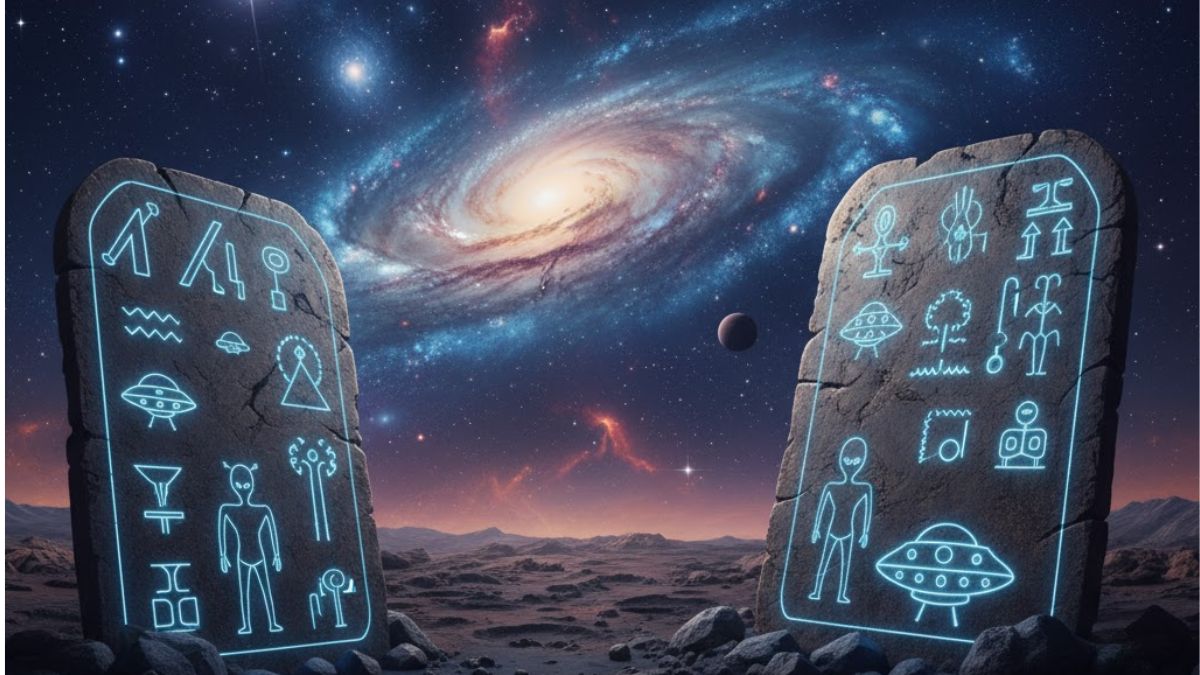
For thousands of years, humans have looked up at the night sky, watching the twinkling lights and wondering if we are alone. Our ancient ancestors told incredible stories about gods descending from the heavens, strange beings bringing knowledge, and fiery chariots flying across the sky. Today, with our powerful telescopes and space probes, we are still asking that same, thrilling question: Are we the only intelligent life in the universe?
But what if the answer isn’t just out there in the distant stars? What if the clues have been here on Earth all along, hidden in the pages of our oldest history books and carved into the stones of ancient ruins? A fascinating idea suggests that our planet might have been visited by travelers from another world long before we built our modern cities. This concept isn’t about little green men in flying saucers today; it’s about the possibility that our distant past holds traces of alien contact.
So, how do we begin to look for evidence of something that might have happened thousands of years ago? If visitors from another star system did come to Earth, what kind of mark would they have left behind for us to find?
What are the most mysterious ancient structures on Earth?
Scattered across our planet are incredible buildings and monuments built by ancient people. We learn in school that they were constructed with simple tools and human labor. But when you look closer at some of them, the story becomes much more puzzling. The precision and scale are so advanced that many people question if we have the full story.
Take the Great Pyramid of Giza in Egypt, for example. It is made of millions of massive stone blocks, each weighing several tons. How did people move these gigantic stones across the desert and stack them so perfectly? The corners of the pyramid are aligned almost perfectly with the four directions of the compass. The stones fit together so tightly that you cannot slide a piece of paper between them. This kind of accuracy is hard to achieve even with our modern machines and technology. It makes you wonder if the builders had some help or knowledge that seems beyond their time.
On the other side of the world, in Peru, there is the mysterious site of Sacsayhuamán. Here, enormous rocks are cut into strange, jagged shapes and fit together like a giant, complex puzzle. The rocks are so big and heavy, and they lock together so precisely without any mortar, that it has survived massive earthquakes that destroyed later Spanish buildings. How did ancient people cut, move, and shape these gigantic rocks with such incredible skill? These structures stand as a silent challenge, making us question what we know about our own history.
Could ancient art and carvings show us alien visitors?
If ancient people saw something extraordinary, like a visitor from the stars, they would probably want to record it. They might paint it on cave walls or carve it into stone, creating a permanent record of their amazing experience. This is why archaeologists and researchers spend so much time studying ancient art, looking for clues that might point to something otherworldly.
In the deserts of Val Camonica, Italy, there are rock carvings that are thousands of years old. Among the drawings of everyday life, some figures stand out. They appear to be human-like shapes, but they are wearing suits that look strangely like modern astronaut helmets and suits. Of course, we cannot know for sure what the artist was trying to show. It could have been a shaman in a ceremonial costume. But the resemblance is uncanny and makes you stop and think.
Then there are the famous “birdmen” from the ancient Maya civilization. They created intricate carvings and sculptures of figures that look human but have unusual, non-human features. Some of these figures are depicted inside what looks like a complex vehicle with flames and smoke coming out the bottom, eerily similar to a rocket ship. Again, experts have their own interpretations, suggesting they represent gods or symbols from their religion. But when you see these images, it is hard not to imagine an ancient person trying to draw something incredible they witnessed—a powerful machine descending from the sky.
Why do so many ancient cultures have similar “sky god” stories?
One of the most compelling pieces of this puzzle is found not in stones, but in stories. Cultures that were separated by vast oceans and mountains, who could never have met, often tell very similar tales. They speak of powerful beings who came from the stars, bringing wisdom and technology to early humans.
The Sumerians, who lived in what is now Iraq over 5,000 years ago, wrote detailed stories about the Anunnaki. These were described as god-like beings who descended from the heavens to Earth. They were said to have given humanity the knowledge of writing, agriculture, and laws. The descriptions of their arrival and their powers sound, to some, less like magic and more like advanced technology.
On the other side of the world, the indigenous peoples of the Americas have legends of the “Star People.” For example, the Hopi tribe in North America talks about their ancestors coming from the stars and living in the sky before arriving on Earth. In South America, pre-Incan cultures tell of beings called the “Gods of the Sun” who arrived from the sky and taught people how to build and farm. When you hear the same theme repeated across the globe, it makes you wonder. Is this just a common human imagination at work, or could it be a shared, distant memory of a real event?
What is the “Panspermia Theory” and could it explain our origins?
Maybe the traces of alien life are even more fundamental than visitors. Perhaps they are us. This idea is known as Panspermia, and it is a scientific theory that suggests life did not start on Earth at all. Instead, it proposes that the basic building blocks of life, like bacteria or tiny organisms, hitched a ride to our planet on an asteroid, comet, or even a speck of space dust.
Think of space as a vast ocean, and asteroids and comets are like sailing ships. These space rocks can travel for millions of years. If a rock containing tiny, hardy bacteria was knocked off a planet in another solar system, it could have journeyed through space. Eventually, it might have crashed into a young, lifeless Earth billions of years ago. Upon impact, these microscopic organisms found a perfect home—a planet with water and a good atmosphere. They then began to grow and evolve, eventually leading to all the life we see today, including us.
This theory is exciting because it means we might all be descendants of life that began somewhere else in the galaxy. We would not be looking for traces of alien visitors in ancient ruins, but in our very own DNA. The evidence for this would be incredibly difficult to find, but the idea connects every living thing on Earth to the cosmos in a profound way.
How do scientists search for proof of ancient aliens?
You might be thinking that this is all just a fun story. But are real scientists actually looking into this? The answer is yes, but not in the way you might see in movies. The scientific search for extraterrestrial life is a serious field, and it includes looking for signs in our ancient past. This field is often called SETI, which stands for the Search for Extraterrestrial Intelligence, and it also includes a branch called “Archaeology of the non-human.”
Scientists do not typically dig for alien bones. Instead, they look for unusual evidence that cannot be easily explained. They might analyze an ancient metal artifact to see if it is made from a material not known to exist on Earth, or with a purity that should have been impossible for ancient people to achieve. They study geological layers for signs of events that could be linked to advanced technology, like a layer of glass that could only be formed by an immense heat, similar to a nuclear explosion.
They also use tools like carbon dating to verify the age of objects and sites. If someone claims a strange object is from an ancient alien visit, scientists will test it to see how old it really is. Most of the time, a logical, earthly explanation is found. But the scientific process requires an open mind. The goal is to follow the evidence, no matter where it leads, and to always question and test every theory.
What about UFOs and government reports today?
The conversation about alien visitors is not just about the distant past. In recent years, the topic of Unidentified Aerial Phenomena (UAP), which is the modern term for UFOs, has moved from science fiction into serious government discussions. The United States government has officially released videos taken by military pilots showing objects in the sky that move in ways we cannot explain.
These objects perform maneuvers that seem to defy our understanding of physics. They can stop instantly, make sharp turns at incredible speeds, and move without any visible engines or wings. Military pilots, who are highly trained observers, have reported seeing these objects on multiple occasions. Governments around the world have started to admit that they do not know what these objects are. They have ruled out secret military technology from other countries and natural phenomena, but they have not provided a final answer.
This new openness makes the search for ancient traces even more relevant. If there are unexplained objects in our skies today, is it so hard to believe that they might have been here centuries or millennia ago? The official attention given to UAPs today lends a new layer of credibility to the idea that we should be seriously investigating the possibility of non-human intelligence, both in our present and in our past.
Conclusion
The idea that our planet was visited long ago by beings from another star is one of the most exciting and mysterious possibilities we can explore. From the mind-boggling construction of ancient pyramids to the strange figures in prehistoric art, and from the universal stories of sky gods to the serious science of Panspermia, the clues are scattered throughout our history. While we may not have a definitive piece of proof like a starship in a museum, the collection of mysteries is compelling.
The search for answers is not about proving that ancient humans were not clever or capable. They were incredibly ingenious. It is about asking whether their incredible achievements might have been inspired by something, or someone, from beyond our world. As we continue to explore our own planet and reach out to others, we keep looking for that one piece of evidence that will change everything.
So, the next time you look at an ancient monument or read an old myth, ask yourself this: Could the greatest story of our past still be waiting to be fully told?
FAQs – People Also Ask
1. What is the most convincing evidence for ancient aliens?
Many people point to the incredible precision and size of ancient structures like the Pyramids of Giza, the mysterious stone heads on Easter Island, and detailed ancient artwork that seems to depict astronauts and flying machines as some of the most intriguing, though not conclusive, pieces of evidence.
2. Has NASA ever found proof of ancient aliens?
No, NASA has not found any proof of ancient aliens. Their focus is on the scientific search for simple, microbial life elsewhere in our solar system, like on Mars or the moons of Jupiter, and not on investigating ancient ruins on Earth for signs of intelligent visitors.
3. Why is the Panspermia theory taken seriously by some scientists?
Scientists consider Panspermia a plausible theory because we know that some microorganisms can survive the harsh conditions of space, and we have found amino acids, the building blocks of life, on asteroids. It offers a possible explanation for how life began so quickly after Earth cooled down.
4. What is the difference between a UFO and a UAP?
UFO stands for “Unidentified Flying Object,” a term that became popular in the past. UAP, or “Unidentified Aerial Phenomena,” is the newer term used by governments and militaries to describe objects in the sky that cannot be identified, aiming to remove the stigma associated with “UFO.”
5. Did ancient Egyptians have help building the pyramids?
Mainstream archaeology believes the pyramids were built by skilled Egyptian workers using ingenious ramps, levers, and sheer manpower. The idea of alien help is a speculative theory proposed by those who find the official explanation insufficient for the pyramids’ extreme precision and scale.
6. What do ancient alien theories say about human evolution?
Some ancient alien theories suggest that extraterrestrial beings may have genetically manipulated early hominids to accelerate the evolution of modern humans. This is a fringe idea and is not supported by mainstream science, which explains human evolution through natural selection and fossil evidence.
7. Are there any books written by scientists about ancient aliens?
While many books explore the topic, most are written by authors and researchers outside mainstream science. The scientific community largely regards the ancient astronaut theory as pseudoscience because it lacks testable evidence and peer-reviewed support.
8. How do we know that ancient art really shows aliens?
We don’t know for sure. Interpretations of ancient art are highly subjective. What one person sees as an alien, an expert might interpret as a stylized human, an animal, a god, or a person in a ceremonial mask. There is no universal agreement on these images.
9. Could ancient “magic” or “miracles” have been advanced technology?
This is a core idea in ancient alien theories. It suggests that technologies like powerful energy sources, advanced medicine, or flight would seem like magic to ancient people. Stories of miraculous events in religious texts are sometimes re-interpreted by believers as descriptions of advanced technology.
10. What would be definitive proof of ancient aliens?
Definitive proof would be something undeniable and unexplainable by earthly means. This could include the discovery of a complex artifact made from materials not found in our solar system, a skeleton with non-Earthly DNA, or a functioning piece of technology buried in ancient rock layers.