

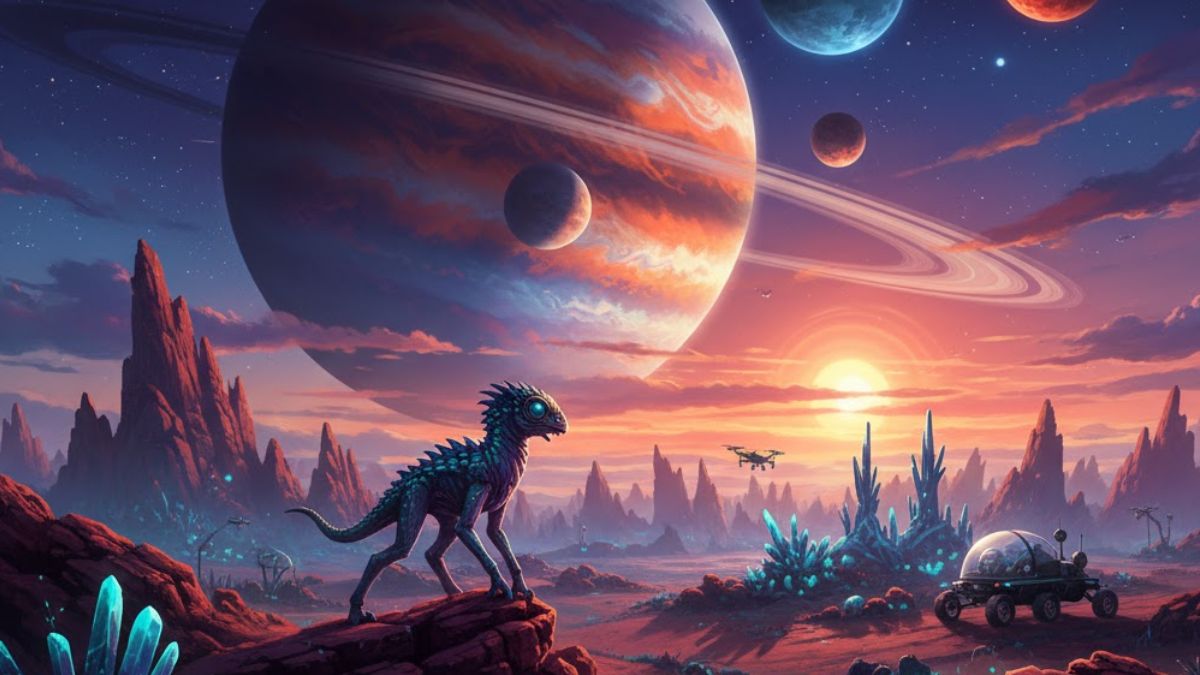
We often look up at the night sky, at those tiny points of light, and wonder what’s out there. Each star is a sun, and many of those suns have their own families of planets. Scientists have found thousands of these alien worlds, planets that orbit distant stars. They come in all sorts of strange and wonderful forms—gas giants bigger than Jupiter, rocky worlds covered in lava, and maybe even watery planets like our own. But what would it actually be like to stand on one? Let’s go on a journey in our minds to visit a few of these incredible places. We won’t need a spaceship, just our imagination. We’ll explore what a single day might feel like on a planet that is nothing like Earth. From the color of the sky to the ground beneath your feet, everything would be new and different. What kind of wonders and challenges would you face from sunrise to sunset on a world light-years away?
If every star is a potential sun, then what kind of morning would you wake up to on a planet in another solar system?
What Would the Sky Look Like on an Alien Planet?
The first thing you would notice on any new world is the sky. It wouldn’t look like the blue dome we are used to. The color of the sky depends on the planet’s atmosphere, or the layer of gases that surrounds it. On Earth, our air scatters blue light from the Sun, making the sky appear blue. But on an alien world, things could be very different.
Imagine you are on a planet that orbits a red dwarf star. This star is smaller and cooler than our Sun, and it glows with a deep, dim, red light. As you wake up, the sky wouldn’t be bright blue. It might be a permanent shade of orange, red, or even a dark, murky yellow. The sunlight would feel weak and would not provide much warmth, even at midday. If this planet has a very thick atmosphere, the sky might always look hazy, like a perpetual, colorful sunset. You might not even see the star clearly, just a general glow in the sky.
Now, picture a different scenario. You are on a planet with two suns. Yes, a real-life Tatooine! In the morning, you might see two stars rising at slightly different times, casting double shadows that dance around you. The light could be a strange blend of colors—perhaps one star is yellow and the other is orange, creating a beautiful but weird mix. The sky itself might be a color we can’t even describe, maybe purple or black, if the atmosphere is thin or made of different gases. The view alone would tell you that you are very, very far from home.
How Would It Feel to Walk on a Planet with Different Gravity?
Stepping out of your imaginary lander, the next thing you’d feel is the pull of gravity. Gravity is the force that keeps your feet on the ground. It changes from planet to planet based on the world’s size and mass. This would change everything about how you move.
Let’s say you land on a “super-Earth,” a rocky planet that is much bigger and heavier than our own. The gravity here would be crushing. Just standing up would feel like you are carrying a heavy backpack full of rocks. Taking a single step would be a huge effort. Your body would feel heavy and slow. You wouldn’t be able to run or jump. Even lifting your arm to wave would require more energy. A simple walk to explore a nearby hill would feel like the hardest workout you’ve ever done.
On the flip side, you could visit a small world, like a moon orbiting a giant gas planet. This place might have very low gravity. Walking wouldn’t really work here. Instead, you would bounce. With each step, you would leap high into the air, floating down slowly. It would feel like you were on a trampoline all the time. While this sounds like fun, it could also be tricky. A small push could send you tumbling head over heels. You’d have to learn to move carefully and slowly to get anything done. Everything, from setting down a tool to pouring a drink, would behave in strange, slow-motion ways.
What Kind of Weather Would You Experience?
Weather on Earth can be wild, but on an alien world, it could be truly extreme. The weather is driven by a planet’s atmosphere, how close it is to its star, and how fast it spins. Some planets have weather that would make our worst hurricanes look calm.
Imagine a planet that is tidally locked. This means one side always faces its sun, and the other side is in permanent darkness. On the bright, day side, it is always scorching hot. The heat would be so intense that it could melt metal. This would create powerful, never-ending winds as the hot air from the day side rushes toward the cold night side. You might experience constant, screaming hurricanes that would tear across the landscape. There is no calm, sunny day here—just a perpetual, violent storm.
On another type of world, it might rain. But it wouldn’t be rain like we know. On a hot, Jupiter-like planet made mostly of gas, scientists think it might rain liquid diamonds deep inside its atmosphere. Closer to the surface, it could rain glass, or even rocks! On a colder world, the rain might be made of methane or sulfuric acid, falling from yellow, chemical-smelling clouds. An umbrella wouldn’t be much help. You would need a strong shelter to protect you from the sky itself.
Could There Be Alien Life Forms and Landscapes?
If we are imagining a day on an alien world, the biggest question is about life. Would we see strange plants or animals? What would the ground look like? While we don’t know for sure, science gives us some exciting ideas.
Let’s explore a planet that is covered in a global ocean, with no land in sight. The “landscape” would be endless waves. The life here wouldn’t be fish as we know them. Imagine giant, jellyfish-like creatures that float in the deep, glowing with their own light to communicate or hunt. The plants might not be green; they could be black or purple to absorb different kinds of light from their star. Swimming through this alien sea, you’d be surrounded by silent, floating shapes and brilliant colors in the dark water.
Now, think about a rocky planet with active geology. The ground might not be dirt and stone. It could be made of different minerals, creating fields of crystalline structures that sparkle in the starlight. These wouldn’t be plants, but they would grow like forests, forming amazing, jagged shapes. If there is life, it might be very small, like microbes that live in the soil or within the rocks themselves. You might not see giant monsters, but the whole world would feel alive in a subtle, mysterious way, with a quiet, alien beauty all its own.
What Would Sunset and Night Be Like?
The end of the day on an alien world could be the most spectacular part. A sunset is all about the light from the star passing through the atmosphere. With different atmospheres and often more than one sun, the evening show would be unforgettable.
On a planet with two suns, sunset would be a long and complicated event. The first star might set, casting the world into a dim, twilight state. Then, you would wait for the second star to dip below the horizon. The colors in the sky could shift from orange to deep purple and finally to a strange, dark blue. The shadows would stretch and change shape in confusing ways. It would be a light show that lasts for hours.
Once darkness falls, the night sky would be the ultimate proof that you are not on Earth. If you are in a solar system with multiple planets, some of them might appear huge in the sky, showing their colorful rings or large moons. The constellations would be completely unfamiliar. Instead of our Big Dipper, you would see patterns and shapes that no human has ever named. The Milky Way might stretch across the sky in a different orientation, a river of stars reminding you of your faraway home. On a moon orbiting a gas giant, the night might never be truly dark, as the giant planet would reflect so much light, hanging in the sky like a magnificent, striped marble.
A day on an alien world would be a full experience of strange sensations. From the moment you wake up under a strange-colored sky, to the effort of moving in different gravity, to surviving extreme weather, and finally witnessing an unbelievable sunset, every moment would be an adventure. It shows us that our universe is a place of endless variety and wonder. The planets out there are not just simple rocks; they are dynamic, complex, and utterly fascinating worlds waiting for us to understand them.
We’ve imagined a day on a planet with two suns and another in a global ocean. If you could choose, what kind of alien world would you most want to visit for a day?
FAQs – People Also Ask
1. What is an exoplanet?
An exoplanet is simply a planet that orbits a star outside of our own solar system. These are the alien worlds that scientists are discovering around other suns in our galaxy.
2. How many exoplanets have been found?
Scientists have confirmed the discovery of over 5,000 exoplanets so far, and they are finding new ones all the time. Our galaxy alone could have billions of planets.
3. Can any exoplanets support life?
Scientists look for exoplanets in the “habitable zone,” where temperatures could allow liquid water to exist. While several planets have been found in this zone, we do not yet have proof that they actually support life.
4. What is a gas giant planet?
A gas giant is a very large planet that is not primarily made of rock. It is composed mostly of gases like hydrogen and helium. Jupiter and Saturn are gas giants in our own solar system.
5. What is a tidally locked planet?
A tidally locked planet is one that takes the same amount of time to spin around once as it does to orbit its star. This means one side is in permanent daylight, while the other side is in permanent, freezing darkness.
6. Could we ever breathe the air on an alien world?
It is very, very unlikely. The atmosphere would probably be made of a completely different mix of gases, like carbon dioxide or methane, which would be toxic for humans to breathe.
7. How do scientists find exoplanets?
They use special telescopes to watch for a tiny dip in a star’s brightness, which happens when a planet passes in front of it. This method is called the “transit method.”
8. What is a super-Earth?
A super-Earth is a type of planet that is larger and more massive than Earth but smaller than a gas giant like Neptune. It is a classification of size, not necessarily a planet that is like Earth.
9. What is the closest known exoplanet to Earth?
The closest known exoplanet is Proxima Centauri b, which orbits the star Proxima Centauri, the closest star to our Sun. It is about 4.2 light-years away.
10. Do any exoplanets have moons?
Scientists believe that many exoplanets likely have moons, just like planets in our solar system. They are starting to develop methods to look for these “exomoons,” but they are very hard to detect.