

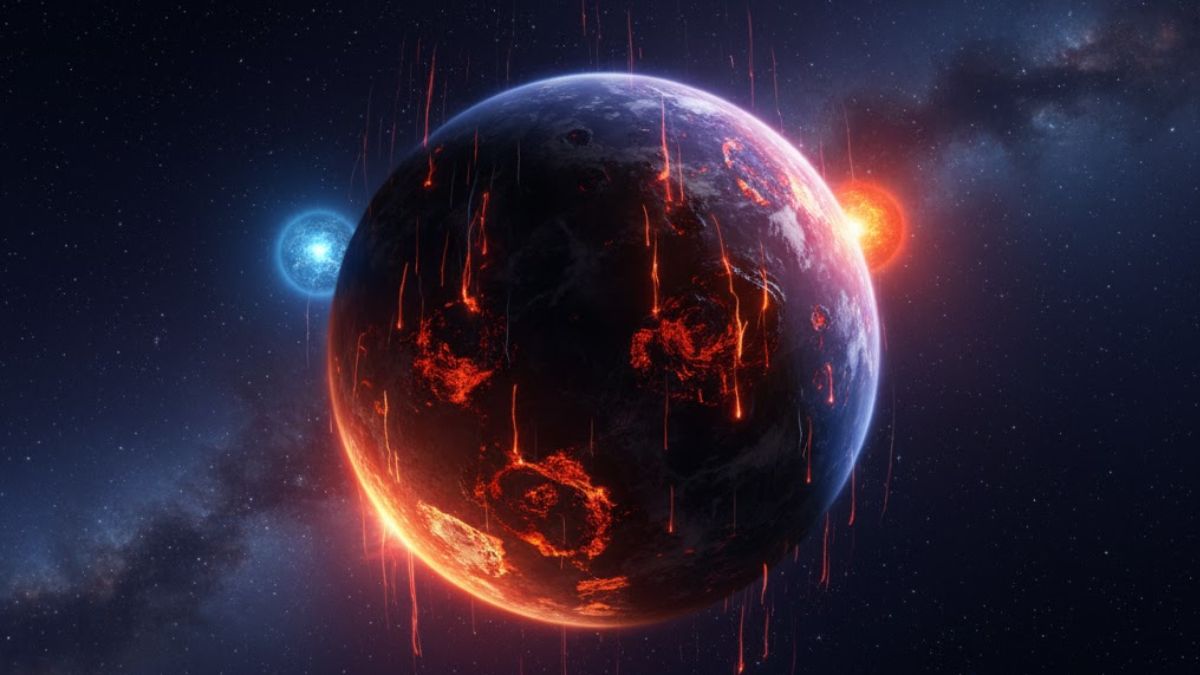
For most of human history, we only knew about the planets in our own solar system. We learned about the rocky worlds like Mars and the giant gas balls like Jupiter. But about thirty years ago, astronomers made an incredible discovery. They found the first planet orbiting a star similar to our Sun, but far, far outside our own little cosmic neighborhood. This opened a door to a whole new universe of possibilities.
Since that first discovery, we have found over five thousand of these “exoplanets”—planets that orbit other stars. It turns out that planets are not special; they are everywhere. But what has truly shocked scientists is that many of these distant worlds are nothing like what we have at home. They defy our imagination and challenge everything we thought we knew about how planets form and behave.
We are about to take a journey to some of the most bizarre and fascinating places in the cosmos. We will visit a world where it rains glass sideways, a planet as fluffy as cotton candy, and another that has not one, but two suns in its sky. The universe is far stranger and more wonderful than any science fiction story. So, what could make a planet so unusual that it stands out in a galaxy of billions?
What happens on a planet where it rains glass?
Picture a world larger than Jupiter, but orbiting so close to its star that a full year—one complete trip around—takes just a few of our Earth days. This is HD 189733 b. The proximity to its star creates some truly extreme weather. Scientists have determined that the daytime temperature soars to a scorching 1,700 degrees Fahrenheit. That is hot enough to melt aluminum.
But the heat is not the strangest part. The atmosphere of this cobalt-blue planet is thick with silicate particles. Silicates are what sand and glass are made of. On this world, those particles are whipped into a frenzy by winds that howl at speeds of up to 5,400 miles per hour. That is seven times the speed of sound. So, if you could somehow stand on this hellish world, you would be instantly vaporized, shredded by supersonic winds, and pelted by sideways-blowing, molten glass rain. It is a storm of unimaginable fury that never, ever ends.
How can a planet be lighter than cotton candy?
When we think of giant planets, we imagine massive, heavy worlds like Jupiter. But then there is Kepler-51b. This planet is about the size of Jupiter, but it is incredibly lightweight. Its mass is only a tiny fraction of Jupiter’s. If you could find an ocean big enough to drop both planets into, Jupiter would sink, but Kepler-51b would bob like a beach ball.
What makes this planet so incredibly puffy? Scientists believe it has a very small, dense core surrounded by an enormous, extended atmosphere of lightweight hydrogen and helium gas. Because it orbits very close to its star, the intense heat from the star causes the atmosphere to swell up, like a hot-air balloon. It is essentially a planet with a severe case of cosmic bloat, giving it a density that is far less than water. It is a mystery how such a fragile world can hold itself together without its atmosphere simply drifting off into space.
Is there a planet that orbits two suns?
For anyone who grew up watching science fiction, the idea of a planet with two suns is a classic image. Astonishingly, such a place is real. It is called Kepler-16b. This planet orbits a pair of stars that themselves dance around each other. From the surface of Kepler-16b, you would see two distinct suns in the sky, and you would experience double sunsets and sunrises.
This makes Kepler-16b what scientists call a “circumbinary” planet. The planet’s orbit is stable, but its conditions are not very welcoming to life as we know it. It is a cold, gaseous world, likely similar to Saturn. The existence of Kepler-16b proved that planetary systems can form and survive in the dynamic environment of a double-star system, suggesting that there could be millions of such “Tatooine-like” planets in our galaxy, some of which might even be rocky and habitable.
What if a world was made of solid diamond?
The universe has a way of creating things that seem too fantastical to be real. Take PSR J1719-1438 b, for example. This planet started its life as a star, the companion to a rapidly spinning neutron star called a pulsar. Over billions of years, the pulsar’s intense gravity siphoned away almost all of the material from its stellar companion, stripping it down to its core.
What remained was a fantastic object. This former star is now a planet-sized body, and scientists believe it is composed mostly of crystallized carbon. In other words, it is likely a giant diamond, roughly five times the size of Earth. Imagine an entire world that is, in essence, one enormous, glittering jewel orbiting a dead star. It is the ultimate treasure, but located so far away that it is completely beyond our reach.
Can a planet be darker than coal?
In our solar system, planets reflect a good amount of light. Venus is brilliantly white, and even Jupiter reflects more than half the light that hits it. Then there is TrES-2b. This distant gas giant is darker than black acrylic paint, reflecting less than one percent of the light from its star. It is the darkest planet ever discovered.
Why is it so incredibly black? Astronomers are not entirely sure. They suspect its atmosphere might be filled with strange chemicals that absorb light, like gaseous sodium and potassium, or titanium oxide. But the exact recipe for this cosmic black hole remains a mystery. It does not simply look dark because it is far from its star; it orbits very closely. This hot, Jupiter-sized world is so dark that if you could float near it, it would appear as a featureless, pitch-black silhouette against the glowing background of its star, a true void in space.
Is there a planet that shouldn’t exist?
According to our best theories of how planets form, a giant planet should not be able to exist around a tiny star. It would be like an elephant giving birth to a mouse. The star and the planet are just too mismatched in size. Yet, that is exactly what we see with the planet LHS 3154b. It is a giant, Neptune-sized planet orbiting an ultracool dwarf star that is nine times less massive than our Sun.
This discovery has sent planetary scientists back to the drawing board. The current models suggest that the disk of dust and gas that formed this star did not have enough material to create such a large planet. Its existence challenges the fundamental rules we thought governed planet formation. It is a cosmic rebel, a planet that, by all accounts, should not be there, forcing us to rethink how solar systems are born.
What would a water world really be like?
We often dream of finding ocean planets, and GJ 1214b might be the closest known example. This “super-Earth” is larger than our home planet but smaller than Neptune. Observations suggest it is composed of a vast, global ocean hundreds of miles deep, surrounding a rocky core. It is a world with more water than all of Earth’s oceans combined.
But this is not a pleasant, tropical paradise. The conditions on GJ 1214b are extreme. It orbits very close to its star, meaning the temperature at the surface of the ocean is likely hundreds of degrees. The immense pressure from the deep water and the planet’s thick, steamy atmosphere would create a strange state of matter called “hot ice” or “superfluid water.” It is a world where the very nature of water is alien and unrecognizable, a far cry from the life-giving oceans we know.
Could a planet be weirder than a star?
Some planets are so close to their suns that they are literally being evaporated. HD 209458b, nicknamed Osiris, is one such world. This gas giant orbits its star so closely that its scorching atmosphere is being blown away into space, creating a gigantic, comet-like tail. The planet is losing millions of tons of its mass every second.
Astronomers have actually detected the elements being ripped from its atmosphere, including carbon and oxygen. It is a planet in the process of slowly destroying itself, offering us a rare glimpse into the violent end that some worlds may face. Watching Osiris is like seeing a planet’s final, dramatic act played out over millions of years.
Is there a planet that wanders alone in the dark?
Not all planets have a home. Drifting through the cold, dark space between stars are rogue planets. These are worlds that were flung out of their young solar systems by gravitational interactions with other planets. Without a star to orbit, they travel through the eternal night of interstellar space.
Imagine the surface of such a world. The sky would be perpetually black, dotted with stars, but there would be no sunrise, no daytime, and no warmth. The only heat would come from the planet’s own internal core. Any oceans would be frozen solid on the surface, but if the planet has a thick enough ice crust, there might be liquid water deep below, heated by geological activity. It is a lonely existence, but these dark wanderers might be among the most common planets in the galaxy.
Conclusion
The discovery of these strange exoplanets teaches us a valuable lesson about the universe: it is a place of infinite variety and creativity. The rules we have learned from our own solar system are just a single page in a vast cosmic library. Every new world we find adds another chapter to our understanding, showing us that reality is often more imaginative than our boldest fictions.
As our telescopes become more powerful, we will undoubtedly find even stranger places—perhaps a world with rings so large they eclipse its star, or a moon with a thick atmosphere around a gas giant. The search continues to answer the biggest question of all: in a universe filled with so many different kinds of planets, could there be another one like Earth, a pale blue dot waiting to be found?
FAQs – People Also Ask
1. What is an exoplanet?
An exoplanet is any planet that exists outside of our own solar system. These planets orbit stars other than our Sun, and we have discovered thousands of them in our galaxy so far.
2. How do scientists find exoplanets?
Scientists use several clever methods. The most common are the “transit method,” where they detect a tiny dip in a star’s light as a planet passes in front of it, and the “wobble method,” where they measure how a star wobbles due to the gravitational pull of an orbiting planet.
3. Can we see pictures of these exoplanets?
For the vast majority, no. Exoplanets are incredibly far away and are lost in the bright glare of their host stars. We know they are there by studying their effects on their star’s light. A handful of the closest and largest exoplanets have been directly imaged, but they appear as tiny dots of light.
4. What is the most Earth-like exoplanet found?
One of the most promising is Kepler-452b, which has been nicknamed “Earth’s cousin.” It orbits a Sun-like star in the habitable zone, where temperatures could allow for liquid water to exist on its surface.
5. Could there be life on any of these strange exoplanets?
While the planets mentioned in this article are far too extreme for life as we know it, their discovery shows that many types of worlds exist. This increases the chance that somewhere, in the right conditions, life could have found a way on a more temperate exoplanet.
6. How many exoplanets are there?
We have confirmed over 5,000 exoplanets, but NASA estimates that there are likely hundreds of billions of exoplanets in our Milky Way galaxy alone, meaning there are more planets than stars.
7. What is the habitable zone?
The habitable zone, often called the “Goldilocks Zone,” is the region around a star where it is not too hot and not too cold for liquid water to potentially exist on a planet’s surface. Water is considered a key ingredient for life.
8. Are exoplanets part of our solar system?
No, not at all. Our solar system only includes the planets, moons, and other objects that orbit our Sun. Exoplanets have their own distinct stars that they orbit, many light-years away from us.
9. What is a “Hot Jupiter”?
A Hot Jupiter is a class of exoplanet that is similar in size and composition to our Jupiter but orbits extremely close to its parent star. This makes them incredibly hot, with surface temperatures reaching thousands of degrees.
10. Will we ever be able to travel to an exoplanet?
With our current technology, it is impossible. The distances are unimaginably vast. The closest known exoplanet, Proxima Centauri b, is over 4 light-years away. A journey there would take tens of thousands of years with today’s spacecraft.