

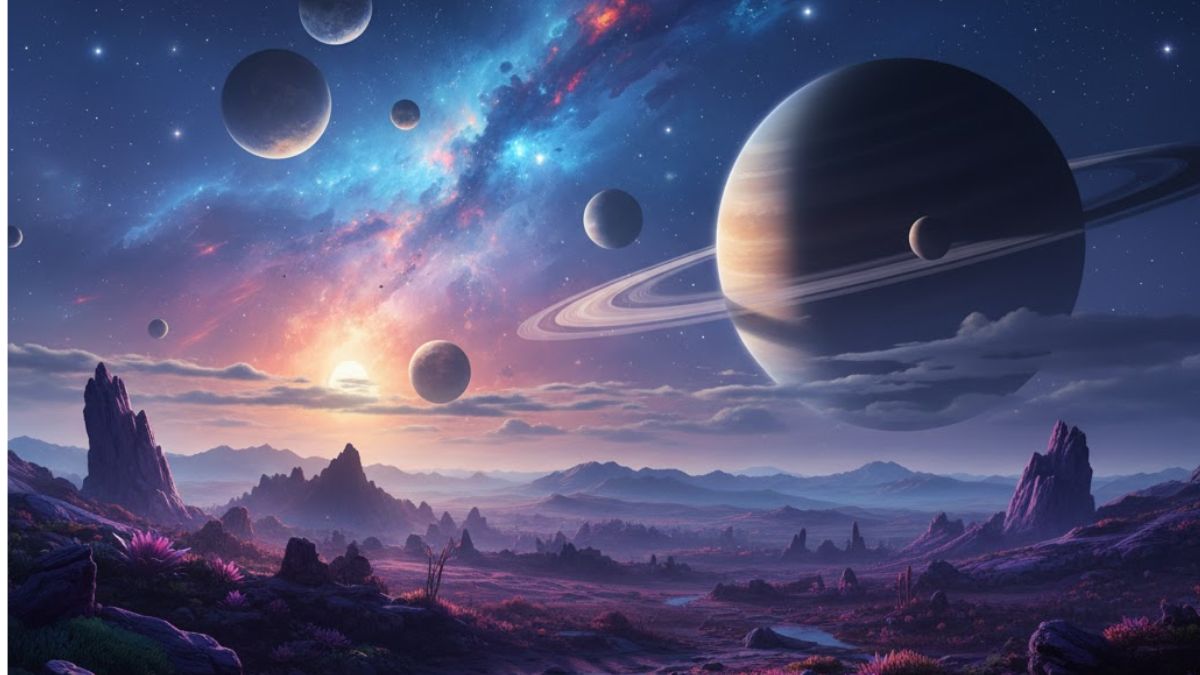
There’s something special about looking up at the sky. On a clear day, we see a beautiful blue ceiling stretching above us. At night, it becomes a dark canvas dotted with tiny, twinkling lights. This is what we know, our normal. But what if you could stand on a world millions of miles away from Earth? What would you see when you gazed upwards? The sky above you could be a completely different masterpiece, painted with colors and sights we can only dream of.
The color of a planet’s sky isn’t just a random choice. It’s a result of the planet’s air, the type of star it orbits, and even the dust in its atmosphere. It’s a science and an art show happening all at once. Our blue sky is a gift from our sun and the way its light dances with our air. But change just a few ingredients in that recipe, and the whole view transforms.
So, are you ready to take a journey to some of the most amazing alien worlds? Let’s explore what it might be like to stand on their surfaces and look up. What incredible secrets do these alien skies hold?
What gives our sky its beautiful blue color?
To understand why alien skies are different, we first need to know why our own sky is blue. It all starts with light from our Sun. Even though sunlight looks white, it’s actually a mixture of all the colors of the rainbow, like red, orange, yellow, green, blue, and violet. This mix of colors travels through space in tiny waves.
When this sunlight reaches Earth, it crashes into the tiny molecules of gas that make up our air, mainly nitrogen and oxygen. These gas molecules are much better at scattering the light waves for blue and violet colors. Scattering means they take the blue light and send it bouncing in every direction across the sky. So, when you look up, no matter where you look, you see this scattered blue light. That is why the sky appears blue to our eyes.
Think of it like a big party where everyone is talking. The deep, loud voices (like red light) can travel through the crowd easily. But the high, chirpy voices (like blue light) get scattered in all directions as they try to move through the room. Soon, the whole room is filled with that chirpy sound. Our atmosphere is that crowded room, and the blue light is the sound that gets scattered everywhere.
This process is called Rayleigh scattering. It’s the same reason sunsets look red and orange. When the sun is low, its light has to travel through more of our air to reach our eyes. Most of the blue light gets scattered away before it gets to us, leaving behind the beautiful warm colors of red and orange that we love to watch.
What would the sky look like on a planet with two suns?
Many of the planets we have discovered in our galaxy don’t orbit a single star like we do. They orbit two stars, locked in a dance with a double sunset. These worlds are called “circumbinary planets.” If you were standing on one, your sky would be a spectacular sight.
First, the colors would be different. The color of your sky would depend on the colors of your suns. If both stars were like our Sun, the sky might be a familiar blue, but much brighter. But if one star was a big, hot, blue star and the other was a smaller, cooler, red star, the mix of light could create a sky with a lavender or a pale purple hue during the day. The light would be a constant blend, creating colors we don’t have on Earth.
Second, the sunrises and sunsets would be incredible. Imagine one sun starting to rise, painting the sky in orange. Then, just as it gets fully bright, a second sun begins to peek over the horizon. Your single shadow would suddenly be joined by a second, fainter one, creating a strange double vision effect. During the day, the two suns might move around each other in the sky. Sometimes they would be close together, casting intense heat and light. Other times, they would be far apart, creating long, overlapping periods of dawn and dusk.
There would be no true night on some of these worlds. As one sun sets, the other might still be in the sky, keeping the landscape in a permanent twilight. Only when both stars dip below the horizon would darkness fall. And your calendar would be wild. The concept of a “year” would be based on the complex orbit of the two stars, and “day” might not have a simple meaning at all. Life under two suns would be a never-ending light show.
Could a planet’s sky be red or even black?
Absolutely! The color of a sky is a direct window into a planet’s atmosphere, or lack thereof. Let’s take our neighbor Mars as a real-life example. The Martian sky is not blue; it’s a rusty butterscotch color. Why is that?
Mars has a very thin atmosphere, and its surface is covered in fine, red dust rich in iron oxide—the same thing that gives rust its color. When the sun shines on Mars, the weak atmosphere doesn’t scatter blue light very well. Instead, the tiny dust particles in the air are just the right size to scatter red light. So, during the day, a visitor on Mars would see a pinkish-red or salmon-colored sky. During sunset, the opposite happens. With the sun low, the dust scatters the blue light, and people have seen images from Mars rovers showing a blue halo around the setting sun against the red sky. It’s a complete color swap of our earthly experience.
Now, imagine a world with no atmosphere at all, like our own Moon. When you look at the Moon’s sky, it is perpetually black, even in the middle of the lunar day. Why? Because there is no air to scatter the sunlight. The sunlight travels in a straight line from the Sun to the surface. Unless you look directly at the Sun, your line of sight goes straight out into the blackness of space. The stars would be visible all the time, never fading in the daylight. You could stand in brilliant sunshine while looking up at a perfectly black, star-filled sky. It would be both beautiful and terrifying, a constant reminder of the vacuum of space just above you.
What if a planet orbited a different colored star?
Our Sun is a yellow dwarf star, which gives us our particular quality of light. But stars come in different colors, and the color of the star is the first paintbrush that colors an alien sky.
If a planet orbited a cool, red dwarf star, the daytime sky would be a dramatic scene. Red dwarf stars are much fainter and redder than our Sun. From the surface of a planet in its habitable zone, the star would appear large and dull red in the sky. The light bathing the landscape would be a perpetual deep orange or red, like an endless evening on Earth. The sky itself might not be blue. With the dominant red light, the sky could appear orange, yellow, or even a murky brown. Because red dwarfs are prone to violent flares, the sky might also be frequently lit up with spectacular auroras.
Now, let’s go to the other extreme. Imagine a planet orbiting a massive, hot, blue giant star. These stars are incredibly luminous and pour out immense amounts of blue and ultraviolet light. The sky on a planet around such a star would be overwhelmingly bright and white-blue. The intense blue light would be scattered so powerfully that the sky might appear almost white with a blue tinge. It would be a harsh, brilliant environment. The parent star would also have a very short lifetime, so such a sky would be a temporary spectacle in the cosmic timeline, a brilliant flash before the star’s eventual death.
How do clouds and storms change an alien sky?
Weather plays a huge role in what we see in our sky, and on other planets, the weather can be truly alien. Let’s travel to the gas giants in our own solar system for some examples.
Jupiter is a world of swirling clouds and colossal storms. If you could float in its upper atmosphere, your sky would be a wild tapestry of tan, orange, pink, and white bands. These bands are actually massive rivers of clouds moving at different speeds. Towering above you would be the Great Red Spot, a storm so large that three Earths could fit inside it. This giant, ruddy eye would dominate one part of the sky, a constant and terrifying reminder of the planet’s power. The sky would be alive with motion and violent weather, lit by a sun that is just a small, bright dot in the distance.
Then there is Venus, a planet shrouded in thick, toxic clouds. The sky on Venus is not blue or black. If you stood on its surface, you would see a perpetual overcast sky with a yellowish-orange glow. The clouds are so thick and dense that they completely hide the Sun and the stars. The sunlight that filters through these sulfur dioxide clouds gives the entire landscape a dim, eerie, orange light, like a perpetual foggy afternoon. The pressure is so immense and the atmosphere so thick that it would feel like you were at the bottom of an ocean, not standing on a planet.
Could we see multiple moons in an alien sky?
Our single Moon is a beautiful companion in the sky, but many planets could have multiple moons. Imagine looking up and seeing two, three, or even dozens of moons of different sizes and colors.
The view would change every night. Sometimes the moons would be close together, looking like a pair of brilliant eyes in the sky. Other times, they would be on opposite sides of the sky. They would go through their phases at different rates, creating a complex dance of light. On a night when several moons were full, the landscape would be bathed in a bright, silvery light, casting multiple, faint shadows from every object.
These moons could also be very different from each other. One might be a small, fast-moving speck. Another could be a large, world-like moon, showing detailed features like craters and plains, much like our Moon but bigger. Some might even be volcanic, glowing with a faint red light during the eclipse. The sky would never be boring. It would be a dynamic, ever-changing clockwork of celestial bodies, making our single Moon seem quiet and lonely in comparison.
What would a sky full of rings look like?
Perhaps the most breathtaking sight in an alien sky would be that of a giant ring system. Saturn has rings, but we see them from a distance. What if you were on a planet that had them?
If you were standing on a world with rings like Saturn’s, the sky would be dominated by a brilliant, thin band of ice and rock stretching from one horizon to the other. This ring would look like a gigantic, luminous bridge arching across the heavens. The rings might look solid from a distance, but up close, from the planet’s surface, you would see that they are made of countless individual pieces, all reflecting the light of the sun.
The rings would cast shadows on the planet, and the planet’s shadow would fall on the rings. During the day, the rings would create a beautiful pattern of light and shadow on the landscape. At night, they would reflect so much sunlight that they could create a “ringsglow” bright enough to read a book by, turning night into a strange, second daytime. The view would change with the seasons. Sometimes you would see the rings edge-on, appearing as a thin, bright line across the sky. Other times, they would open up, presenting their full, glorious face. It would be a sight of unimaginable beauty, a constant celestial artwork.
Conclusion
The universe is a gallery of incredible worlds, and each one offers a unique view from its surface. From the double sunsets of binary stars to the eternal orange haze of Venus, from the stormy bands of Jupiter to the starry blackness of an airless moon, the possibilities are endless. The sky is not just a ceiling; it is a storybook that tells the tale of the planet’s air, its sun, and its place in the solar system.
Next time you look up at our own familiar blue sky, remember that it is just one version of reality. Out there, somewhere, another being might be looking up at a lavender sky with three moons, or a brilliant white sky under a blue sun. It makes you wonder, if you could visit just one of these alien worlds, which sky would you most want to see?
FAQs – People Also Ask
1. What color is the sky on Mars?
The sky on Mars is a pinkish-red or butterscotch color during the day. This is because the very thin atmosphere is full of fine red dust that scatters red light, unlike Earth’s atmosphere which scatters blue light.
2. Can it rain on other planets?
Yes, but the rain can be very different. On Earth, it rains water. On Venus, it rains sulfuric acid, but it evaporates before hitting the ground. Scientists think on planets like HD 189733 b, it might rain molten glass sideways due to fierce winds.
3. Do other planets have auroras like our Northern Lights?
Yes, many planets have auroras. Jupiter and Saturn have incredibly powerful auroras that are much larger and more energetic than Earth’s. They are created when charged particles from their sun hit the planets’ magnetic fields.
4. Why is the sky not blue on other planets?
A planet’s sky color depends on what its atmosphere is made of and how that atmosphere scatters light. If the atmosphere has different gases or dust particles, it will scatter different colors of light, leading to red, black, or even purple skies.
5. Could a planet have a green sky?
It is theoretically possible. If a planet’s atmosphere had the right kind of gas particles that scattered green light most effectively, the sky could appear green. This would require a very specific and unlikely atmospheric composition.
6. What would happen if Earth had a ring system like Saturn?
If Earth had rings, they would appear as a brilliant, wide band of light stretching across the sky, much brighter than the Milky Way. They would be visible both day and night and would cast shadows on the ground.
7. How many suns can a planet have?
A planet can have more than one sun. We have discovered planets in systems with two, three, and even four stars. In a system with two suns, the planet would orbit both stars, or one star while the other star orbits them from farther away.
8. Is there a planet with a purple sky?
While not confirmed, some scientists theorize that a planet orbiting a red dwarf star could have a purple sky. This could happen if the red starlight mixed with a blue scattering effect from an atmosphere similar to Earth’s.
9. Can we see pictures of alien skies?
We have real pictures of the sky from the surface of Mars and the Moon, taken by our rovers and astronauts. For planets outside our solar system, we cannot see their surfaces yet, but we can use science and imagination to guess what they might look like.
10. What is the most common type of star for planets?
Red dwarf stars are the most common type of star in our galaxy. This means that statistically, the most common skies in the universe are probably under the dim, red light of a red dwarf sun.